

After reviewing what the blog meant in 2024, it is time to look at the next part of my business: my e-commerce.
I am going to focus exclusively on Yo pongo el hielo, which is the main project. Mister GoodBuy is still a baby and, although it already runs on its own, publishing its figures is not a priority right now, so I will share them later. They are also very small by comparison.
My overview will cover the figures, marketing, the use of AI and the plans for 2025.
#1. The figures
Getting straight to the point, this is what 2024 delivered:
- Web-channel revenue: €2,200,000
- Retail media revenue: €27,000
- Traffic: 1,360,000 sessions if we exclude what we suspect are bots. 1,810,000 sessions if we include them. In other words, an average of 5,000 sessions a day.
Let us break it down a little.
Revenue
We are talking about record figures.
In previous years we came close to €2 million (€1.8m, €1.9m), but this year we comfortably exceeded it.
You could already sense it because momentum was very strong from day one, and the rest of the year simply confirmed it.
The serious setback we suffered in December 2023, when the website was attacked from every direction and stayed down for almost two days, forced us to get moving and replace every system with much more robust ones.
And it showed.
Faster loading times, fewer isolated outages, fewer errors… Everything helped the excellent commercial momentum we had built since mid-2023, which was cut short that December, resume its upward path once we got past the setback.
Every month we exceeded €100k in revenue—the first year we have managed it—and we had several peaks:
- In June—a historically poor month—we set a record by exceeding €200k for the first time in our history, thanks to the Tenth Anniversary campaign.
- In November, with Black Friday, we beat the previous record, taking €283k in revenue.
- Finally, in December we broke it again, taking €300k in revenue. Not bad at all. Really, not bad at all.
This is the month-by-month trend:
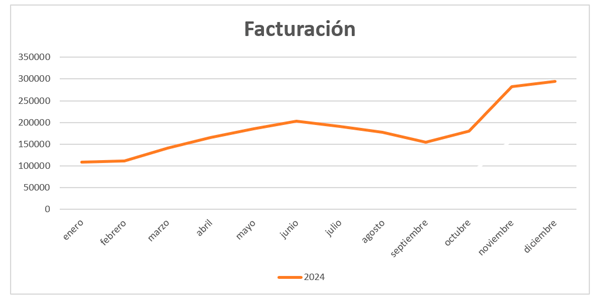
The best part is that January 2025 has started well… And the whole sale period is still ahead.
If you ask me what caused this increase, I will give you a mixture of data and opinion.
First, despite being 11 years old, the company is young and still growing. In other words, we can reach a much larger audience that does not know us yet.
And yes, although Spain's drinks market is declining, the online segment continues to grow, with us as a prominent player.
The second reason is that our operations are carefully managed.
We try to provide the best possible customer service and we monitor the number of incidents closely, always trying to keep them to a minimum and, when one does occur, to give the customer a quick solution.
This means we stop working with certain logistics intermediaries, because the extra layer delays the solution for the customer, even when giving those intermediaries more volume would suit us on cost. We do not do it for that reason, and the customer experience is better as a result.
Of course, marketing and the change of model we began in 2023 were another key factor, but I will come back to that later. First, I want to focus on another highly relevant aspect.
The best-selling products
At the end of the day, our e-commerce business sells products.
And it helps to stock the products the market wants, with suitable pricing and shipping terms, together with carefully designed weekly promotions.
There is a lot of work behind this:
- Product, to keep a strong catalogue online for a varied audience.
- Purchasing, responsible for securing good starting prices.
- Business and commercial management, creating different promotions for every channel—web, email, Telegram exclusives…
- Marketing, to advertise those products and bring traffic to them.
The result of all this is that we have a diversified catalogue of more than 2,000 products, with several star products, such as Johnnie Walker Blue Label and its special editions, the ultra-premium rum Isla del Tesoro, Luis Felipe brandy, Whissin alcohol-free whisky, Natureo 00 alcohol-free wine, packs of Guinness cans, mid-range products such as Black Label, Barceló Imperial and Martin Miller’s, and products that practically sell themselves, such as Burla Negra, Campari and Croft Twist.
Interestingly, if we rank categories by the number of bottles sold, this is what we get—these are the top ten, although there are many more:
| Gin | 12.59% |
| Rum | 12.53% |
| Whisky | 10.79% |
| Red wine | 7.09% |
| Vodka | 4.47% |
| Imported beer | 4.08% |
| Vermouth | 3.13% |
| Liqueur | 2.88% |
| White wine | 2.86% |
| Tequila cream liqueur | 2.85% |
| Brandy | 2.29% |
And I say interestingly because whisky and gin have traditionally been the kings of our website and now we can see rum slipping in between them.
Even so, if we analysed revenue rather than bottles sold, whisky would still be king.
Premium whiskies are one of the star gifts for a certain audience. This year we sold several priced at €3,000.
Retail media
Here we have fallen from last year's €43k to €27k this year.
Although there is a certain accounting 'trick' in the figures, because we moved the invoicing for some agreements and work from the previous financial year into January 2025, the undeniable fact is that we are down.
I accept the blame: because the pure e-commerce side was doing so well, I focused on it and put less effort than I should have into selling our promotional channel to brands.
And that is a shame, because this is a channel whose profit is virtually 100% of revenue.
It is clear that in 2025 we need to place more focus here.
Profit
More good news here. We increased our margin by a few points, which makes a considerable difference to the final balance.
The result is that we never needed to use the credit facility we arranged when the intra-EU VAT law changed and, more importantly for me—though not for my partners, who are keener on tax optimisation— we have enough cash on hand to pay every team salary for a full year.
In other words, if we did not earn another euro, we could keep everything operating for 12 months.
Obviously, that is a hypothetical scenario that will not happen, but reaching that level of peace of mind had been a personal goal since we started hiring staff a few years ago.
And yes, having that money in the bank lets me sleep even more soundly.
#2. Marketing
To understand the change we began in 2023 and that is producing these excellent results, I have to repeat that none of it would be possible without meticulously managed operations.
In other words, our model is based on always taking very good care of the customer—and continuing to do so now, of course.
If you add good commercial terms —in other words, the price of our products plus shipping costs plus delivery time is almost always equal to or better than the competition—you get a satisfied customer.
That was something we were not actively exploiting until 2023, when we assumed it was enough and that a satisfied customer would naturally come back.
So we could focus on acquiring more and more new customers.
A mistake.
At the beginning, that is indeed how you have to do it. But once you have some history and a healthy number of customers, leaving repeat purchases entirely up to them costs you sales.
That is why, in 2023, we changed our marketing model and stopped focusing on acquisition and went all in on repeat business.
That always sounds great when you say it, but let me turn it into concrete facts so you can see it more clearly:
First, we asked ourselves which tools we could use to generate repeat business. We came up with five:
- Email marketing: the most obvious one.
- A programme for professionals —who naturally buy more often: we tested it and it performed worse than expected, so we closed it.
- Developing our social media: too expensive for the results we expected at the time.
- An app and its notifications: we liked the idea and spoke with several providers that suited us quite well, but we postponed it. It is time to pick it up again.
- Copying Amazon's model and selling products at a discount provided the customer repeats the purchase every X months. We did not see it working for us.
So the option that best fitted our costs and timing was to develop email marketing.
And we did. On a huge scale, too.
Email marketing
We went from sending only one weekly product newsletter to also sending a daily email about one product..
We relied on storytelling and paired it with the corresponding flash offer to encourage FOMO.
It started well and, despite the initial resource cost—nobody on the team had done it before and it took us more than three hours to create and schedule each email—the results made it clear that this was the way forward.
Once we saw it was working, we focused on capturing more email addresses on the website. And the truth is that we captured quite a few.
And finally, we expanded our previously very limited automation..
We built an in-house system that sends two messages a week featuring products or offers we think may interest the customer:
- Based on their purchasing behaviour.
- On their favourite category.
- On an RFM analysis.
- On sociodemographic variables—birthday and gender.
And several other factors.
The result surprised us.
In a good way.
Because there are certain emails that are hugely successful. Far more than other, apparently similar ones. It is fascinating to see, because you begin to understand why that particular email works so well.
You start to understand your customer at a deeper level.
In addition, to support this increase in email volume we changed our platforms and now send everything through Amazon's servers, where we have to monitor certain email quality metrics much more closely..
That is why we unsubscribe customers who signed up but never open our emails. Or never buy from us.
We warn them, of course. But if they do nothing, off the list they go.
This means that, although our subscriber count grows less than it could, the list is much more carefully pruned and clean.
Those 30,000 subscribers are pure gold.
SEO and SEM
Until then, they had been our star channels.
The pampered children.
We kept up with everything Google said and did.
And we followed best practices religiously.
Until, at the end of 2023, the attack on our servers was combined with a negative SEO attack as well.
And we fell.
Hard.
In a couple of weeks, our organic traffic—the traffic that had cost us blood, sweat and tears over many years—was cut in half.
Fortunately, we had begun our repeat-business plan almost a year earlier. Had we still been using the old model, this would have been a very, very serious blow.
Thanks to that change—and another I will mention shortly—we weathered it fairly well.
And yes, we analysed the causes and corrected a few issues of varying importance that we found. But there was not much. In fact, I cannot remember making a single website development to improve SEO during the whole of 2024.
That is the level we are talking about.
And SEM is not far behind.
We were very happy with our Smart Shopping campaigns, which required little attention and brought us highly profitable sales.
But their replacements, PMax, arrived and immediately started getting on our nerves and demanding more work.
And the latest problem is that, all of a sudden, Google detects availability discrepancies between our feed and our website.
With the same feed we have used for years.
With no changes to the website.
You speak to support, send them examples, and they tell you that yes, our examples are correct, but for some reason the bot detects discrepancies.
Go fuck yourself, Google.
We have spent countless hours on the issue and it is not improving. So, as with SEO, we will leave it alone. It is not worth it.
Affiliate marketing
And it is not worth it because affiliates cover search for us.
Yes, economically it is less profitable than SEM—and obviously than SEO—but once you include our investment of time, the picture changes completely.
And it fits.
Because even though it is less profitable, if Google changes the rules, the affiliates are the ones who have to adapt.
And because each affiliate masters its channel like nobody else—far better than we do, obviously—the results reach its clients, including us.
So, thanks to this channel, we continue acquiring new customers every day. Customers who join our email lists and become repeat buyers.
And this model—simple in theory, although it still has to be built and fitted together—has allowed us to grow and achieve this year's record results.
Traffic
Here you can see the month-by-month trend in our traffic, which, because of the fall in SEO and SEM, declined from 2.3m in 2023 to 1.8m in 2024:
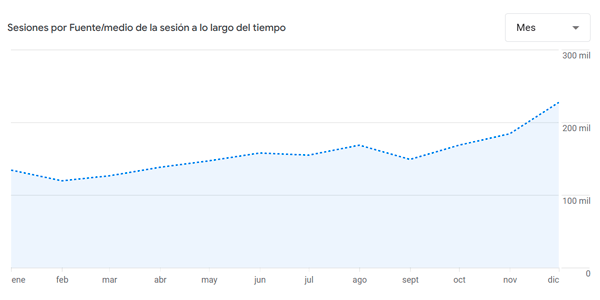
As for the traffic mix , it is as follows:
- Direct: 37%
- Organic: 34%
- Affiliates: 13%
- Google Ads: 9%
- Email: 7%
But when we look at revenue, the order changes:
- Organic: 29%
- Google Ads: 21%—including the brand campaign
- Email: 20%
- Affiliates: 15%
- Direct: 15%
It is obvious that brand recognition among our audience is growing and, above all, that email marketing generates a great deal of revenue for us. In fact, it is entirely possible that this year it will take second place, overtaking SEM even when the latter includes the brand campaign.
And where are social media in all this?
I will answer that next.
#3. Applying AI
This was the year of artificial intelligence at Yo pongo el hielo.
Since we started testing it, progress has been significant. So much so that we cannot imagine working without it.
At every level.
Starting with marketing, we use ChatGPT heavily to produce product descriptions.
In fact, as soon as the API became available we were able to “get rid of” spun product descriptions that had been with us since launch.
Of course, it also helped us with the daily email.
And with the creation of banners and designs.
But where it has shone most, without question, is on social media.
It has enabled us to create content of a quality that would previously have been impossible because of the time and money required.
So, from videos, voice-overs, music, designs… every piece of content we create is supported by AI. Not a single piece published from the middle of the year onwards escaped passing through the filter of some AI.
For example, the music in our Tenth Anniversary celebration video:
You can also find more examples on our Instagram.
I am convinced that artificial intelligence has arrived, among other things, to democratise content creation. The thought alone excites me.
Outside marketing, in departments such as operations, it makes life easier when comparing logistics invoices, or when making sure invoices are entered correctly in the system.
And with translations, of course.
Finally, the IT team can no longer imagine developing code without it.
And I have not even discussed Mister GoodBuy, where everything is based on AI…
#4. Next steps
First, to keep growing as we have been. That is the goal. And judging by the first few days of January, so far we are on track.
On the other hand, there are a couple of areas we want to improve. First, the Telegram community.
It is a system that suits us very well and the adjustments we are making are beginning to show. We currently have 750 users and the aim is to exceed 2,000 by year-end. Let us see what we come up with.
Second, the next step should be to finally launch the app.
Why?
Because it is completely aligned with improving repeat business.
Simply having an app on the customer's phone increases it. Add notifications that are genuinely useful to the user and things improve even more.
We already know how and with whom we want to build it, but we still need to pause, define the steps, timings and objectives, and get started.
And finally, on an almost personal level, I would like this to be the year when our YouTube channel takes a step forward. I think the foundations are there.
Conclusions
I think it is obvious how happy I am while writing this post.
I could tell you it was a very hard year, but that thanks to a huge effort we met our objectives.
But the truth is that I would be lying.
The truly hard year was the previous one. In 2023 we laid very solid foundations and, once we had moved to the new premises, replaced the website's engines, built the email marketing systems and refocused the business objective, 2024 was mainly about managing growth.
And the good thing is that, even at specific peaks such as the Anniversary campaign and Black Friday, not even the warehouse team suffered, thanks to that growth management.
Even the absence of two key team members in late November—our peak for sales and orders—did not create stress comparable to previous years at the same time, when nobody was absent.
That means the system works. The pieces are in place and well-oiled. The foundations are solid. It can withstand pressure and unexpected events.
And this is the first time I have had that feeling since I started all this almost 12 years ago.

Leave a Reply