
The title of this article is the same as the talk I gave at the fourth edition of the event Erros X Aprendizaxes at the Palacio de Congresos in La Coruña.
The format was very cool, because every talk started from the same premise: telling our biggest mistakes so that the people coming after us can avoid them.
And since screw-ups always spark curiosity, it led to a very good debate.
I made quite a few when I set up my ecommerce in 2013, and in this article I’m going to explain the 10 main ones, some of which, combined, almost sank the project.
By the way, before we start, in this other article you have my full summary of the event, with all the ideas I took away from the other talks.
The presentation
Here’s my full PDF presentation, with slides I’m not going to explain in this post so I don’t repeat myself, since that content is covered elsewhere on this site:
Next, I’ll explain the main points of the presentation. Let’s get to it.
Introduction
Setting up an ecommerce looks easy from the outside.
The idea is lovely: you choose a sector, build a website, run four campaigns and orders start coming in.
Then reality arrives.
And the reality is that creating a profitable ecommerce is not, by any stretch, that easy.
There is a lot of work behind it, and on top of that it guarantees you nothing. Because, until it becomes a solid project, the chances of it closing are significant.
It usually does not break because of one single absurd big decision, but because of a sum of small screw-ups that seem reasonable at the time. And by the time you realise, you have spent months losing time, margin, sales or mental health.
The interesting thing about all this is that, when you look at it with perspective, many mistakes are avoidable.
That is exactly what I want to tell here: not pretty theory, but a real case.
The one about Yo pongo el hielo, an ecommerce I set up with three other partners in 2013 and that, in 2025, closed with:
- 1.7 million sessions.
- 26,000 transactions.
- A 1.5% conversion rate.
- 2.9 million in online revenue.
- More than 20 million in group revenue.
- Average order value of €115.
- 12-month LTV of €280.
In other words, we are talking about a “serious” store by now.
And that is exactly why it is worth talking about the screw-ups.
Because when a project survives, grows and also has scars, that is when you can really draw useful lessons from it.
The context: how the project was born
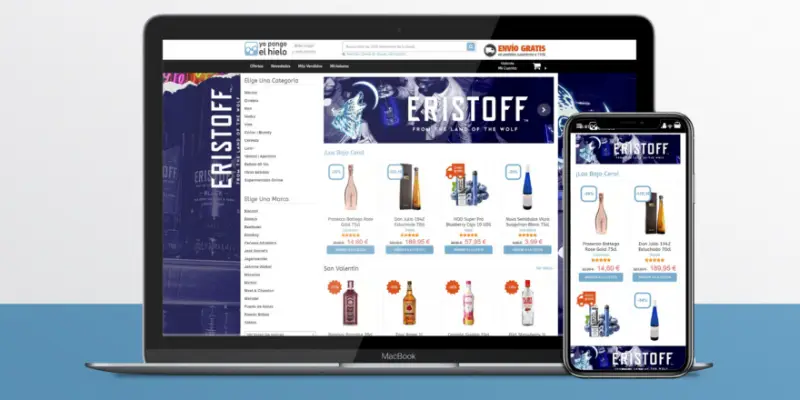
The starting point was fairly common: wanting to build something of our own, a balanced team and three fairly clear criteria for choosing a sector.
Those criteria were three:
- That it had nothing to do with pets (the 4 of us came from TiendAnimal and it would have been a bit ugly).
- That it was fast-moving consumer goods, so there would be lots of searches.
- That there was competition, but not too much, so we could steal a good slice of the pie.
That is how Yo pongo el hielo was born, a drinks ecommerce very focused on spirits.
The launch, admittedly, was very 2014.
We copied the TiendAnimal model:
- Daily purchasing, with no stock or warehouse.
- “Free” marketing based on SEO and email.
- CMS with custom development on top.
- A very carefully handled customer service under the mantra that “the customer is always right”.
It took us 8 months to get it ready and the investment was €3,000 per partner.
Did it work?
Yes.
Were there things to improve?
Also. Quite a few.
What we did get right
Before getting into the mud, it is worth saying something: not everything was a mistake.
There were several keys in the project’s evolution that explain why the business ended up working.
Among them, these 6:
- We had good suppliers.
- An efficient cost structure.
- Simple operations.
- Customer service at the centre.
- Correct prioritisation.
- Keeping an eye on market changes: from marketing trends to operational issues such as free shipping costs or the weight of SEO.
As we grew, the model evolved: we opened a warehouse, started managing stock, expanded marketing channels with a performance focus and developed logistics and conversion features.
Later, already inside a holding company, we moved to a model with 80% own stock, 20% daily purchasing, more weight for email marketing and affiliation and less dependence on Google.
In other words: the ecommerce grew because we professionalised it.
But even as we grew, we carried important mistakes with us.
And here comes the juicy bit.
The 10 biggest screw-ups when setting up an ecommerce
1) Taking too long to launch
The first one is very typical: wanting to launch perfect.
It took us 8 months because everything had to be wonderful. The problem is that, in many cases, it does not need to be wonderful. It needs to work well and the catalogue needs to make sense. Full stop.
This is a textbook classic: confusing quality with delay.
And watch out, because often it is not perfectionism. It is having no clue dressed up as high standards.
2) Doing too much custom development
There is an important lesson here.
We took a CMS and built on top of a specific version.
Result: over time, updating became practically impossible and the system was condemned to live on patches. Rebuilding it would have taken us more than a year of development.
This happens a lot: development is done “to gain flexibility” and do things “custom-made”, and what you really gain is technical debt.
3) Not really controlling the finances
Delegating accounting is not the problem.
The problem is delegating it and switching off.
In our case, shortly after I joined full-time, we detected a €60,000 debt with suppliers, which forced us into a contingency plan that limited operations for 18 months.
Translation: for a while we were at risk of technical bankruptcy. And reversing the situation took us months, headaches and, in my case, many new grey hairs.
We reached this point because of errors 4, 5 and 6, which I detail below.
4) Giving the customer the benefit of the doubt by default
Customer service is critical. But assuming the customer is always right can also be very expensive.
We had extreme cases: for example, a customer with 32 orders, €13,500 spent and a 72% incident rate. Compared with the average we had of between 4% and 1% (depending on the period). Something did not add up.
The conclusion is fairly simple: the customer is right when they are right, although it is worth trying to keep them happy. But it is not exactly the same thing.
One thing is taking care of the experience. Another is giving away margin to someone who has learned how to stretch the rope.
5) Not fighting enough with logistics partners
If you have a contract and insurance with your logistics operator, it is not enough to assume they will respond when they should.
You have to claim. And claim properly.
Here we learned something very basic: if both parties have obligations, both must meet them. And it is worth making sure that happens; you have to put the right mechanisms in place.
This seems obvious until you start losing orders, money and time.
6) Deciding by intuition instead of data
Another very common screw-up: making decisions based on feelings or opinions.
The recommendation here is direct: implement analytics at every level.
Not digital analytics, as some people think.
Analytics in logistics, customer service, marketing, customer, product…
Real business analytics, not cookies from returning users.
7) Not working on loyalty when it was time
For a while we kept betting almost everything on acquisition, when it would have been easier for us to grow by activating the recurrence lever. Which, in fact, is what made us grow at another scale from 2023 onwards.
Over time we understood something important: good service and good commercial terms are not enough to build loyalty. You have to work on it intentionally.
Many ecommerce businesses discover this late, when their CAC has already become a stone in the shoe that bothers them more than it should.
8) Postponing critical changes to web systems
Here the blow was serious.
Although we had already been suffering daily micro-outages due to attacks and aggressive bots, we kept delaying the system change.
Until the server went down in the middle of the Christmas campaign: two days without selling and five more at half speed. Result: a loss of 30% of revenue during that period.
The lesson is simple: ecommerce has a lot of “commerce”, but also a lot of “e”, and technical robustness is not a whim.
It’s business.
9) Eating an SEO penalty for not acting sooner
As a consequence of the previous point (micro-outages), we had to reduce bot activity, and on top of that came a negative SEO attack with thousands of toxic links.
A nice mix, which resulted in a 40% SEO penalty on organic traffic (our main channel), from which we never fully recovered.
10) Not separating the brand from physical stores
The tenth mistake has to do with brand architecture.
Using another group brand instead of linking it to Yo pongo el hielo meant we did not fully take care of the CX of the gourmet physical stores we launched.
That scenario ended up making them operate more like distributors than true boutique stores.
You do not always need to merge brands, but you do need to be clear about the pros and cons in each case. Because the effect is noticeable.
Could this have been avoided? In 2024, yes

The good part of all this is that years later we launched a second ecommerce, Mister Goodbuy, and thanks to these mistakes we were able to do many things quite a bit better.
We launched it in 2024 as a multi-sector ecommerce (beauty and care, pets, household products…) supported by the operation already in place and designed to experiment with different technology, another marketing mix and, above all, to push AI hard.
And here is the really useful part: how we corrected the previous mistakes.
- We launched in 3 months, not in 8.
- We bet on an updatable development, with paid modules and little custom code.
- We kept financial control from the start, with internal P&L.
- We applied previous lessons in customer service and logistics.
- We put business analytics at the centre from day one.
- We reused Yo pongo el hielo’s loyalty system.
- We set up from minute one scalable and robust web systems.
The project was profitable from its first year of life. Nothing like the previous one.
And this brings us to an obvious question you may be asking yourself…
So, how would I build a multibrand ecommerce today? My 10 recommendations
If I had to summarise what I learned into specific recommendations today, they would be these:
1. Launch fast, but not recklessly
Do guerrilla market research: real demand and real competition. An Excel with useful information that will work as a traffic light to decide whether you have a green light and can move forward with the project.
2. Do not complicate things with unnecessary technology
WooCommerce, PrestaShop or Shopify —depending on the project and the team’s knowledge— are more than reasonable options to start with. Do not move away from them.
3. Start with channels that actually move the needle
SEO, Shopping and email from the beginning. Remarketing, later.
4. And avoid the ones that do not (at the beginning)
Social media, in this type of ecommerce, is not essential.
This will annoy many people, but not every channel that makes noise makes money.
5. Take copy seriously
Product pages, web texts, emails, ads. Everything communicates and everything converts… or slows down the purchase.
6. If you are starting out, do it without stock
If you do not have a physical store, a daily purchasing system can be a sensible way to minimise risk at the beginning.
7. Do not depend on a single logistics operator
Working with two transport agencies almost from the beginning (from 10-15 orders a day) is a very reasonable recommendation. It gives you operational margin and reaction capacity.
8. Delegate, but control
Administration, accounting or marketing can be delegated. What you should not delegate is control of the business at any level.
9. Embrace bootstrapping
Growing with your head screwed on, without mortgaging yourself for the sake of appearances, is a good way to avoid headaches and sleep better.
10. Use AI, but with human control
At Mister Goodbuy we are using AI for everything:
- Images.
- Texts, descriptions and copy.
- Translations.
- Emails.
- Development support.
- Analytics and GTM.
- Marketing (customer analysis, attribution and personalisation).
But always with human supervision and thinking carefully about which part of the process each one enters (human / machine).
That is how it makes sense to use it: useful accelerator, not magic replacement.
By the way, before closing with the conclusions, here is an article with the 10 questions I would ask myself before launching an online store.
The conclusion of all this
If I had to summarise this whole experience in one single idea, it would be this:
Setting up an ecommerce is not about having a website, but about building a business.
One that is robust in every area: operations, finance, logistics, data, customer service and technology.
Because most screw-ups do not come from not knowing how to run ads or from not posting on Instagram.
They come from launching late, measuring badly, depending too much on a fragile system, not controlling the numbers or thinking that acquisition fixes everything.
It does not fix it.
What makes an ecommerce last over time is usually far less glamorous: prioritising well, simplifying, not over-innovating, measuring, having control and not postponing uncomfortable decisions.
Not very epic.
Very profitable.
Frequently asked questions
What are the most common mistakes when setting up an ecommerce?
The most common ones are usually launching late because you want everything to be perfect, overcomplicating the technology, not properly controlling finances, depending on a single acquisition channel and making decisions without real business analytics.
Do you need a lot of money to launch an ecommerce?
Not necessarily. You can start with a contained investment if you choose the technology well, simplify operations and avoid adding structure too soon. The problem is usually not just how much you invest, but what you invest it in and with what level of control.
Is it better to start an ecommerce with stock or without stock?
It depends on the model, but starting without stock can be a sensible way to reduce risk at the beginning. Especially if you have not yet validated demand or do not have an operation solid enough to take on more complexity from day one.
What is more important at the beginning: the website or the business?
The business. The website matters, but an ecommerce does not work just because it has a pretty online store. What makes the difference is that the whole setup holds: suppliers, margins, logistics, customer service, analytics and technology.
Which channels should be prioritised when launching an ecommerce?
In many cases, SEO, Google Shopping and email marketing are usually more useful channels at the start than other noisier ones. The important thing is to focus first on those that can move sales in a realistic and measurable way.
How can you avoid technical mistakes that hurt sales?
By not postponing important infrastructure decisions, avoiding unnecessary custom development and setting up updatable systems from the beginning. When an ecommerce grows, technical robustness stops being a secondary issue and becomes a direct business matter.
Why is loyalty so important in ecommerce?
Because growing only through acquisition gets more expensive every time. When you work recurrence properly, you improve profitability, reduce pressure on CAC and build a more stable business in the medium term.
Can artificial intelligence be used to manage an ecommerce?
Yes, but with judgement. It can be very useful for accelerating tasks such as content, images, translations, analysis or support, as long as there is human supervision and it is clear which part of the process is handled by the machine and which still depends on the team.

Leave a Reply