
If you have an eCommerce business, you probably have a fairly clear idea of who your competition is. Likewise, if you have not launched one yet but have been thinking about it for quite some time and already have a well-developed idea, you may also know who your competitors would be. Of course, if you are at an earlier stage—still turning over the idea of setting one up, but with nothing advanced—you will know practically nothing about who you would be up against.
Now, in any of these cases you may be missing quite a lot of data and context about them and carrying out a competitor analysis will be extremely useful. In this article I explain a fairly simple method for doing it, using free tools and without taking up too much of your time. I am fairly convinced that the information obtained will make the time invested worthwhile.
Before starting, it is worth noting that in this article we will focus on digital competitor analysis, not the physical competition, although that is also an important part of sales in the sector. In fact, in some sectors, physical-channel transactions can account for 95% of the market.
What I said in the previous paragraph does not mean that we will only evaluate pure players —those competitors that are purely online—but we will also take into account the websites of physical retail chains, such as Carrefour, Mercadona, Fnac or MediaMarkt provided they are among the most relevant competitors for my business.
In this post we are going to assume that this is the competitor analysis before launching an eCommerce site and that, therefore, we have no idea which websites currently sell my product category. So the first thing will be to find that out. To discover who they really are, we are going to make use of the online demand study we carried out in the previous article.
However, this analysis can (and should) be carried out regularly—at least every six months or annually—when managing an online store. The template we will use covers both situations: the initial study and the recurring one.
Finally, although there are paid tools that will make the work easier, we will use some completely free ones (the browser will be our most faithful ally here) or tools with a limited free plan. In the template you can download below, there is a column indicating the right tool to extract the required information.

Points to analyze
The sections I suggest assessing for each competitor, in order to get as complete an overview as possible without spending too much time extracting the information, are the following:
- Digital Marketing
- SEO positioning
- Paid channels
- Social Media
- Permanent promotions (welcome coupon with 10% off or free shipping on your first order or after spending X euros)
- Operations: logistics companies they work with
- Shipping costs
- Shipping time
- Packaging
- Returns
- Traffic
- Categorization
- Filters
- Target audience
- Value proposition
- Competitive advantages
- Best sellers
- Prices
- Channels used
- Tone
- Revenue
- Marketing budget
- Year founded
- Number of employees
So, starting with SEO positioning is a good way to find out who my competitors are at first glance, since it is unusual for the 3 or 4 main players not to appear on the first pages of Google when I search for the terms I know have the highest monthly search volume.
We will continue with the example of the online sneaker store that we used in the previous article, where we carried out the demand analysis for these products. Let’s start here:
Digital Marketing
SEO
As many of you will know, SEO stands for Search Engine Optimization and covers how well a website is built from a search engine point of view; in other words, whether that website is “good” for Google, mainly. If it is, Google will reward us with top positions when someone searches for any of our products or brands.
The order of this index is not random; each section is placed in the way I consider most appropriate so that each point gives us more context and we gradually get a clearer idea of who we are competing against.
To investigate who our online competitors are, we are going to use this downloadable template. Subscribe to download it:
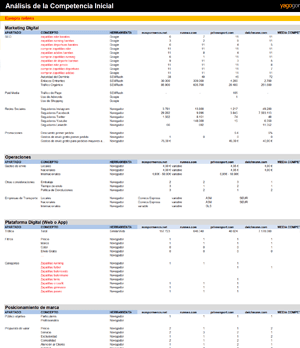
Be clear about this: if you do not know who your competition is and what it is like, you are at a disadvantage
Fortunately for you, it is very easy to find out. If you use this template, of course.
It’s yours just by leaving your email.
And while we’re at it, every day in your inbox, a tip or piece of advice to improve your business or digital project.
Keywords
The first step is to fill in the “SEO” tab with the keywords (keywords) most searched for on Google that we collected during the demand study:

The second step is to search for each word one by one on Google using a browser in incognito mode. This is a browser mode that prevents Google from giving us personalized results based on our previous browsing. Each browser has its own way of opening an incognito window. In Chrome, for example, you open it like this:

Once Google is open, we search for the first word:

One important thing: for this analysis, it is essential that you do not take Google’s paid results into account, only the organic ones (the free ones):

We add the domain occupying each position in Google’s results to the corresponding cell in the template:

And we do the same with the following keywords until the table is complete:

Looking at the results, we see that there are two giants I am going to have to fight: Amazon and Zalando. Amazon is a regular in any eCommerce sector and Zalando in anything related to footwear and clothing.
Next come those that, while not as large as the previous ones, are probably fairly established competitors and a model to follow:

Although they are all genuinely competitors, in this first screening I would keep maspormenos.net, runnea.com, priveesport.com and deichmann.com as competitors, at least to start with, for several reasons:
- All four are sneaker eCommerce sites with well-developed SEO, something I consider essential if you want to set up an online store with a tight budget.
- I would leave Zalando and Amazon aside because they are certainly not low-budget eCommerce businesses. They are too big in every way for their data and figures to be useful to us.
- The Adidas and Nike websites are not multi-brand and, most likely, we have in mind that our store will be.
Once I am clear about which competitors I am going to study, it is time to start doing it.
Domain authority
It is a metric that refers to the importance of a domain on the internet. Practically every SEO tool has its own way of assessing this “authority”, based on its algorithm and the metrics it uses for the calculation.
To see the metric from SEMrush we only have to add our competitor’s domain in the field at the top (maspormenos.net in this example) and select “domain overview” in the selector. Once this is done, the metric will appear just below (38 in this case):

Backlinks
The number of pages linking to a competitor is a way to see two things:
- How popular a website is (free links earned organically)
- The budget it has used to obtain those links (paid links)
It is therefore a metric that will tell us how much a competitor has invested in SEO and how well known it is among a certain type of audience.
The same SEMrush report as before shows it:

Organic traffic
One last relevant point that will help us understand how much SEO work has been done on a website is the organic traffic it has; that is, the number of users arriving from a search engine.
Again, from the previous report in SEMrush we can extract the information, referring to the number of visits the tool estimates the website had in the previous month. It is important to understand that this is exactly that, an estimate, because only the company that owns the website (and Google) will know the real data:

Well then, once we have explained how to extract the information for each of our competitors, it is time to put it into the template and move on to analyzing paid traffic:

PAID MEDIA
In contrast to free organic traffic, here we want to find out how our online competitors are advertising. This will give us an idea of each competitor’s digital marketing investment budget. We will focus on Google Ads and Shopping, the most common paid channels in eCommerce.
We will use the same weapons as in the previous point: SEMrush and Google. If we start with SEMrush, we see that maspormenos.net does not use Google Ads:

After several searches on Google, we cannot get the competitor to appear among Google Google Ads paid results:

Nor among Google Shopping’s free results:

We fill in the template with the results for each competitor:

It is very likely that, when carrying out paid searches, you will notice that there are competitors that did not seem very strong in SEO, but that do invest quite a lot in paid traffic and should also be kept on the radar, since, given that they apparently have a high marketing budget, it is quite possible that their digital sales are also high.
In this case we have detected several, such as Deporvillage.com, JD Sports or Sprinter.

At this point you begin to see that, in most sectors, in eCommerce there are several leagues of competitors, differentiated above all by marketing budget and approach. If your goal is to launch your online store with the smallest possible budget, you will have to work hard on SEO; whereas if you expect to be able to invest in digital marketing, you will have to invest better than others by capturing cheaper paid traffic. With this in mind, you can now start thinking about options and refine the one that best fits your project.
SOCIAL MEDIA
Regarding our competitors’ social media, at this point we are going to focus on two aspects: the networks they use and how many followers they have on each profile. A browser or the corresponding app is more than enough to extract the data and put it into the template.

After seeing the results, it is clear to us that the competition takes care of social media. Getting the number of followers they have—however many may have been bought—is not the result of a single day, but of a strategy and constant dedication.
We can also infer that Instagram and Facebook are the most used networks, although one of the competitors has a great ally in YouTube. LinkedIn and Twitter are far behind the leaders.
PROMOTIONS
To close this analysis of the digital marketing carried out by our possible competitors, we only need to find out whether they use any of these three very common tactics:
- Discount on the first order
- Free shipping on the first order
- Free shipping for any order above a certain amount (not just the first one)
To extract the necessary information, in most cases it is enough to browse our competitor’s website until we find it:


In other cases, however, it will be necessary to register and add products to the cart without completing the purchase, so that the offer can arrive in our email. It is a very common technique, known as “cart recovery”.
Once we have all the information, we fill in the table and thus complete the Digital Marketing section of the market study.

Operations
We start with the second section of the analysis, Operations. Here the aim is to evaluate our competitors’ entire shipping system: the service scope (local, national or international), packaging, delivery time and the companies they work with.
This information is essential to design our system, because by knowing the companies our competition works with, we will be able to ask each of them for rates and choose the one that suits us best.
As for packaging, placing a test order and processing its return will allow us to find out whether they ship using boxes, bags or envelopes, and what protective material they use. In the same way, we can request quotes for the options we are interested in, in order to properly evaluate shipping costs.
Finally, researching the returns policy will give us an idea for our own and allow us to play with different percentages to evaluate costs more realistically under different scenarios (for example, evaluating different costs if returns account for 2% or, on the contrary, reach 10% of orders).
SHIPPING COSTS
Here we separate the different usual services: local, national and international. Some more specific ones could be added if we think they are relevant, such as shipping to the Canary Islands or breaking down international shipping by country.
To fill in the template, it is enough to go to the website and obtain the information for each service. This is usually available on one of the information pages in the footer of the website.

If costs vary depending on the country, we will write that down; if it does not offer a certain type of service, we leave the cell empty:

OTHER CONSIDERATIONS
Here the aim is to evaluate certain characteristics subjectively: packaging type, shipping time and returns policy. In each case, it will be scored with 3 as the highest mark and 1 as the lowest.
Obviously, to evaluate the packaging it is necessary to place at least one test order and, while we are at it, also assess the returns system. All this information will be entered into the table:

It is worth adding that, once we know what packaging they use, we can go to a logistics solutions company so they can inform us of the cost, which will be very useful shortly when putting the figures into the financial plan before launching the eCommerce.
SHIPPING COMPANIES
Finally, it will be enough to investigate which courier companies my competitors work with. There are two ways to do this:
- They state it on their information pages
- We have to register and move through the checkout process until we find out


As we said at the beginning, once we have this information in our possession we will be able to request rates from all the courier companies used by our competition (and some more, if we know them) to decide which one or ones suit us best.

With the rates in hand, we will already have real figures to adjust the budgets and financial plan of our project objectively, not based on estimates.
Digital Platform
In this third group we begin to analyze each competitor website. The goal is to try to understand how much traffic they receive, which product categories they sell, how they group them and which filters they offer us. With this, we will be able to shape our digital platform: we will know what we want to offer our users and which CMS and themes make it possible.
TRAFFIC
We use the free plan of SimilarWeb to find out. They are estimates, not absolute data, and desktop-only (not mobile), but they are enough to give us an idea:

SimilarWeb also allows us to compare domains:

As we can see here, deichmann.com is a multinational online store and the tool currently does not allow us to segment only the store for each country, hence the enormous differences in traffic. Even so, this is the figure we will enter as estimated traffic.

The tool gives us much more information, so I encourage you to poke around a bit and start understanding each competitor’s online strategy. Together with SEMrush, we will be quite capable of understanding each competitor’s mix.
FILTERS
Filters are a convenient way to narrow product searches down to what we need. There are some filters that are repeated in most online stores, while others are specific to the sector or to the particular store.
Among the usual ones, Price and Brand stand out; among sector-specific ones, we could place Color; and among store-specific ones, Free shipping. The template includes these four, but it is prepared to add all those that interest us for our project by duplicating any of the filter lines, hence the ellipsis “…” in the last filter.
To fill in the template, it will be enough to browse each website and see whether it has the filter we are looking for or not.

CATEGORIES
In exactly the same way as we check whether certain filters exist or not, we do the same with categories: adding 1 to the template if the competitor has that category or 0 if it does not.
However, there is one difference, which is that categories vary enormously between sectors, so the first thing is to think about which product categories I want or can incorporate into my platform and write them in the red cells. To do so, we can use the online demand analysis we carried out previously.

Once all the competing websites have been reviewed and added to the template, it is possible that we may think of adding a category we had not considered at first but that several or all competitors have. For example, in this case “Trekking shoes” seems relevant, so it would be interesting to see whether I can add that section to my store now or in the future.
We could check the number of searches for the category as we did in the demand analysis section, although if several competitors have that category, it is more than likely that it does have suitable online demand.

Brand positioning
So far everything has been quite objective: lots of numbers or binary possibilities—either “1” or “0”—but now we come to a group where subjectivity and interpretation have a place.
In this section we will try to interpret which value propositions each competitor has and which audience they target: individuals or professionals. And to find out, it will be necessary to browse the website and, above all, interpret the messages and images shown to us, with their connotations. The type of promotions will also help us understand what type of consumer they are aimed at.
TARGET AUDIENCE
Is it a website focused on the end customer and using simple language, or on the contrary does it seek the professional customer, the one who buys in large quantities and masters the technical terms?
We will add a “1” in the corresponding boxes:

VALUE PROPOSITION
When filling in the template, we will analyze the feeling the website gives us regarding each possible value proposition: is it a website focused on price? Does it mainly highlight customer service? Or how easy it is to buy from it? And its images: do they convey exclusive or quality products?
Based on these kinds of questions, we will place a “1” if we do not think it focuses on that aspect, a “2” if it partially focuses on it, or a “3” if it is very present throughout the website.

COMPETITIVE ADVANTAGES
Bringing the previous point a little more down to earth: what are the direct advantages that, as users, we can observe on the website? This is no longer about guessing, but about observing the advantages they offer us. In some cases they will highlight them and in others they will not (perhaps because they themselves are not even aware that they have that advantage over the others, such as delivery time or shipping costs).
For the scoring, we will also rely on data we have obtained throughout the analysis process we are following: we have already checked the cost of shipping, delivery time and whether they offer free shipping, for example.
For the last two aspects (SEO positioning and marketing budget) we will use SEMrush estimates. We have already extracted the SEO metrics in the Digital Marketing module of the table. To estimate the paid media budget, we will focus on these: the higher they are, the better.

We will score each competitor between 1 and 3 in both sections, SEO and marketing budget, and with that we will have completed the Brand positioning group.

Products
We are now approaching the end of the competitor analysis and we still have not tackled one of the fundamental aspects of any store: its products.
A product analysis can be very broad, so what I propose here is to narrow it down to finding out whether your competitors have the 10–20 best-selling products in the category and at what price.
To find out which products are the best sellers, we will turn to Google, where we will almost always find information about the best-selling items in a category. Otherwise, we can always turn to the best-selling items of one of my competitors (preferably the strongest one) or, if I had a physical store and want to launch the online channel, to my own best sellers. Once I have chosen them, I paste them into the red cells of the template.

It is time to browse each competitor and check whether they have each model in stock and note its price in the table.

As can be seen in the image, none of the chosen competitors has more than two or three of the best-selling models in stock. This could be a good point in my favor, if I am able to obtain these models.
That said, by running searches we have found that another competitor not included in the template and which we have already talked about before, JD Sports, does have several of the models listed here for sale. Perhaps it is time to pay more attention to it and add it or replace one of these four with it (for example, runnea.com, which is the most different because it is a marketplace). Competitor analysis is not set in stone; on the contrary, it always changes over time.
That is why, although the one we are doing here is focused on deciding whether to launch an online store or not, when the store is launched, a similar study can (and should) be repeated regularly (every 3 or 6 months), collecting the changes that have occurred during that period, with the appearance of new competitors and updated information on all my competition. Knowing what they are doing will help me understand changes in my store’s numbers.
Customer service
It is likely that you are not clear which channels customers will use to contact you and, although at first it is very commendable to think that we will be able to handle all of them, reality always shows us that this is not the case. Therefore, identifying the channels that users of portals similar to mine are used to will help us simplify things.
What I suggest you do is go into each competitor site and observe which channels they use. In addition, if we want to go one step further, we can contact them through each channel and determine whether the language used is formal or informal. It is a good support point for deciding how we want to do it ourselves.

Each competitor’s customer service channels are different. Interestingly, none uses WhatsApp, which could help us differentiate ourselves. Nor do they promote the use of social media as a contact channel.
Economic and company data
To close the competitor analysis, it will be time to dive into Google and find information about the organization. It is very useful to know how large each competitor is in order to understand what resources it may have and to infer the marketing budget it may use to attract users.
And how do we start searching for this data? Generally, the simplest way is the following:
- Go to the “Legal notice” page, which is usually in the footer, to find out the name of the company that owns the portal


- Search on Google for the name of the owning company. Pages such as empresite.eleconomista.es, libertaddigital.com or einforma.com will appear, providing quite a lot of information about the company

- There is another data source, which is press appearances. It is likely that there are articles on Google talking about the company or its founders and they will generally provide economic data, which is what we want to add:

Now we add everything we find to the template:

With all this information we can now better understand each competitor’s trajectory: whether it is a multinational that has opened an online channel in our country, whether it is a physical store launching its online store, whether it is a pure player that has just appeared or has been online for more than 10 years…
We have all the context we need for the most important point of any analysis: drawing conclusions and making decisions based on it.
Drawing conclusions
After carrying out the whole process, I will have enough information to assess and position my competitors. The result of the study may reveal different situations:
- There is no competition: this is the ideal situation, but it is unlikely to happen, at least in sectors with some demand. Even so, from time to time we see a success story that would have been hard to imagine beforehand, for example, a store selling religious supplies for churches. It is worth thinking about a niche like that and checking product demand.
- Several medium-sized competitors with no clear leader: another good starting situation. If the foundations of our project are strong, it may be possible to get into the fight and for there to be enough market to go around. In this case it is advisable to keep a close eye on competitors and check that none of them takes off and, if one does, understand why and whether we can replicate its success.
- One strong leader and several secondary players: the situation starts to get complicated. It will probably take us years to compete with the leader, if we ever manage to do so. Here it is important to quantify the size and trend of the sector online, because, depending on this, what the leader leaves behind may be enough to make other projects profitable or may really not be enough. Here it is essential to obtain the revenue data of the rest of the competitors in order to decide.
- Monopoly: if there is no competition, it may be a sign that either no one has thought of it before, or that the current market situation does not allow for it. If it is the first case, no problem. If it is the second, we will have to continue with the business plan before ruling anything out.
- Several strong leaders: the worst scenario. Most likely you will have to lower prices (and with them the profit per product) in order to compete, which will greatly limit your project’s room for maneuver. If you want to launch the project just to try it out, the initial investment in time and resources is minimal and you have low expectations, go ahead. Otherwise, I would recommend thinking very carefully about it, because the project is likely to become yet another eCommerce business that does not make it past its first year.
With these situations in mind and with enough context acquired by carrying out the market study, we will be quite capable of making decisions about our eCommerce project.
So, if I am thinking of setting up my store, assessing the previous situations will allow me to decide whether or not to continue with the project. If I am managing an existing online store, I will get ideas to increase my competitive advantages over them.
On the other hand, the study will have provided us with a great deal of information about the operations of our store (current or future):
- What the packaging should be like
- Which transport companies to talk to
- Which customer service channels I can add
- How much average shipping costs amount to
- What time margin I have for shipments
- What margin they work with on the best-selling products
- …
Ultimately, I will have resolved many of the doubts I probably had before starting the analysis. This aspect is undoubtedly one of the most valuable reasons to complete the study.
As you can see, this system is designed to obtain a lot of information with a very small investment of time and resources, so I recommend carrying it out whenever necessary.
Of course, it can be expanded to whatever depth you need, adding fields, products or keywords. Using the template as a base, it is easy to duplicate fields or add others. Every project is different, although I try to make this system valid for a large number of online stores.
Any suggestions or improvements can be left in the comments. They are all welcome.

Leave a Reply