
This week I was lucky enough to take part in the 4th edition of Erros X Aprendizaxes, a cracking ecommerce event organized by the Clúster de Ecommerce Gallego and which brought together around 200 people — no small thing — in La Coruña.
An event that reflects the real maturity of the sector in Spain. Or at least in Galicia.
I say that because all the talks were by “normal” companies, purely digital or not, that were making profitable their ecommerce channel.
And by normal companies I mean they were not the big success stories in the sector, which have been headlining events like this for years.
No, they were smaller companies that are doing things really well.
That is why I assume that the online layer has now gone deep and taken root in the business fabric of SMEs, reaching a level of maturity that not so long ago felt a bit utopian.
Of course, for that to happen, the longer-standing business owners have had to take a “leap of faith” and embrace the new consumer paradigm, hand in hand with highly qualified professionals —digital natives or converts— who have stepped forward and taken responsibility for the part of the business P&L that was theirs.
In this post I want to focus on these professionals and their talks, because every single one of them was absolutely top-notch.
Also, before starting, I have to say that the approach, based on the mistakes made in each of the projects, was a complete success: very entertaining and educational at the same time.
Because what they were saying, if you have or manage an ecommerce business, definitely, definitely rang a bell.
A lot of truth packed in there. And very little posturing.
Seriously, 10 out of 10.
Right, with the introduction out of the way, here is the summary and the main ideas I took away from each talk.
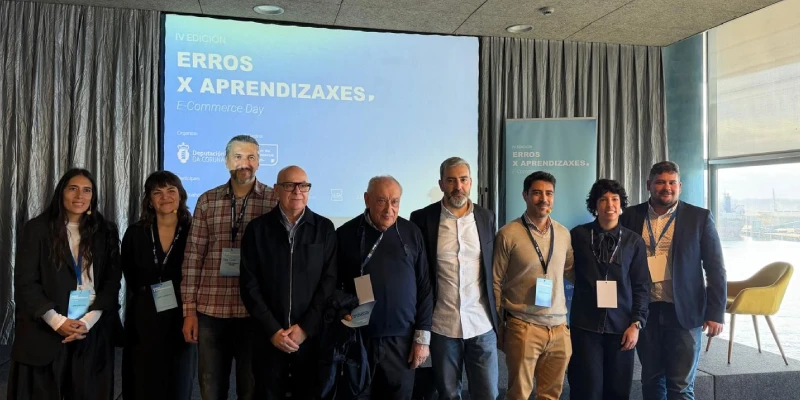
The talks
Par y Escala was the first. Iara Viñuales, its founder, explained how she started this women’s fashion brand.
She emphasized two ideas:
- Play in favor of seasonality: focus on the months when your audience buys the most and use the lower-season months to improve the company’s operations.
- The importance —and difficulty— of getting the company’s legal form right, because, as also happened to us, it started as a cooperative and later had to become an SL.
Then it was my turn, where I explained the 10 biggest mistakes made when launching my first ecommerce and how we fixed them when launching the second one.
Just before coffee, Víctor Salgado, managing partner of Pintos & Salgado Abogados, S.C.P., a Galician law firm, told us the 10 main mistakes their clients make in digital.
And which I think all of us who have been around for a while have made:
- Copying other people’s legal texts.
- Or having AI draft them and not reviewing them.
- Cookie consent handled in any old way.
- Or commercial communications.
- …
Anyway, an entertaining talk that reminded us of the importance of “prevention is better than cure” in this area that is so often neglected in our projects.
Alda Hotels is an example of business growth based on having a very, very clear idea of its ideal customer and what they are looking for. Thanks to that, in its value proposition it offers neither more nor less than what its customers need.
And that is why they are doing so well.
María Domínguez, their ecommerce manager, also explained a nasty —but very funny from the outside— move AI pulled on them.
And the thing is, the customer-service chatbot closed a sponsorship deal with the organizers of a foosball championship without any human being having validated it.
And they had to pay.
Seriously, it was a very funny story, while also making clear the mess an uncontrolled AI can make in your business.
Right after that I think the event reached its peak, when Jorge Bermello, founder of the historic chain of home-appliance stores Bermello, was interviewed by Xosé Luís Reza (president of the Ecommerce Cluster).
The curious thing here is that Jorge is about to turn 90. And he is still at the helm of the company. No surprise, because the clarity and experience his words showed made you do nothing but shut up, listen and learn.
And made you want to build things that still motivate you as you enter your ninth decade.
Afterwards, Sergio Castelo, SEO Manager and Director of digital projects at Smartclick, a digital marketing services company that advocates for ethical SEO, gave a very dynamic and fun presentation with mistakes he has seen and how AI is affecting SEO.
He also explained how to distinguish a natural SEO drop from the effects brought by AI Overviews, since it is easy to confuse them and therefore diagnose a case and treat it incorrectly.
Marta Calvo García, Marketing & Event Manager at Calvo Joyeros, a long-standing jewelry and luxury-products company, explained how something that works technically at a specific point in a project may stop working some time later.
And how, when changing it, it is important to let yourself be advised, but also follow your instincts, because nobody knows more about your business or your project than you do.
And, I’ll add, you are the one who will bear the consequences above all. If it goes wrong, no partner or employee will suffer what you will have to suffer. So yes, trust yourself once you have been properly advised.
Very, very much in agreement with absolutely everything Iván Expósito, Head of Customer Service at Dinahosting, which, in case you do not know it, is a Galician company specializing in domains.
Iván explained that ecommerce has much more “commerce” than “e” (electronic)). And, after 17 years in the sector, I could not agree more.
On top of that, the fact that it is a company from the “e” side saying it gives it even more value.
Anyway, his talk is one that anyone thinking of launching an ecommerce should watch and reread several times before jumping into the adventure.
The event closed with Cultura Urbana, a benchmark streetwear store. Omnichannel and with an ecommerce since 2007, which is no small thing. Iván Omar, treasurer of the Cluster, interviewed Marcos Cardero, the founder of the store, whose career tracks the sector itself in Spain.
If I had to keep just one point, it would be the management of the relationship between brands and multibrand ecommerce businesses (or stores). Because it is a relationship in which the brand, in most cases and especially if it is very large, holds all the cards.
The case of Nike, which decided to change its model and move to DTC (Direct-To-Consumer) meant that, overnight, Cultura Urbana (and all the brand’s other distributors) stopped earning millions of euros.
I repeat: millions of euros.
And of course, that affects revenue, but also logistics (storage), staff, cash flow… Everything.
That is why, if you have a multibrand ecommerce, considering creating your own brand is a fundamental pillar to lean on in order to make your business profitable and sustainable.
Conclusions
I hope I have convinced you with this short summary that it was a superb event from beginning to end, where I met super kind and very top people, from whom there was a lot to learn while also having a very pleasant time.
So all that remains is to thank Ivan, Beatriz and Xosé Luis for the invitation and wish them that this very cool event they have built keeps going as it has so far: upwards like a rocket.
Seeing the hands it is in, I have no doubt that it will.
Frequently asked questions
What does this event show about ecommerce?
That the online channel has already matured inside many SMEs and traditional businesses. The event brought together profitable and operational companies, not just big media success stories, reinforcing the idea that ecommerce is now a real part of the business fabric.
Why was the mistake-based approach so useful?
Because it grounded the lessons in real problems: poorly planned legal decisions, uncontrolled automations, dependence on external brands, SEO diagnosis errors or strategic failures when scaling. That is precisely why the talks were educational and credible, with no posturing or empty theory.
Which legal mistakes are most often repeated in digital businesses?
Among the most common are copying legal texts from other websites, leaving sensitive documents in AI’s hands without human review, and mismanaging consents such as cookies or commercial communications. That was one of the central ideas in Pintos & Salgado Abogados’ talk, which stressed the importance of prevention over cure.
What risks come with using artificial intelligence without supervision in ecommerce?
It can cause quite serious operational and reputational errors. A striking example was the case shared by Alda Hotels, where a customer-service chatbot ended up closing a sponsorship deal without human validation. The anecdote was funny, but the lesson was not: uncontrolled AI can create a proper mess.
How do you know whether an SEO traffic drop is really a serious problem?
The first thing is not to diagnose in a rush. Not every drop means a penalty or a structural loss: there may be SERP changes, the impact of AI Overviews or normal demand variations. That was one of the key points Smartclick explained, stressing that confusing different causes leads to wrong decisions.
How much weight do operations and business have compared with technology in ecommerce?
Much more than many people think. One of the most accurate ideas of the event was that ecommerce has much more “commerce” than “e”. Dinahosting put it very clearly: technology matters, yes, but without customers, operations, service, product, margins and management, no business can hold up.
What can a multibrand ecommerce learn from the strategy changes of big brands?
That depending too much on third parties leaves you exposed. Cultura Urbana explained very well how a change in model by a large brand can suddenly affect revenue, logistics, stock, staff and cash. That is why, in many multibrand ecommerce businesses, developing your own brand can become a key strategic lever.
What practical lessons can you take from this summary if you manage an ecommerce?
Several: adapt operations to seasonality, review the legal side properly, do not delegate critical decisions to uncontrolled automations, interpret SEO data with your head, listen to experts without losing your own judgement, and do not forget that the online channel is part of a complete business. That is exactly what talks like those by Par y Escala, Alda Hotels, Smartclick, Calvo Joyeros, Dinahosting or Cultura Urbana left behind.

Leave a Reply