

This isn't the first time I've talked to you about this topic. In fact, given its impact, I have several related articles:
- Consent Mode V1 and V2
- How to implement Google Analytics without a cookie banner.
- How to improve GA4 data with a dual implementation.
But in this article I'm not going to explain how to implement anything; I'm going to show you a real case.
With real data.
It's about an experiment that I ran with a client who had a problem with analytics in general, and digital analytics in particular.
Let me tell you about it.
The client
We're talking about a multinational ecommerce business that turns over several million euros a year, has 10 employees and invests around €5,000 a month through different agencies across all the usual channels:
- SEO.
- SEM.
- Retargeting.
- Social media (organic and paid).
- Email.
For an SME, that investment is no small matter, so it has to deliver the highest possible return. And the best way to do that is to analyse properly what works and what doesn't.
That's where digital analytics comes in.
The problem
In this case, there wasn't one problem. There were several:
First, the person who used to manage the budget had left some time ago and no one had picked up the baton. Well, actually the owner had, but while giving the different agencies a great deal of freedom.
That could work in a positive context like the years—plural—of the pandemic, but once that effect faded, things started to creak.
And of course, if no one is really in charge, the data doesn't get analysed properly. And what happens when data isn't analysed regularly? Apart from not using it to make decisions, you don't realise whether you can actually obtain the data you need.
Or whether your tools are implemented correctly.
I can already tell you that without an internal review, it's difficult for them to be.
In this case, they weren't.
The process
With this whole jumble of things lying around in the attic, the first task was to put everything in order.
Review the GA4 implementation to, first, fix errors and second, collect the necessary metrics conveniently.
We implemented a roll-up property that combined data from all the country websites into one, since until then there had only been one property per domain and the data had to be exported and consolidated. With this property we could obtain the business's global data quickly.
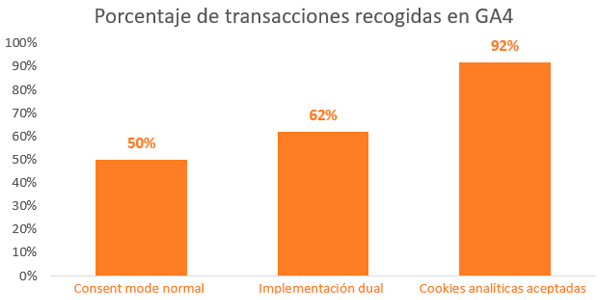
Well, with the property in its standard setup and Consent Mode left as it was, it captured around 50% of the store's transactions (taken from the CMS), which is an extremely low percentage and completely insufficient if we want to use GA4 as the main judge of the sales and revenue brought in by each channel.
So we configured this property as bannerless within a dual measurement analytics system, which increased sales capture to 62%.
A little better, yes, but still a long way from optimal figures, which I put above 80%.
At this point, we had two testing routes to try to improve matters:
- Check that the GA4 script always fired on the thank-you page.
- Review Consent Mode and how we had implemented it.
I can tell you that the first route achieved very little. Our tests confirmed that the script fired correctly every time a purchase was completed.
The solution
So we took the other route: tinkering with consent.
And that's when we saw that, although the dual system correctly captures the source and medium through which the user reaches your website, once the second consent comes into play, everything falls apart. It records only 10% more conversions, as I mentioned earlier.
What did we do?
We tested what happened if we set analytics-cookie consent to “granted” regardless of what the user did: whether they accepted or rejected cookies, GA4 cookies were always set (advertising cookies were not).
The result?
GA4 recovered 92% of the actual transactions, something I hadn't seen since my days at TiendAnimal.
Of course, with data of this quality—together with the reports from each platform—it's much easier to understand how our marketing mix works and make sound decisions.
The final decision
So, what do we do? We have three options:
- Do we leave it as it is and risk a fine from the AEPD? In return, we have much more information.
- We can also modify the cookie banner: its design and copy, or introduce a €2 paywall as media outlets are doing.
- Build a solution that allows the roll-up property to collect all the data (which we are legally allowed to do) while the other properties collect data according to whether or not the user consents.
- Add a tool such as Matomo, which does not take Google's Consent Mode into account and aggregates data from all the websites, similarly to GA4's roll-up property.
And there is no universal answer that works for every business.
In this case, we'll go with option three, knowing that the code itself won't be especially difficult, but that it will require a lot of testing until we get it right.
Conclusions
As you can see, digital analytics gets a little more complicated every day.
That's the reality, and we have to adapt as well as we can—at least if we don't want to operate blindly and lose competitiveness in the digital environment.
So, if you're interested in the topic, you can take a look at other articles about analytics that I've written, both digital and business analytics.
You can even subscribe and receive one in your inbox every week.
And if what you need is someone to review your business with you, contact me here.

Leave a Reply