
Email marketing is a marketing channel I love.
I’ve lost count of how many times people have tried to kill it, yet there it is, still standing its ground.
And no matter how many social networks appear, how many ad formats Google adds to search, or how much audiences are refined and targeted with banners and programmatic advertising, in the end it is very difficult—if not impossible—to beat email’s ability to tell a user exactly what you want.
And exactly how you want to say it.
So in this article I want to explain what email marketing means to me and what you need to know to launch campaigns for your business. Whatever that business may be.
And if it happens to be an ecommerce, I recommend reading this other article first:
Email marketing guide for ecommerce.
Then, if you like what you read and want to go further, here is phase two:
Email marketing training for ecommerce.
But there is plenty of business beyond ecommerce, so if you want to get started with email marketing, here is something that may interest you:
Following that idea of going beyond ecommerce, in this post I want to cover a broader, more general overview of the channel, including every kind of business.
Inevitably, that means I will not go deeply into every section, because this would turn into a monster of a post.
But it will also force me to write more articles later on the topics that need them and link to them from here. Read together, they will give you a very good picture of what the channel can offer and what an email strategy will require from you.
To begin with, let’s talk about numbers.
Email marketing figures and statistics
To put anything into perspective, I like to turn to the numbers.
Because they are cold and they do not lie: they show what is really there.
And what the numbers say about email marketing may surprise you.
Overall industry figures
Let’s look at a few figures:
- 350 billion emails were sent on average EVERY DAY in 2023, 4.3% more than in 2022.
- The figure is expected to exceed 360 billion in 2024.
- Revenue generated by the channel was estimated at 11 billion dollars in 2023 and is expected to exceed 12 billion in 2024.
- 88% of users in Spain say they use email every day.
- 77% of B2B buyers say they prefer to be contacted by email.
- 25% never check the Promotions tab.
Here are two more metrics per send:
- The open rate averages around 20%.
- The click-through rate, 2.5%.
I don’t know whether these figures make you think the same as me: the pie is enormous, it will grow every year, and the sensible thing is to take the biggest slice we can.
My numbers
Of course, you may not care in the slightest what I think. And you may be wondering what I know about email marketing and why I believe I am qualified to talk to you about it.
That is a fair question.
So let me sum up my relationship with the channel:
- I started out managing customer databases—both consumers and businesses—at a Yamaha dealership. My job was simply to send what I was told to the database I was given. In other words, I only managed the email tool. I never saw the results of those campaigns, although they cannot have been bad, because we sent several different emails week after week.
- At TiendAnimal I created the channel. We started with a database of 50k customers, which grew to more than 100k during the three years I was in charge. We ended up sending emails every day to lists segmented by customer type and, in revenue terms, the channel accounted for around 25–30% of the business, which grew from 4 million when I joined to more than 20 million when I left. By my quick calculation, in the final year alone I sent more than 5 million emails that generated around 6 million euros. Not bad.
- In my ecommerce Yo pongo el hielo I have been sending emails since 2014. Weekly at first and then daily, plus automated sends based on customer behaviour. With a list of 25,000 users, we are on track to send close to 8 million emails in 2024, generating 300k euros in revenue. They are not TiendAnimal numbers, but they are not bad.
- Obviously, I also use it in my personal business (the website you are reading). I have been sending at least three emails a week to my database since 2023. Because I sell services, it is harder to know exactly how much revenue they have generated—Analytics does not tell you—but honestly, things are going well.
These figures show one part of my relationship with the channel.
To complete the picture, I should also add the consulting projects I have carried out for CRM departments such as the one at Primor (which sends more emails than you can imagine) and for other, smaller ecommerce businesses.
And the training I teach on a couple of Digital Marketing and Ecommerce master’s programmes.
I do not even want to think about how much time I have spent sending emails if we added up all the hours. The thought is frightening.
Let’s talk about things that are much more useful to you.
The advantages of email marketing
Here are three easy, familiar ones:
- It is very affordable. It can even be free—in monetary terms—for small projects.
- That means a well-implemented strategy can achieve an extremely high return on investment.
- Setting up the system can be quite simple. Think of something as basic as a tool, a list and some copy.
- It works for any type of business. For some it will fit like a glove; for others we will have to think a little harder. But I assure you that I have yet to see a business where some form of email marketing has no place. More than that: some businesses are built entirely around an email list. I am talking about businesses turning over several million euros a year, such as Isra Bravo’s.
Let’s move on to some more personal advantages:
- If the emails are text-based rather than a collection of products, they involve writing. Writing constantly makes you write better. It also makes you research your customers and understand them better. Combine better writing with a deeper understanding of your customers, and the result is more sales. Beyond email itself, I mean.
- Writing also forces you to structure your ideas. You end up seeing certain issues with a clarity you did not have before, and that helps you make better decisions.
- If, on the other hand, your emails feature products, as ecommerce emails usually do, choosing the products and defining the editorial calendar (which email you will send on each date), and thinking about promotions or how to frame the benefits of the products you advertise, will once again help you sell more. Above all because you can reuse everything you have analysed to make changes to the website: homepage products, banners, promotions…
- And finally, you can use the channel to build authority. To prove through actions—and words—that you are an expert in your field. You do not achieve that with one email, of course, but with quite a few.
And that brings me to the main advantage:
- Email marketing allows you to build a relationship with your users. It lets you communicate with them directly and create something more substantial than the purely transactional contact that follows a purchase. Something for the medium and long term, which is where the best commercial relationships are built.
Disadvantages of email marketing
Like every channel, it has its drawbacks, of course.
The first is that, although the basic system can be very simple, as soon as we want or need to do more complex things, things get complicated.
What we have in mind may not be possible with our current tool, so we have to find another one—and migrate the list, which is no small task.
The technical setup has also become more complex. In the past, all you had to worry about was collecting consent—when I started, not even that—connecting your list to the tool and sending.
Now you need to configure things on the server. They are not particularly difficult, but they can be intimidating if you have never done them before.
That complexity is a fairly manageable inconvenience. For me, however, the biggest disadvantage is this: getting leads is becoming harder every day.
We are sick of overflowing inboxes, so we no longer hand over our email address for a miserable lead magnet.
And if we do, you can be sure that we also hit the unsubscribe button. Far more easily. You have to keep people interested, whether with quality content, entertainment, good offers…
Whatever it takes, but it is not easy. It requires thought and action; you cannot simply switch on autopilot and leave it there.
Because if our unsubscribe rates are high, we will end up destroying our “deliverability”. In other words, the major email providers—Gmail, Hotmail, Outlook and Apple—will close the door on our messages and prevent the users we worked so hard to acquire from receiving them.
And that is bad news.
These ESPs also do something slightly less nasty (Email Service Providers), which is make analytics more difficult.
In other words, they distort our open rates, strip parameters from links or obfuscate them “for privacy”. Of course they do, darling.
Even so, when I weigh the advantages against the disadvantages, I honestly think the advantages win.
By a long way, too.
Email marketing strategies and types of email
I am grouping the two concepts together because they go hand in hand. One cannot work without the others.
In general, let’s say there are four types of email:
- Commercial: these are the ones I will focus on, and we cannot send them to users without their prior consent.
- Informational: we are allowed to send these to users at any time, but they must not be commercial. A store opening, a change of address or changes to the general terms and conditions would fall into this category.
- Transactional: these are the automatic emails used to manage the purchasing process. For example:
- Account creation.
- Cambio de contraseña.
- Pedido realizado.
- Cart recovery, if we believe an error may have occurred during the process—an important distinction if the email is to be sent legally.
- Customer service: replies to users who contacted us through the website form or our contact email address.
As I said, from here on I will focus on commercial email strategies, leaving transactional and customer-service emails aside.
Types of commercial email
There are quite a few, believe it or not.
Depending on the type of business and the resources available, the first question is which kinds of email make sense. Let’s look at a few examples.
Mass campaigns
These are sends I make to the entire database or to a specific segment.
The type of content can vary:
- It may be an email rounding up your own articles or other people’s news.
- Or it may be a sales email for a service or a list of products from your ecommerce.
- Or an email focused on a piece of news—an interview or an event you are taking part in.
These mass sends can also have different frequencies:
- They may be daily or weekly sends—the most common options.
- Monday to Friday.
- Occasional, whenever I need one.
Finally, another variable is whether they are created manually or automated.
Personalised CRM sends
These are personalised emails sent to a user when they trigger an event or when we want to produce a specific effect. We could divide them into two groups:
Customer journey
We place the customer at a point in the journey and send the email we consider appropriate:
- Welcome: a single email or a sales funnel.
- Second order.
- RFM analysis: we cluster the customer, place them in a group according to their orders and send a loyalty or reactivation email.
- Emails related to their purchases, with offers or news in their favourite categories.
Specific events
- Abandoned cart—one email or several.
- A recurring product has been purchased and its renewal date is approaching.
- Birthday.
Cold outreach
When you prospect and obtain the addresses of people you are interested in—for example through LinkedIn, at an event or by any other means—you can email someone who may not know you or recognise your name.
That is cold prospecting—usually to offer your services—and it is another form of email marketing with its own rules.
A few more concepts
Besides the above, here are a few more concepts you need to understand clearly.
Newsletter
This is a type of mass send. It may contain text or products and may come from either an individual or a business.
We could say that the term “newsletter” refers to regular mass sends to a list.
Daily email
It means exactly that: sending one email a day to your list—or at least several emails over the course of a week—with the aim of selling something.
It may be personal, to sell training and services—the most common use, I would say—informational, with a news roundup, or sent by a business.
In my view, besides frequency, its defining feature is that text takes precedence over images and it is not simply a pile of products.
This type of email has two fundamental advantages :
- The repetition effect: more sales and more authority.
- And because it is text-based, it usually lands in the inbox rather than the Promotions tab.
It also has a problem: if users do not like what you are saying, the unsubscribe rate can be extremely high.
Sales funnels
In this case, we are talking about welcome sequences made up of several emails, not just one.
The aim is to let users get to know us a little better and gradually become interested in our products or services, so they want to buy what we sell.
It is extremely common for selling almost anything, but especially online training.
How to build an email marketing strategy for a project
At this point, I think you may have one main question:
How does all this fit together in a real project?
There are different ways to do it, but I am going to tell you about mine.
Email marketing strategy for ecommerce
I am going to explain the strategy we use at Yo pongo el hielo:
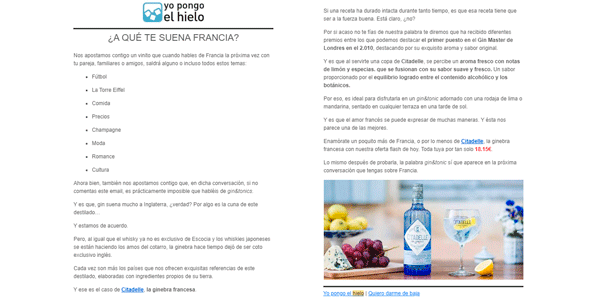
#1. Daily mass send
From Monday to Friday, we send text-based emails that use storytelling, to promote a product. We also usually put that product on a flash offer for the day to encourage purchases.
They are emails of just 300 to 500 words that land in the inbox, but if writing one email a day feels like too much, you can always use AI to help you write it.
#2. Weekly mass send
One email every Monday, announcing 30 products we are promoting that week:
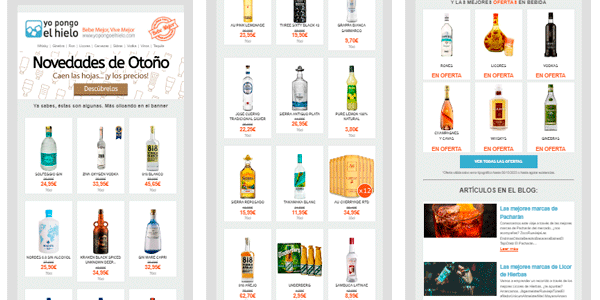
We segment only by language and use an annual weekly calendar to define which promotions run each week—winter and summer sales, Black Friday, Christmas, Whisky Week…).
We reuse the promotion on the website through banners, badges and featured products. It is not promoted only by email.
#3. Personalised CRM send
Two emails a week, on Wednesday and Saturday.
These are either product emails selected specifically for each user based on their behaviour, or text emails based on their user journey.
We use an RFM model to cluster customers for some of these sends:
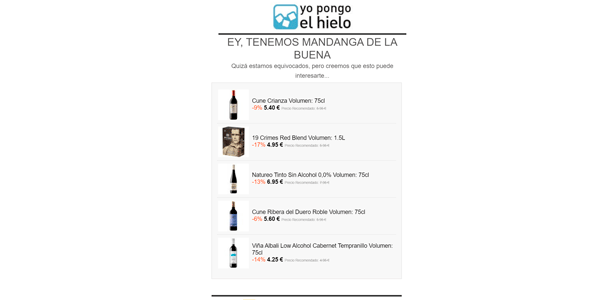
That is our campaign at a general level, but you can see each email type explained in more detail in my email marketing guide for ecommerce.
Email marketing strategy for a personal business selling services and training
In my personal business, because it focuses on selling training and services, I use a different strategy.
#1. Sales funnels
The funnel varies depending on the lead magnet the user downloaded:
- If it relates to ecommerce, they enter the sales funnel for my ecommerce training.
- If it relates to analytics, they enter the sales funnel for my analytics training.
- If it relates to local businesses, they enter the sales funnel for my local-business training.
Each funnel contains between six and ten emails, delivered daily. Following Eugene Schwartz’s stages-of-awareness principle, I try to move the reader closer to buying with every message.
#2. Mass sends
Once the user finishes the funnel, whether they bought or not, they join the daily email list.
I send three emails a week to this list.
In my case, I send them on Monday, Wednesday and Thursday, with this approach:
- Monday and Wednesday: sales email for training or services.
- Thursday: email featuring the new weekly article on my blog.
And that is it.
For now, that is my complete email strategy for my consulting and training business.
Which businesses can use an email marketing strategy
I do not think I am wrong when I say: any of them.
That said, the strategy must be adapted to each business, because running an ecommerce catalogue with 20,000 products is not the same as selling only funeral insurance.
Every business needs a different approach and frequency, although in general it is rare to find one that cannot send at least one email a week to its list.
How to define and execute the strategy
We have two options: handle it internally or outsource it.
Internal development
If we know something about marketing, communication, copywriting, advertising, writing or similar fields, we—or someone on our team—may be able to both design and execute the strategy.
You may need a little help with the technical side, but support from the chosen tool, the hosting provider, or both is usually enough.
Bear in mind that when you are starting out and have never written emails before, producing something decent can easily take more than an hour, so account for that in your strategy.
Using ChatGPT is a good idea—if you know how to handle it—and if you want to learn, this is the best training course for creating text-based emails that I know.
And in this other course, which is mine, you will learn how to use email marketing for ecommerce and generate at least 25% of your revenue through this channel.
External development
Here we have several options depending on what we need: email marketing agencies, automated tools or freelance copywriters.
Email marketing agencies
This is probably the first option that comes to mind. That is understandable, because a good agency can generally offer a solution whatever your business.
They will also normally handle the channel from top to bottom, meaning they:
- Define the strategy, either on their own—by creating a proposal—or together with you.
- Help you choose the right tool.
- Configure the tool correctly.
- Create the editorial calendar.
- Write the emails.
- Schedule them.
- Analyse the results.
- Give you feedback and reporting on the channel.
- Make the necessary changes to improve the original strategy.
Will every email marketing agency carry out every one of these steps?
No.
It depends on the agency’s level and the agreement you reach with them.
Finally, a good agency can create both text-based and product emails, although some specialise more in one area than another.
Automated CRM tools
Some email marketing tools and platforms specialise in sending automated product emails based on the customer’s history.
They are designed for ecommerce. They connect to our website and receive and collect all the data associated with each user.
This lets them know things such as the user’s birthday, the product category they buy most often, their average order value and purchasing frequency.
Using all that information and the sending-frequency rules we set, the platform itself generates the email content, choosing the most suitable products for each user at every moment.
Not bad at all.
Probance is one platform you can look at if you want to see how it works.
Freelance copywriter
If you sell training or services, text-based emails are the natural choice.
They also work very well for selling a specific product without displaying an entire catalogue in the email.
In that case, you can turn to the excellent professional copywriters in this country—for example, my partners Rafa Casas and Josely, a very copy-minded guy—to help you or, more accurately, take care of the entire channel.
The editorial calendar
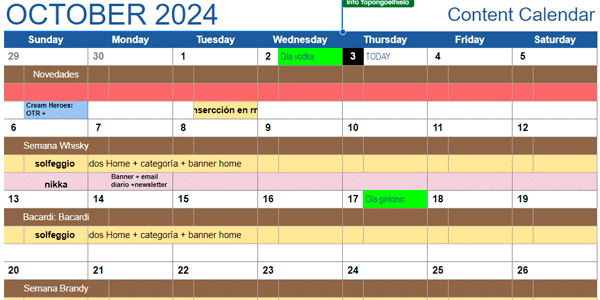
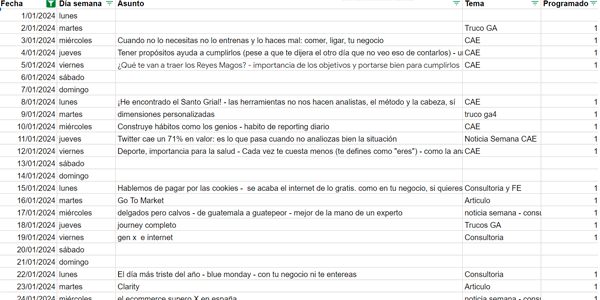
Whether you do it internally or seek outside help, in both cases you will need an editorial calendar in which every email is planned.
It may be the calendar for an ecommerce’s weekly newsletters:
Or the calendar for the daily email of your service business:
But whatever the case, if you want this to work and not feel forced, you will have to plan.
If you cannot think how to do it, you know the options:
- Copy the people who do it better than you.
- Delegate it to people with more experience.
- Get training.
Whatever you do, plan well in advance.
Email design
Some people do not think it matters.
I do. Whether it is a product email or a text-content email.
In either case, if your eyes reject what they see at first glance, that is bad.
First, something very obvious: your email has to be responsive.
That means it must look good on both mobile and desktop.
Most tools include templates that achieve this, but it is still worth checking your first sends on several different devices.
Another good practice is to make your content fit within a column about 500px wide. This almost always ensures that the font will not be shrunk by certain email clients such as Gmail.
This shrinking of the original size happens more often if we add an image to the email. In fact, if you add one wider than 650px, your mobile app will almost certainly reduce the text size.
And while we are talking about images, the more you add to an email, the more likely it is to end up in the Promotions tab. Yes, the one that the figures say 25% of people never open. So if you run an ecommerce, check it.
Also, if they are too heavy, the download may fail and the images may not even open on a phone.
Finally, whether you send ecommerce emails with many products stacked one below another or link roundups with your own comments, be careful: if the message gets too long, the ESP will clip your email. To see what I mean, subscribe to Idealista alerts in several areas and open your inbox the next day.
Email marketing tools and platforms
You will find quite a few in this email marketing guide for ecommerce that I published some time ago.
Besides those listed there, I would add a few more, including these two that I particularly like:
- GetResponse: good deliverability and features.
- Acumbamail: also good deliverability, but fewer features in exchange for a lower price, with lifetime plans on AppSumo.
- SalesManago: a complete CRM for ecommerce. Cost-effective if you make full use of it, because it is not cheap.
- Klaviyo: I have not used it, but it is the most widely used option for Shopify ecommerce businesses in the US.
And these are the ones I like a little less:
- ActiveCampaign: once one of the most common tools for daily-email strategies, but it seems to be in decline.
- Brevo: when I have used it, it has seemed expensive for the features and capabilities it offers.
Email marketing analytics
I am opening the final section by stressing that the major ESPs are increasingly messing up our data.
As I said when discussing the channel’s disadvantages:
- They distort our open rates.
- They strip the parameters from links tagged for Google Analytics.
- Or obfuscate them.
Even so, you cannot simply stand still and measure nothing: you have to measure.
At least if you want to improve.
So you will need to measure two different groups of data:
- Data for the email channel as a whole.
- Data for each send.
There are not many KPIs—only five in total—and I explain them in my lesson on how to create a dashboard for the email channel in Círculo Copy, my membership for digital business, copywriting and AI.
Final advice and conclusions
More than four thousand words later, I am closing this article, in which I have laid out the entire framework of what I believe email marketing involves, covering every aspect I consider relevant.
As you can see, the type of business you run will determine which options are available to you.
What is clear is that there will always be a good option for you. Always.
It is, after all, the channel with the best ROI in the industry, neck and neck with SEO.
So my final piece of advice is to start thinking now about an email marketing strategy for your business.
Work out what may suit you: doing it yourself or outsourcing, comparing tools and costs, considering related issues, and so on.
I have included links to several training courses that may help, along with other articles that explore particular aspects in more depth. But if you still need help after getting thoroughly up to speed, write to me and we can discuss it.
On the other hand, if you liked the article and want to receive a similar one every Thursday, subscribe here, choose your free gift, and read me in your inbox next Thursday.

Leave a Reply