
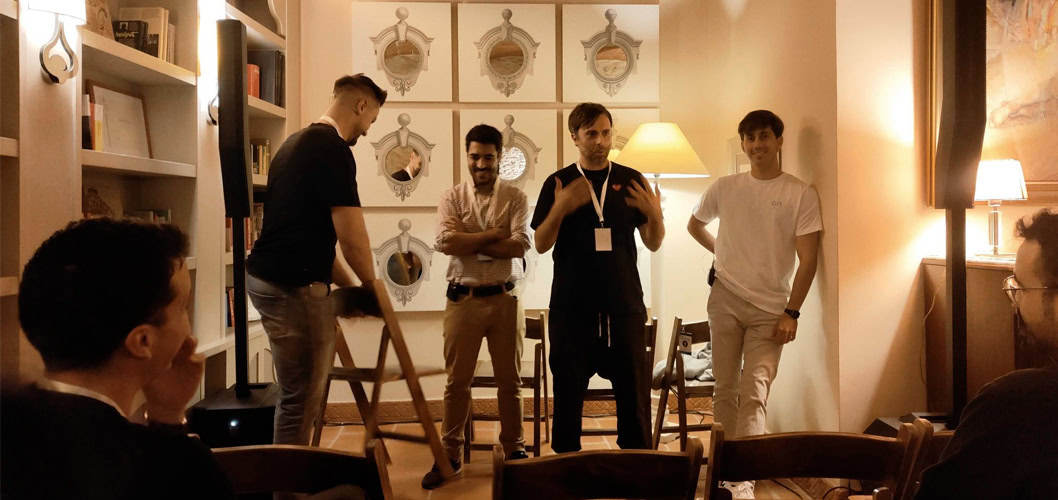
The event organised by Josep Deloufeu from VisibilidadOn last Thursday gave me the perfect excuse to talk about a subject that, like every analyst, I enjoy: trends.
In this case, ecommerce trends, which formed the backbone of the whole meeting.
The first thing I want to highlight is that the format encouraged everyone to take part—around 70 people, by my estimate.
It was a round table moderated by Guillem Hernández—CEO of Eleva and partner at Crisp Studio, a Shopify specialist agency—and by Josep himself. Jorge Peláez—from Farma2Go —and I were there, talking about our stores’ experiences with the different topics they put to us.
The audience’s contribution was also spectacular, because there were representatives from several solutions and ecommerce businesses turning over tens of millions a year.
The perfect breeding ground for a fascinating discussion.
And this article is about the different cans of worms we opened and what was said about each one, closely linked to what is going to happen—or is already happening—in ecommerce in Spain.
#1. Shopify vs open-source CMS
Things got heated right away.
There seems to be a growing trend—real or imagined, but certainly louder—towards launching new projects with the ecommerce SaaS par excellence.
Scalability is supposedly better.
You supposedly do not have to worry about the technical side.
And it is supposedly more secure.
The thing is that, at lunchtime that very day, Shopify’s POS (Point Of Sale), its physical point-of-sale system, had gone down.
Gone down meant nobody could sell. At all.
And you might think that, for an ecommerce business with one store at most, it is a pain but survivable.
The problem is that companies such as Singularu, with 50 physical stores using the service, had packed shops and sales assistants unable to do anything. For several hours.
That is a disaster.
Because, on top of everything else, it is beyond your control: you did not break it, and you cannot fix it.
And nobody is going to plug the hole in your revenue caused by an outage like that either.
So the main value proposition Shopify salespeople give those of us using open-source CMS platforms such as PrestaShop or WooCommerce to persuade us to migrate simply disappears.
Shopify can crash. Just like your own development.
Jorge pointed out that Farma2Go cannot migrate from Presta to Shopify because of the commission it charges per transaction, but that without it he would do so because of the attacks and technical headaches involved in a custom build.
I will add one point to that. But a little later, when we talk about…
#2. Marketplaces
Obviously, at an ecommerce event, this was a major topic.
Farma2Go started through this channel and then opened its own. Amazon and Miravia matter to them, and they may open on Temu too.
Changes in terms and the trade war between China and the United States affect ecommerce
Among the attendees was Rakumart’s head of Spain, from a behemoth that imports products from China worldwide. Its backend is developed by an Alibaba team and contains many parts in Chinese—I assume code comments rather than back-office sections, but I did not dig into it, although now I think about it, I should have.
What everyone was saying was that the landscape has changed enormously.
Both Amazon and its logistics and Miravia and its terms.
And Temu is frantically looking for local companies in Spain to avoid what is happening now: huge delivery times and no invoice for your orders.
On that point, I asked whether it was legal.
Apparently it is, because even though the sale and delivery take place in Spain, you are buying from a Chinese company. For administrative reasons I do not know, it can sell without itemising VAT.
Interesting.
All of this sits within the framework of the trade war between the United States and China, which leads China to finance its big players so they can compete with Amazon, crushing every other player along the way.
Interesting—or perhaps not—that just this week Amazon announced its low-cost ecommerce platform with products from China, to compete with these Asian marketplaces.
But beyond China, which I will return to shortly, we discussed other sides of marketplaces.
Returns
For example, we talked a lot about how you have to swallow the cost of returns.
About how, until Amazon Spain was defrauded of €2 million through returned iPhones replaced with stones in the boxes, its only check was that the weight of the products sent out and returned was similar.
It has now gone one step further and checks the product with a scanner. That has reduced the problem but not eliminated it, because criminals now buy branded T-shirts and return ones from Decathlon.
Honestly…
And the clothing sector faces another massive problem: size-related returns.
Customers buy two, three or four different sizes, and you are going to eat the return cost no matter what.
Finally, it was not all going to be bad.
A piece of advice
We also discussed the various techniques for moving Amazon customers to your own channel, using flyers, printing on product packaging and ‘tweaked’ photos.
Of everything discussed, I would probably keep one good practice that I have always recommended and am glad marketplace experts also follow: keep a separate P&L for marketplaces and for your ecommerce channel.
They are two completely different channels. The rules are different, and you cannot lump everything together—not if you want profitability. Prices will differ, expenses will too, and the workload will not even resemble the other channel. So separate them, just as you measure the physical channel without mixing it with digital.
So split digital into ecommerce and marketplaces. As someone pointed out, this lets you compare product behaviour across countries and remove from Amazon Germany the shoes that are not profitable there because of the higher return rate—a real example shared by an attendee.
My opinion
And this is where I give you my view on marketplaces, Shopify and, to some extent, social media. It is roughly the same in every case: I prefer freedom and control to all the other advantages:
- I would rather run the CMS on my own server and control, expand and secure it than pay a 1.5% commission per transaction—plus Shopify’s monthly fee, of course.
- I would rather control all the marketing and logistics and sell through my own channel than hand Amazon that power in exchange for a possibly larger reach and customer base.
- I would rather build my email list and communicate with it however I choose than build an audience on any social network and let an algorithm decide what reaches them.
In all three cases, my mindset is to avoid the risk of someone changing the terms whenever they please, potentially wrecking the entire project.
I believe it is extremely important to have the freedom to do what I think is right for my business, without being tied—or enslaved, choose whichever word you prefer—to a solution governed by other people’s judgement rather than mine.
#3. China
We talked a great deal about this—not so much during the event itself, but before and afterwards.
Let us take it step by step.
Chinese suppliers and how they work
First, during the car journey between Girona and Begur that I shared with the extremely likeable Jesús Castillejo, partner and head of design at Minimalisim, Josep Deulofeu senior—father of Josep Deulofeu, the agency’s CEO and the event organiser—explained how his various companies operated.
Of all that, I am going to focus on the part concerning the Asian giant.
Josep told us that he has been working with the same Chinese company for almost 40 years—first with Mike, as the owner called himself, and now with his daughter.
Although countless cheaper suppliers have approached him, he has always stayed with the same one. That has given him a major advantage.
First, because Mike, as a good supplier, knows his country’s industry well, and whenever Josep needed something new, Mike could provide it at the right price and quality.
That saved a great deal of time and work searching for new Chinese suppliers for every need.
Furthermore, during the pandemic, it allowed him to continue operating with some normality, adding masks to his textile catalogue, for example.
He also told us many other interesting things—for instance, that for anything that can be automated, manufacturing prices and quality are much better in Europe, basically because we have better machinery.
The same goes for ink printing: better here.
He also said he had tried suppliers in India and that, for now, China is better: similar quality, but much cleaner textiles and more reliable deliveries.
Speaking of deliveries, he also explained the problem of shipping containers by sea. Costs have risen from €1,500 to more than €4,000 on some occasions. And their containers are often left behind because a last-minute customer pays the shipping company more to load theirs and takes the space.
He also told us about the country’s transformation :
- How, when he arrived, Hong Kong and Taiwan were moving their factories to China and acting as its ‘bosses’.
- How China is now doing the same with Vietnam.
- And how the government moves factories from one place to another according to administrative interests, with manufacturing quality suffering during the transfer.
- That Hong Kong is probably the most interesting city of all to visit.
Interesting details for those of us who closely follow Chinese ecommerce—things only someone directly involved can tell you first-hand.
How to bring them into your business through ecommerce
Staying with the topic, that evening I shared a couple of beers with Óscar, partner and manager of Rakumart in Spain.
If you did not know it—I did not either—and the Chinese market interests you, you should already be checking it out.
Basically, this global behemoth finds any Chinese-made product you want and delivers the quantity you need wherever you require it.
Customised or not.
At prices far below Alibaba.
If you have considered making merchandise for your business, I would start there.
Óscar explained how they operate and why they know the Chinese market so well, as well as how they use AI to create catalogue products and their corresponding landing pages in three or four hours, a job that previously took days.
The conversation opens your mind to the different business possibilities offered by the combination of ‘Chinese product + AI’.
Since he told me, I honestly cannot stop thinking about it.
#4. Artificial intelligence
Let us dig a little deeper into AI.
Obviously, it was one of the evening’s star topics.
AI and ecommerce
We all agreed that within two years there will not be a single ecommerce business that does not use it. No living ecommerce business, I mean.
The question is how differently it can be used by own-brand and multi-brand ecommerce businesses, because some use cases vary considerably.
Here are some use cases we apply in our ecommerce business:
- How to generate images with Flux for free.
- How to create social media videos with help from AI.
- How to analyse logistics invoices in PDF with AI.
- All my articles on artificial intelligence.
The point is that these use cases have changed every sector.
Such as translation and localisation. The difference is that localisation means, for example, writing UK English for the United Kingdom website and US English—which is not the same—for the United States website.
I spoke with Óscar Nogueras from Ontranslation, about how, when we requested a quote for localising TiendAnimal product pages into English, French and Portuguese 12 years ago, the price we approved with its competitor was €30 per page.
They now do that work for €1 per page.
The disruption caused by AI is incredible.
But you already knew all that.
What comes next, you did not.
Artificial intelligence degree
The thing is that Julia, Josep’s girlfriend, has completed an artificial intelligence degree.
I did not even know such a degree existed, but it seems highly relevant to me, even though the syllabus will become obsolete year after year.
Julia told me things such as that Spain has one of the world’s largest supercomputers—the MareNostrum —and that we can apply for access, provided we are researchers or non-profit R&D organisations conducting AI research and development, without bearing that cost layer. You know, the Nvidia graphics cards that have turned the company into the world’s most valuable.
She also told me that what we can access through ChatGPT and similar services is a very, very restricted version of AI’s CURRENT power. It goes far beyond that: apparently it can already ‘reason’—or seem to—at human levels. Something much more advanced than OpenAI’s 4o model.
If China has had my head spinning ever since, AI perhaps not quite as much, but it has made me even more eager to devote more time —even more—to the subject.
AI customer service solutions for ecommerce
But enough speculation about the future. Looking instead at current, operational ecommerce applications that I have not yet tried but are apparently brilliant, here are two:
- AI for WhatsApp Business.
- Voice AI agents for telephone calls.
I knew about the first.
I had no idea that the second already had operational commercial solutions . And there are plenty: I searched around Google and found far more than one or two. So, when call-centre costs start biting, you know what to do.
In fact, MediaMarkt is already using it.
Related to this, one more thing: it is not AI yet, but soon will be. I mean marketing automation, where the examples and use cases made it clear that no tool beats Connectif on value for money for an ecommerce business. At least until AI proves otherwise…
#5. SEO for ecommerce
Curiously, although VisibilidadOn is an agency mainly specialising in SEO, we talked little about it at the event.
I did spend a good while over post-dinner beers with Eva Guerero, the agency’s SEO specialist and a digital marketing expert, who has a very cool project that she will reveal in due course.
For now, here is her YouTube channel, highly recommended if you want to learn about entrepreneurship, personal branding and, of course, marketing.
Conclusions and closing thoughts
Of everything said, and speaking specifically about ecommerce, I am left with six points that we could call trends, for what lies ahead:
- Shopify is fine if you have wide margins. But like everything else, it is not a perfect solution.
- Klaviyo is quite literally a ‘little nail in the coffin’ once you start sending lots of emails.
- The marketplaces become more complicated every day. They still offer plenty, but much less than before, and require more work. Today, they are a completely different business or channel from ecommerce.
- Putting the previous three points together, and after listening to some very large ecommerce businesses, my conclusion is that the foundations of ours are very solid. They let us operate comfortably with lower margins than most. When I explained how many emails we send and what we pay, people could not believe it.
- For medium-sized multi-brand ecommerce businesses, AI is a huge help, but we are at the ‘advanced user’ stage, not yet the ‘expert solution builder’ stage. That will come, and we need to be ready.
- China. We need to keep an eye on it and see how we can exploit certain advantages. I have not stopped thinking about it since hearing what was said that day.
Honestly, I have attended few events where I met people and projects as interesting as at this one.
Businesses very different from mine: some with average order values of €20,000; others with entirely different models and problems.
I left with my head spinning, thinking about different things I want to try over the coming months. That is what happens when you surround yourself with entrepreneurs and brilliant people and listen to them: ideas explode and you feel a tremendous urge to get moving.
By the way, speaking of brilliant entrepreneurs, while talking with Josep Deulofeu senior, he told me how, after the new terminal opened at Barcelona Airport, all domestic flights that previously departed from Girona were moved to the Catalan capital.
I can confirm it: to fly from Málaga to Girona, the quickest option involved a five-hour stopover… in Dubai.
Unbelievable.
Since I genuinely could not see that making sense, I had to fly from Málaga to Barcelona and make several connections before finally reaching Girona and Begur, the lovely coastal town where the meeting took place.
Seven and a half hours of travel.
Exhausting, but worth it—as events like this almost always are.

Leave a Reply