

When doing the keyword analysis I usually carry out before writing a long article, I found it curious that Google's keyword planner shows us that the term “CRO”, alone or combined, has no searches in Spain.
None.
Not even a measly 10 a month.
And yet, “UX” gets a solid average of 3.600 monthly searches:

But then I think about how little attention is usually paid to conversion rate in digital projects, and it surprises me less.
It is much easier to buy more traffic –or blame it– than to admit that our digital product, or what we sell through it, has room for improvement.
Because that means working on both.
And buying traffic is much easier.
But because I am convinced that, with advertising costs constantly rising, investing in CRO will give you much better results in the medium term, I want to do my bit so you understand it, keep it in mind and can act accordingly.
So, in this mega guide I am going to give you my complete view of the subject.
I am going to explain why I consider this discipline "the digital King Midas".
Yes, the one that turns the conversion of any part of the digital business it touches into gold.
Get ready: this article, like 25-karat gold, is the first in a list of, for now, 7 articles covering different aspects of the subject.
To start, we are going to explain what CRO is, the matrix of different users, and some concluding tips that I recommend revisiting after you have read the full series of articles.
What is CRO
Well, CRO stands for Conversion Rate Optimization, that is Improving the conversion rate.
If that left you none the wiser, I will add that conversion rate is nothing more than a formula:
Total conversions / traffic
The thing is that what we consider conversions will vary from one project to another:
- They can be sales, as in an ecommerce, which are the most obvious conversions.
- But they can also be leads, as on the website of a law firm.
- Or they can be calls to the website's dedicated phone number.
- Or form submissions or WhatsApp messages.
- Clicks on a banner, if we are talking about a media outlet.
- Or viewing a video that demonstrates how our SaaS works.
All these types of actions (and several more) can be considered conversions, depending on the project.
As for traffic, we will also have several groups:
- All traffic, measured in sessions or users.
- “Commercial” traffic, where we leave out users who, for example, come from countries or regions where we do not provide services.
- Or the traffic entering our store's checkout, if what we want to measure is the conversion rate of the payment process.
As you can see, the “conversion rate” is not measured the same way in every case, although the formula is always the one shown above.
You can keep the idea that the conversion rate measures the percentage relationship between all users who enter your website and those you manage to “convert”.
Well, now that you know what conversion rate really is, I can tell you that CRO is the digital discipline devoted to continually trying to improve it.
And it does so through techniques and tools, some specific to CRO, but always closely related to UX and Digital Analytics.
In fact, when I explain what it consists of, I always draw something like this:

Throughout the article we will talk about techniques and tools, but if conversion is about users, the logical place to start is by talking about them.
The user matrix
One question:
Do you think it is possible to convert 100% of the users who visit your website?
If your answer is yes, I like your mindset, but I am sorry to confirm that it is not possible.
However, if, as I imagine, your answer was no, I will ask you a second and more important question:
Why is it not possible to convert all your users?
And your answer will be something like:
- Not all users are part of my target audience.
- The price of my product or service does not work for every user.
- Not all users are at the right moment to buy.
Or something similar.
And that is the reality: not all users are the same. They do not want the same things. They cannot pay the same amounts. They do not have the same urgency / need to buy.
That is why in CRO we talk about the user matrix:
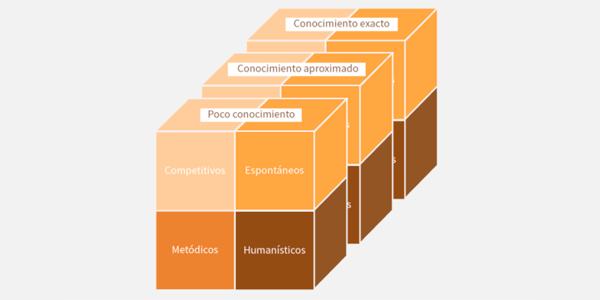
As you can see, we can divide the types of users who visit our website into three (or 4) large groups according to their stage in the buying cycle:
- Those who know exactly what they want.
- Those who have an idea.
- Those who are browsing and gathering information.
- Extra: those who arrive by mistake or expecting something else (they search for a brand on Google and land on the website of another brand in a different sector with the same or a similar name, for example).
Each stage implies a different propensity to convert, with the first group being the most likely.
Furthermore, within each of these broad groups and considering each person's different buying psychology, we can find users with different ways of approaching a purchase / conversion:
- Competitive: they seek achievement and make quick decisions based on logical criteria.
- Spontaneous: they seek emotions rather than rational arguments and also decide quickly (Impulse buying).
- Humanistic: they seek a relationship and are more influenced by service quality (emotional and not short-term focused).
- Methodical: they search, compare and decide using rational criteria. They take their time to decide.
If we combine the stages with customer types, we get a good number of different user groups. Some will be very close to buying and will only need a little push, while others will need much more nurturing.
Others will never buy from us. Or do you know many people who own a Rolls-Royce?
So, when doing CRO, you have to decide who you are trying to optimize for, and that is no trivial matter. Because, for example, adding an upsell at checkout may increase sales among spontaneous users who know what they want, but it may make methodical users think a little longer, especially if they are still in their information-gathering process.
Now, however many types and stages of users there are, the truth is that there are certain cognitive biases shared by humans that lead to universal conversion principles that you should know and apply.
More articles in the CRO series
If you like what you are reading, you can continue here with the rest of the articles in the CRO series:
- What CRO is and the user matrix. This is the one you are reading.
Once you have read them, you can continue with the conclusion of the CRO saga.
Some final tips and conclusions
To close the series, here are some tips I wish I had known when I was starting out.
For example, that it is advisable to start, at least by measuring, the conversion rate as soon as possible. And from there, work on it.
Although some people say you should obsess over it, I prefer to look at higher-level metrics. The thing is, as you grow, you will be able to devote more budget to marketing, so you will get more traffic, which will bring it down.
That is why the first thing to look at is always revenue and profit.
On the other hand, something obvious that I have not mentioned is that, if you work on CRO in ecommerce, you should know that price is an extremely powerful driver, but not the only one.
That is why you have to take care of the entire UX: not only on the website but also in marketing, logistics and customer service. A good UX encourages repeat business and recommendations from your users. If you do not believe me, take a look at this article about Product-Led Growth and the results of companies that follow this approach.
On the other hand, although we always try to improve the conversion rate, sometimes it is beyond our control.
And when Amazon enters our sector, we have to grit our teeth.
At other times, unexpected spikes in visibility such as mentions by influencers or appearances in communities such as Chollometro and similar communities can send us a flood of traffic that is not matched to the same extent by sales.
But it is certainly something positive and you should see it that way. Even if it pushes your conversion rate down.
As for you, to be good at CRO you need to have a critical mindset, even (and especially) about our own work.
Be proactive and have the desire to improve (even if that means extra effort).
Stop being afraid to try things: yes, a test carries the risk of conversions falling, but without it we may be missing out on a much greater benefit.
And that is all the tips I can offer you.
Almost 10.000 words later, we reach the end of the article.
Although I have not gone into much depth on almost anything, I do hope I have given you an overview of what CRO is and its importance in any digital business and product.
Also, with these broad strokes, processes, tools and examples, I think you have more than enough to start working with it.
That said, be careful: once you start and see results, it becomes addictive.
It is great fun to try things, see what works and what does not, set hypotheses, get to know your customers better…
And, above all, improve results.
Because that is what CRO is about. Getting better results with the same volume of traffic, without needing to shovel in more, create new campaigns and open new channels.
That is why, it is hard for an investment in this field not to pay off. And that is precisely why I suggest you start today.
Because once you start, you will agree with me that the digital “King Midas” label fits it perfectly.
If you liked it but need help with your project, get in touch here.
And if you want to receive an article like this by email every Thursday, subscribe on this other page.
I will try not to make you regret it.

Leave a Reply