
Reinterpreting Corto Maltese isn't easy: we're talking about one of the greatest characters in comics. This sailor, and occasional pirate, was created by Hugo Pratt , one of my favourite authors. He also gave us A Ballad of the Salt Sea , which I consider the greatest comic of all time..
However, Martin Quenehen y Bastien Vivès have dared to bring the character back, make him younger and move him into the 21st century, leaving behind the adventures we knew from Pratt.
Océan noir, as this first volume is called, strikes me as a pretty successful take on the character. Quenehen's script is fine, without standing out much, while I found Vivès's artwork extraordinary.
Pratt was not only a brilliant writer but also one of the greatest artists in comics history. However, I'm going to say something many fans of the character probably won't agree with: I think Vivès surpasses him as an artist..
I'll go into more detail later. First, let's start with the plot.
Plot of Corto Maltese: Océan noir
The story begins in 2001, when Corto Maltese takes part in a raid on a luxury yacht. Things don’t go to plan. He rescues an elderly Japanese man and finds himself drawn into an adventure involving a mysterious book and the hunt for an ancient treasure.
From then on, Corto travels to different places and meets characters with their own agendas. It all follows the familiar formula of his adventures, where journeys, unexpected encounters and curious situations matter just as much as the story's ultimate goal.
As I said earlier, updating the character works quite well. After all, Corto has always been an adventurer moving among all kinds of people and conflicts, so seeing him in a contemporary setting doesn't feel strange.
Despite all the changes of scenery, the plot is fairly simple. That’s in keeping with Pratt, whose stories drew their strength from the characters, the dialogue and the way he told their adventures.
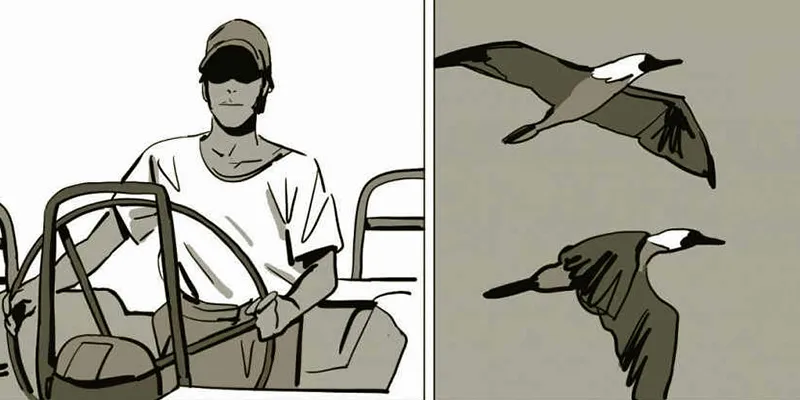
Martin Quenehen's script: good, but not up to Pratt's standard
Quenehen manages to recapture Corto Maltese's personality and build an entertaining adventure, but I think his work falls well short of Hugo Pratt's, at least in this first volume.
You can see it in the characters, who retain many of their familiar traits—interesting people who come and go, leaving us wanting to know more—and in dialogue that tries to revive Pratt's characteristic cynicism, irony and double meanings.
Generally, it works well, but there are moments when Quenehen seems to be trying to imitate Pratt. Pratt let his characters’ personalities emerge naturally, without making it look as though they were trying to prove anything.
In Océan noir, by contrast, some conversations felt a little artificial to me, as though the writer didn't dare make these characters his own and wanted to remind us we were reading a Corto Maltese adventure.
It's not a bad script. The story holds your interest, the characters work and the changes of setting keep the pace moving. I simply think Quenehen delivers a good reproduction of the original adventures without adding much of his own stamp.
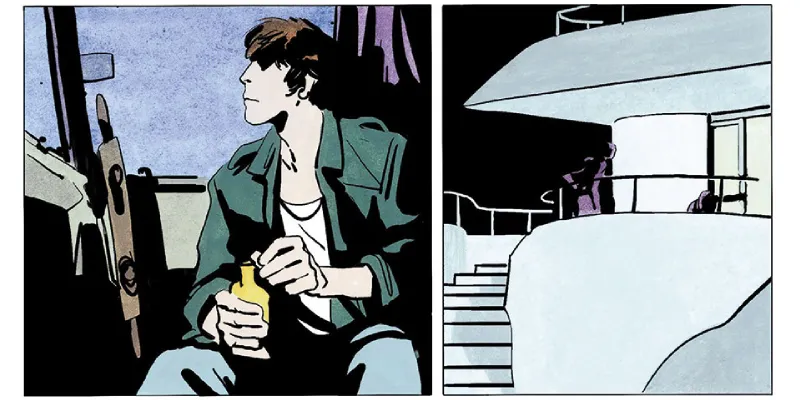
Bastien Vivès's artwork: a work of art
Here, almost the opposite happens to what we saw with the script. While Quenehen seems much more concerned with reproducing the original creator's style, Vivès offers a personal interpretation of the character, without copying Hugo Pratt.
It's true they both favour simple lines and leaving out unnecessary details, but their styles are different. Vivès has a very distinctive way of drawing, making his work recognisable practically from the first page.
And the result is simply magnificent.
He shows his mastery of visual storytelling from the very first page. Using a fairly traditional page layout, rather than relying on oversized panels or unusual layouts, he puts each image just where it needs to be and keeps the story flowing.
There are also lots of genuinely gorgeous panels, and they're not there just for us to admire. Every frame serves the storytelling, and Vivès knows exactly when to move closer to a character, when to show a landscape and how much room a scene needs.
I also love how he uses empty space. Rather than filling pages with details, he removes everything he considers unnecessary, without making the settings look bare or the characters lose their expressiveness.
And this works with practically everything he draws: a conversation between two characters, a ship sailing or a city seen from afar. Even the mountains and landscapes have a distinctive personality, often achieved with just a few strokes.
The use of greys is excellent too, adding depth without sacrificing the clean look of the whole work. Although most pages use this approach, the opening colour pages are just as good. In fact, I'd quite like to see a whole adventure with that colour treatment.
All this brings me to the comparison with Pratt. The Italian was a master of simplification, able to convey an enormous amount with very few elements, and much of his greatness as an artist lay precisely there.
However, I think Vivès goes even a little further, because, while embracing simplicity too, he gives his panels even greater beauty, alongside the natural ease of his storytelling.
Of course, it's a matter of taste, but this is one of those works whose art alone justifies reading the comic..
In fact, while reading Océan noir, I thought of Océan noir another comic, Ronin Rising, which I reviewed recently, for much the same reason: the spectacular artwork by Philip Tan and Daniel Henriques.
Curiously, they're almost opposite approaches to drawing. In Ronin Rising we find huge, detail-packed double-page illustrations where composition matters more than traditional panel-by-panel storytelling. They really are illustrations.
Vivès does almost the opposite. His pages are much simpler and use a traditional layout, yet he produces images that give me a similar artistic thrill.
I'm not comparing their styles, which have very little in common, but the quality of the result. Both works have repeatedly made me stop just to enjoy the images: you can spend several seconds—or minutes—staring at a panel simply for the aesthetic pleasure it gives you..
And that doesn't happen to me often.
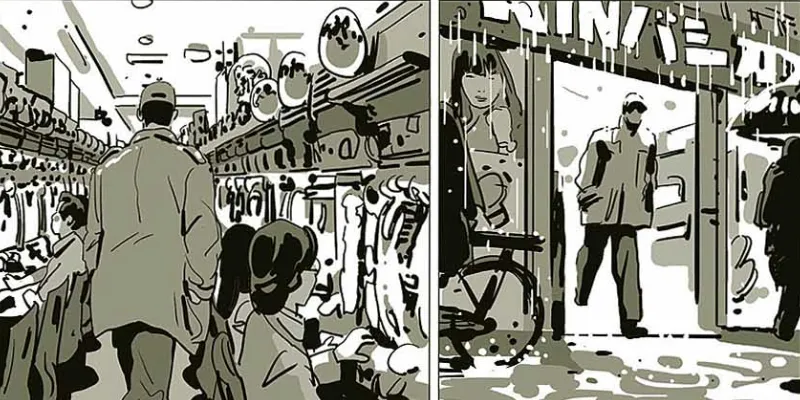
Conclusion: the new Corto Maltese is well worth reading
Océan noir is a good way to bring Corto Maltese back.
Quenehen creates an entertaining adventure, with recognisable characters and generally well-written dialogue, but without the personality and naturalness of Pratt's best stories. I think he's chosen to stick too closely to his model; understandable, but ultimately limiting.
Vivès, on the other hand, has taken far more liberties and I think he's got it exactly right. His artwork has personality, is beautiful and displays a command of visual storytelling we rarely see.
In any case, Océan noir is a highly recommended read, whether you already know the character or want to discover him for the first time. The story may not be especially memorable, but the artwork certainly is.
The best of Corto Maltese: Océan noir
- Bastien Vivès's artwork on every level, which I even consider superior to Pratt's in beauty and visual storytelling.
- The chance to enjoy a different version of Corto Maltese without completely losing his personality.
The worst of Corto Maltese: Océan noir
- The script is decent, but far from Hugo Pratt's best adventures.
- Quenehen imitates the original characterisation too closely, without bringing as personal a vision as Vivès.
- Some dialogue tries to reproduce the original's cynicism and comes across as a little artificial.
Technical details
| Feature | Information |
| Title | Corto Maltese: Océan noir |
| Original title | Corto Maltese: Océan noir |
| Writer | Martin Quenehen |
| Artist | Bastien Vivès |
| Original character by | Hugo Pratt |
| Original publisher | Casterman |
| Spanish publisher | Norma Editorial |
| Year | 2021 |
| Length | 180 pages |
| Genre | Adventure, intrigue |
| Setting | Year 2001 |
Rating
Who it is for
✅ Corto Maltese fans who want to discover a contemporary reinterpretation of the character.✅ Readers who particularly value artwork and visual storytelling.
✅ Anyone who enjoys classic adventures.
✅ European comics fans interested in discovering Bastien Vivès's work.
Who it is not for
❌ Those who only want Hugo Pratt's original adventures.❌ Those who value a complex plot more than the artwork.
Frequently asked questions
What is Corto Maltese: Océan noir about?
The story takes Corto Maltese to the year 2001. After boarding a luxury yacht and rescuing an elderly Japanese man, he becomes involved in an adventure about a mysterious book and the hunt for an ancient treasure.
Who draws Corto Maltese: Océan noir?
The artwork is by French artist Bastien Vivès, who uses a highly personal style based on simplification, empty space and page layouts that make the storytelling flow particularly smoothly.
Who wrote Océan noir?
Martin Quenehen wrote the script. His story retains many of the familiar traits of Hugo Pratt's character, while placing him in a contemporary era.
Do you need to have read the original Corto Maltese comics?
No. Océan noir can be read on its own, although knowing the original adventures helps you appreciate how Quenehen and Vivès have reinterpreted the character.
Does the artwork in Océan noir resemble Hugo Pratt's?
They both share a certain economy of line, but their styles are quite different. Vivès has his own visual identity and, in my opinion, surpasses Pratt in some respects, especially panel composition and beauty.
Is Océan noir part of a series?
Yes. It's the first adventure in Martin Quenehen and Bastien Vivès's contemporary reinterpretation of Corto Maltese. They subsequently published La Reine de Babylone and Le jour d’avant.
Is Corto Maltese: Océan noir worth reading?
Yes, especially if you enjoy the artwork in comics. The script is entertaining without reaching the level of Pratt’s best work. Bastien Vivès’s drawings make it well worth reading.

Leave a Reply