
Forty years after publishing Ronin (you can read my review here), one of the most ambitious and experimental works of his career, Frank Miller decided to return to the universe he created in 1983. The result is Ronin Rising, also known as Ronin: Book II, a six-issue miniseries that brings back the original cast and continues their story.
On paper, the idea had its appeal. Returning to such an unusual universe, one that those of us who enjoyed it remember so fondly, without the constraints of superhero comics, seemed like a good opportunity to keep experimenting.
And yes, it is an experiment. But the result is pretty disappointing.
Here's why.
Ronin Rising plot: a much simpler sequel
After the destruction of Aquarius, Casey McKenna, the protagonist of the first instalment, tries to survive in a devastated New York alongside her son Billy, who has inherited his father's extraordinary powers.
Meanwhile, Virgo, the evil AI, is up to her old tricks. The demon Agat also reappears with sinister intentions. And the “story” —if you can call it that— revolves around Casey and her son fighting these two forces. Don't expect anything else. Two massive battles. That's it.
But that's not the problem. Or at least not the main one.
For a start, it's difficult to connect the events of the two works.
At the end of Ronin, Virgo seemed to have been destroyed and Billy had merged with the samurai’s identity, at least as I read it. The sequel opens in a very different situation, and we’re barely told how we got there.
How did Virgo return? What exactly is going on with Agat? How did we end up in this new situation?
Miller doesn't seem interested in answering these questions. It's up to the reader to fill in the plot holes however they see fit.
The first work also required us to accept quite a few fantastical liberties, but it built a complex mystery whose pieces more or less fell into place. In Rising, however, the lack of explanations makes it difficult to understand the continuity between the two stories.
But again, that's not the work's main problem.
Six issues for two battles and far too much dialogue
As a work of storytelling, Ronin Rising is a different experiment, and a less successful one than its predecessor.
In practice, its six issues contain little more than two major confrontations: one against Agat and another against Virgo. Between them, there's no plot development or anything remotely like it.
The simplification could have worked if Miller had crafted a short, punchy story. Instead, the comic drags on far longer than necessary. Seriously, six issues for this?
The dialogue doesn't help either. Miller adopts his usual grandiose tone, with characters delivering epic pronouncements or threats..
On top of that, those speeches become repetitive, and often the characters seem to say the same thing over and over in different words. It gets so bad that you'll probably end up skipping some of the dialogue. You'll see.
Frankly, this comic is more a book of magnificent illustrations than anything else.
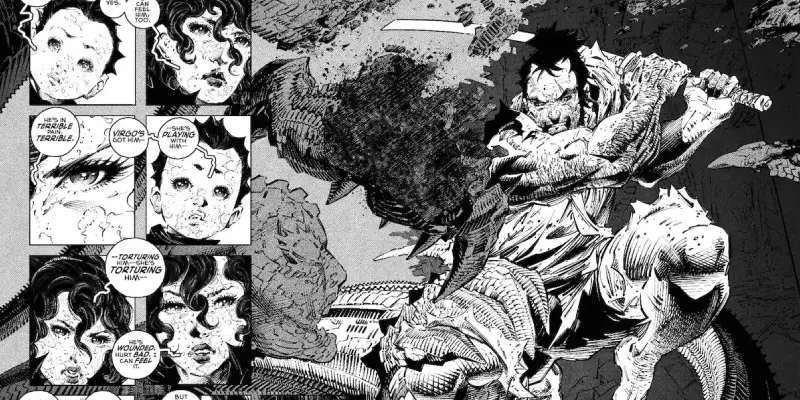
Philip Tan and Daniel Henriques: every page is an illustration
The best thing about Ronin Rising is, without question, the artwork.
Philip Tan draws chapters 1, 2, 3 and 5, working from Frank Miller's layouts and accompanied by Daniel Henriques's extraordinary inks.
The result is stunning..
Rather than drawing a conventional comic, Tan creates enormous panoramic illustrations. The pages barely use traditional panels: open compositions dominate, with numerous characters, grotesque creatures and devastated settings unfolding before our eyes.
Every double-page spread looks like an independent illustration, packed with details that invite you to stop and admire it.
Henriques's work is fantastic too. His inks strengthen the contrasts, add depth and turn the scenes into images of tremendous visual power.
This is artwork worth savouring, because, as I said, we're closer to a succession of spectacular illustrations than to conventional visual storytelling.
Frank Miller: a distinctly manga-influenced style
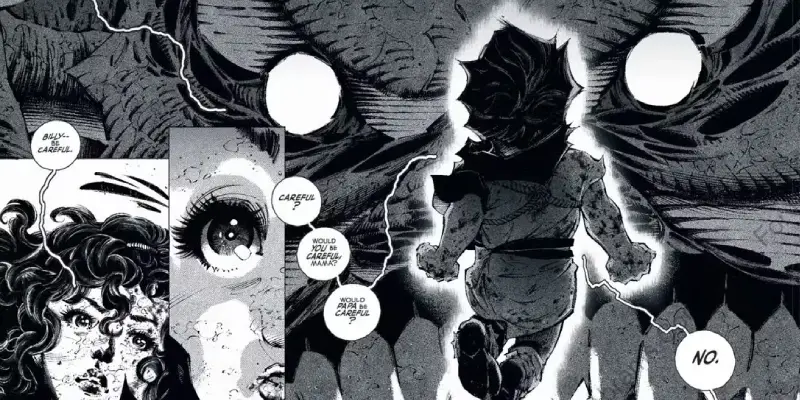
Chapters 4 and 6 are drawn by Frank Miller himself, and the change in style is obvious.
His art is much more stripped down, with simplified figures, energetic lines and an even stronger manga influence than in the first Ronin .
Miller reduces characters and settings to their essential elements, seeking to convey movement and power rather than detail.
It's an interesting approach, with images full of personality, but I find it inferior to his 1983 work.
In the original, Miller combined experimentation and storytelling with extraordinary visual richness. Here he strips the art back so far that some scenes lose that power to surprise.
It's still attractive artwork, but the contrast with Tan and Henriques's compositions makes Miller's own chapters considerably less impressive.
A comic designed to be read in double-page spreads
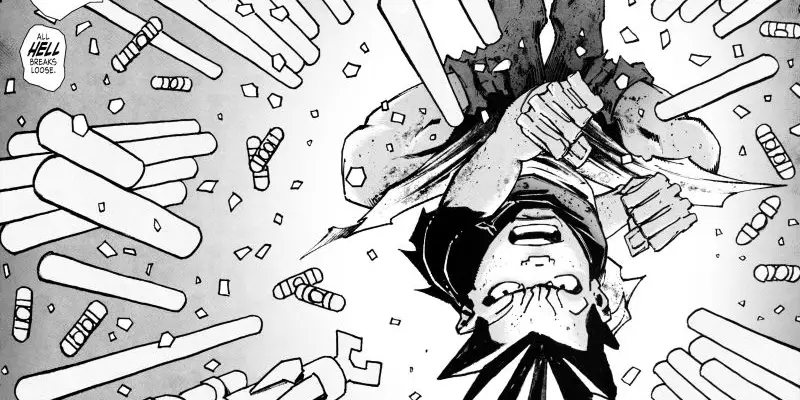
The format is essential to understanding Ronin Rising..
The work was conceived to display large black-and-white panoramic compositions, where double-page spreads function almost as a single illustration.
There are two main collected editions.
The Collector's Edition keeps the landscape format, so the original compositions can be seen as intended. It’s the edition I recommend. Check the price on Amazon.
The Manga Edition, by contrast, rearranges the artwork for a smaller portrait format. Its list price is less than half that of the Collector’s Edition, but I don’t recommend it. Price on Amazon.
The reason is that this transformation undermines precisely the comic's greatest strength. The compositions lose their breadth and the illustrations lose the visual impact they were designed to have.
If you're going to “read” Ronin Rising — and by that I mean take in the artwork — it’s well worth doing so in the original format.
Conclusion: a great visual experiment that's entirely dispensable
Ronin Rising is one of those comics with an enormous gulf between its artistic and narrative quality.
Visually it's extraordinary. Philip Tan and Daniel Henriques deliver spectacular pages, while Frank Miller offers a more pared-back, personal and still appealing interpretation of his own universe.
But the script isn't up to scratch.
There's no real plot, the dialogue is repetitive, and the connection to the first work leaves far too many questions unanswered. What was once a surprising, twist-filled story has become a series of confrontations with little depth.
And worst of all, this sequel adds practically nothing to the original.
Within Frank Miller's body of work, Ronin Rising stands as an experimental curiosity whose main reason for existing is its artwork.
That’s how wide the gap is: 5 out of 5 for the artwork, barely 2 out of 5 for the script..
Is it worth reading? Only if you want to admire its extraordinary illustrations or complete the story of Ronin..
For everyone else, it's entirely skippable.
The best of Ronin Rising
- Philip Tan's spectacular artwork and Daniel Henriques's inks.
- The panoramic compositions that turn every double-page spread into an illustration.
- The personality of Frank Miller's artwork, especially his approach to manga.
- The original landscape edition, which lets you enjoy the art as intended.
The worst of Ronin Rising
- An overly simple plot that barely develops two major confrontations.
- An unjustified length for the story it tells.
- The lack of explanations coherently connecting the sequel to the original.
- The grandiose, excessively repetitive dialogue.
- It adds nothing truly significant to Ronin..
Technical details
| Feature | Information |
| Original title | Ronin: Book II |
| Collected edition title | Frank Miller's Ronin Rising |
| Writer | Frank Miller |
| Artwork | Philip Tan (chapters 1, 2, 3 and 5) and Frank Miller (4 and 6) |
| Layouts | Frank Miller |
| Inks | Daniel Henriques |
| Lettering | John Workman |
| Original publisher | Frank Miller Presents |
| Original publication | 2022–2024 |
| Issues | 6 |
| Collected edition | Abrams ComicArts / Kana (2024) |
| Collector's Edition | 192 pages, landscape format |
| Manga Edition | 288 pages, portrait format |
| Colour | Black and white |
| Genre | Science fiction, fantasy, action and dystopia |
Rating
Who it is for
✅ Fans of Philip Tan's artwork and Daniel Henriques's inks.✅ Readers interested in black-and-white illustration.
✅ Frank Miller fans who want to discover all his work.
✅ Anyone who enjoyed the original Ronin and wants to see how the story continues.
Who it is not for
❌ Readers looking for a narrative sequel worthy of the first Ronin.❌ Those who prioritise the script and character development.
Frequently asked questions
Do you need to read Ronin before Ronin Rising?
Yes, it's highly recommended. Ronin Rising continues the story Frank Miller began in the original, published between 1983 and 1984. It brings back familiar characters and conflicts, though it doesn’t clearly explain how some of them ended up where they are.
Who draws Ronin Rising?
Philip Tan draws chapters 1, 2, 3 and 5, using Frank Miller's layouts and Daniel Henriques's inks. Miller himself draws chapters 4 and 6.
How many issues are there in Ronin Rising?
The original miniseries ran for six issues from Frank Miller Presents. It began in 2022, and the sixth issue went on sale in February 2024. Both collected editions came out in 2024.
What's the difference between the Collector's Edition and the Manga Edition?
The Collector's Edition preserves the landscape format, with large panoramic illustrations intended to be viewed across two pages. The Manga Edition rearranges the content into a smaller, vertical format. To appreciate the original artwork, the Collector's Edition is the better choice.
Is Ronin Rising drawn in black and white?
Yes. Unlike the original Ronin, which featured Lynn Varley's colours, the sequel uses black and white, giving particular prominence to the artists' linework and Daniel Henriques's inks.
Is Ronin Rising worth reading?
Mainly for the artwork. Philip Tan, Frank Miller and Daniel Henriques create extraordinary images, but the story is much simpler than the original, the dialogue repeats itself and the plot leaves too many gaps. I’d recommend it mainly to readers who love the artwork or want to read everything Miller has done.

Leave a Reply