
I’ve always liked to divide SEO into three different legs:
- On-page SEO: which is carried out within the website and includes page structure, content and technical issues.
- Off-page SEO: which is done outside your page and, broadly speaking, is equivalent to talking about link building or acquiring links.
- ORM: which covers everything that is said about us publicly on the internet.
Well, in this article I’m going to try to give you my general view of the second one, off-page SEO. I’ll explain what it covers and the benefits it brings us.
Introduction to link building
The first thing is to make clear what I consider link building to be and what it is not. Let’s see.
Definition of link building
Link building is the SEO strategy that, as I say, consists of obtaining links from other websites to yours.
These links, which are also called backlinks, are like “votes of confidence” for Google towards the URL they point to. The search engine understands, quite logically, that if someone links to something, it is because its content is interesting.
It was the first SEO technique to exist and, in fact, when it became known, the concept of SEO had not even been developed yet.
This is because, at first, when Google appeared, the only criterion considered by its ranking algorithm —and the one that earned it its popularity— was the number of links pointing to a page.
The more links pointed to a page, the more authority it had —then measured by the PageRank — and therefore the more likely it was to appear in the top positions for queries related to the website’s topic.
The importance of link building in SEO
Things have, of course, changed a lot in these more than 25 years.
As the web evolved, new ranking factors appeared. More than 200 are known, which we could group into these:
- Quality content.
- Technical aspects and loading speed.
- Mobile devices.
- User behaviour
Of course, links would have to be added to these four. Although their weight has been adjusted, they are still among the top three ranking factors in terms of importance.
Difference between link building and link sculpting
You may have started wondering how the internal links on your website affect things. Those between two URLs on the same domain.
Well yes, they also affect rankings. And in a similar way: the more internal links a URL on our site has, the more important it will be in Google’s eyes.
But the technique that deals with this internal linking is not link building, but link sculpting.
In other words, we “sculpt” our website, like Michelangelo. We shape it so Google can see it.
But we’ll talk about that another day. Today I want to focus on the other links, the external ones.
Benefits of link building
Well, actually there is one: improved search engine rankings.
But in reality you don’t care about that, because you don’t notice it.
What you do notice is the increase in traffic.
And, if it is well targeted, an improvement in website conversions , which is what it is all about. This increase happens for two reasons, not just one:
- More traffic. Obviously.
- Because the top positions —especially the first one— give the user a halo of trust, which helps improve the conversion rate. This one was not so obvious, but it happens.
All of this achieved thanks to an increase in authority both for your entire domain and for the specific URL the link points to.
As you can see, all good.
In any case, what I want you to remember is that the ultimate goal of a link-building strategy is to sell more.
That is why link building should preferably be done towards commercial pages and the home page, not towards the blog or similar pages.
Seems logical, right?
Parts of a link
Right, now that you know what link building is and what it can do for you, it’s time to get a little into the technique itself so that you understand it properly.
It isn’t difficult, but several concepts need to be clear.
The linking URL: this is the URL of the website, external to ours, that links to us. The more authority this URL and its domain have, the better: the more strength it will pass to us.
The linked URL: the one on our website. The one the previous URL points to.
The anchor text: these are the words to which the link has been added. The most typical examples would be “click here” or “read more”. In fact, these examples are the worst, since they give Google no information about the topic of the page they point to.
Much better would be anchor texts that give clues such as “the best badminton rackets”, “SEO tool for monitoring link building” or “film magazine”. With this anchor text, Google already knows that the linked URL is strong on these topics.
The context around the anchor text: also has an influence. This was discovered relatively recently, but it makes a lot of sense, especially for the bad examples I gave you before (“click here”). If the anchor text gives you no information, then I look at the text around it to see whether that does.
Link attributes: here I mean the “rel” attribute, which can have values such as follow, nofollow, noindex, UGC or sponsored, which are the ones that matter for SEO. I’ll explain them later. For now, just keep the idea that each one passes a different amount of strength.
It can also have a couple of other values such as noopener and noreferrer, which are security parameters with no relevance to SEO.
I’ll give you a real example with all this so that, if this is new to you, you can understand it better.
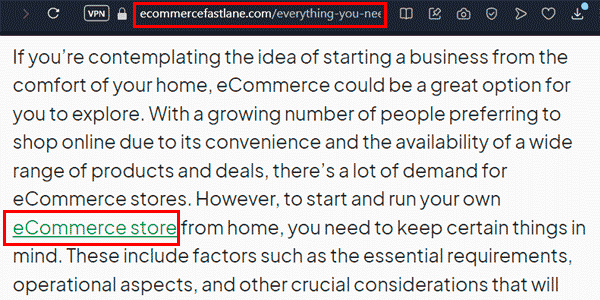
Look at this link:
And its HTML code:
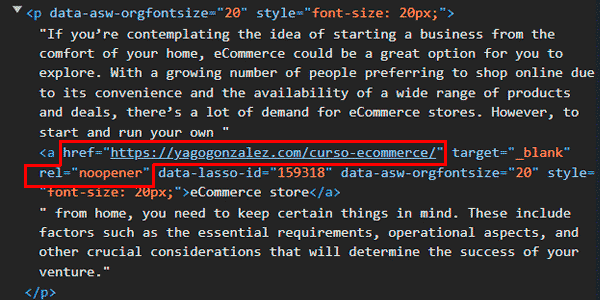
In this case, these would be the relevant parameters:
The linking URL: https://ecommercefastlane.com/everything-you-need-to-start-an-ecommerce-store/.
The linked URL: https://yagogonzalez.com/curso-de-link-building-para-ecommerce-y-webs-comerciales/.
The anchor text: eCommerce store.
The context around the anchor text: However, to start and run your own … and … from home, you need to keep certain things in mind. These include factors such as the essential requirements, operational aspects.
Link attributes: noopener.
I think this example will have made everything clear.
Types of links
Now we move into another section.
As you can imagine, not all links are equal to Google: some are better and some worse. Some are more suitable for our project and some less so. We’ll talk about that later.
First I want you to know how they are usually classified according to two different criteria.
By the type of information given to the search engine
This is where the attributes come into play
- Follow: we tell Google that we are linking to good content. We pass authority to it. It is the standard type and the one Google assumes by default if we do not specify anything.
- Nofollow: here we are saying that we do not want to pass strength to the link in question. It is usually used to link to pages external to our website or for link sculpting with internal ones.
- Noindex: we do not want Google to index the linked page for some reason, either because it is an external page or because it has no value on our website, such as mandatory legal URLs.
- UGC: User Generated Content. We tell the crawler that it is user-generated content in forums, blog comments or reviews.
- Sponsored: we tell it that it is paid content. It is like legitimising the purchase of a link.
I think it is useful for you to know that you can specify several at the same time, for example with rel=”noindex nofollow”, so I tell it that I do not want it to pass strength to the linked URL and that I do not want it indexed either. What would make no sense, of course, would be rel=”follow nofollow”, as you can imagine.
By how it is obtained
In addition to the attribute type, links can be classified by how they are obtained
- Natural or organic links: those we get without doing anything, simply because the manager of a website considers our content useful. They are the strongest, the hardest to get and, if it were up to Google, the only ones that would exist.
- Purchased links: those we buy directly from a media outlet or through link buying and selling platforms.
- Directory links: they can be local directories (Google Maps, Bing Places, Yellow Pages…) or sector-specific ones (El Tenedor, El Abogado, Top Doctors…).
- Guest links: also called guest posting. They consist of publishing content —usually an article— on a company blog. The business gets free content and, in return, you are allowed to include a link to your website. A win-win.
- Links in forums or blogs: those you can leave on Reddit, Forocoches or in the comments of a blog. They are generally nofollow, but they can bring you brand recognition and traffic if you do it well and add value.
- Links on social media: again, most are nofollow, but as branding carries more weight every day, I would not be surprised if Google began to take them into account somehow.
- Reciprocal links: I link to you and you link to me. It should not be done that way, but by triangulating the links, because Google does not like it.
- Links on Wikipedia: there are two routes here. The first is to add your link at the bottom of each page, in the “other links of interest” section, where the link will be nofollow. The other is to create a page about your company, business or yourself, which is difficult to achieve if you are not a recognised Wikipedia editor. Here you can get a follow link.
Link-building strategies
We have just mentioned some ways of getting links, since they are closely related to the classification by how they are obtained.
However, let’s look at some more strategies.
Creating high-quality content
A classic.
Probably the most widely used way to get links.
Valuable and relevant content is a source of natural links.
Yes, research, case studies, tutorials or guides can generate quality backlinks to our blog, but there are other formulas too, such as attractive offers if you have an ecommerce site, since there are a number of bargain and deal websites that will pick them up, providing you with valuable links.
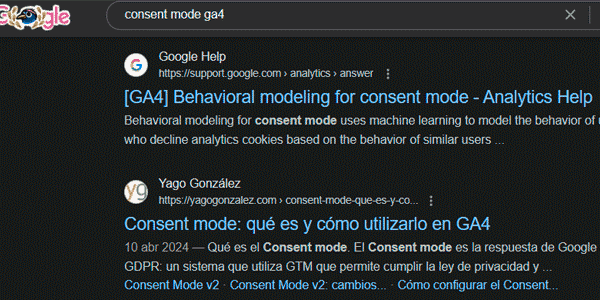
For example, these two tutorials of mine:
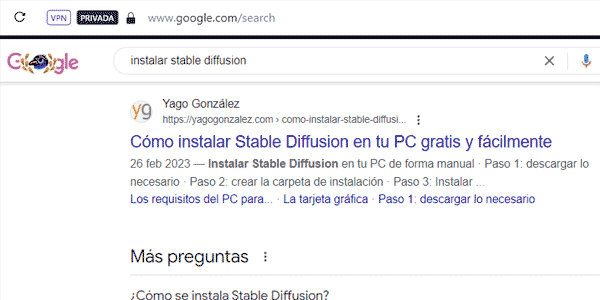
- https://yagogonzalez.com/como-instalar-stable-diffusion-en-tu-pc-gratis-y-facilmente/
- https://yagogonzalez.com/consent-mode-que-es-y-como-utilizarlo-en-ga4/
They rank in the top positions for the relevant keywords.
Look at the first one, in first position:
And the second, in second position:
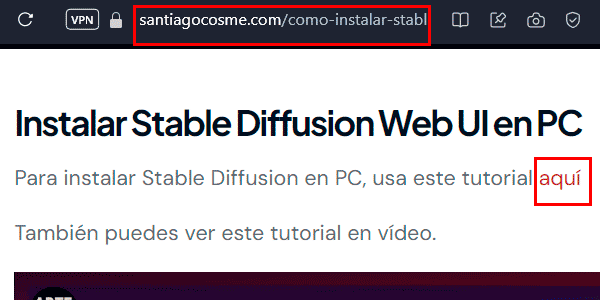
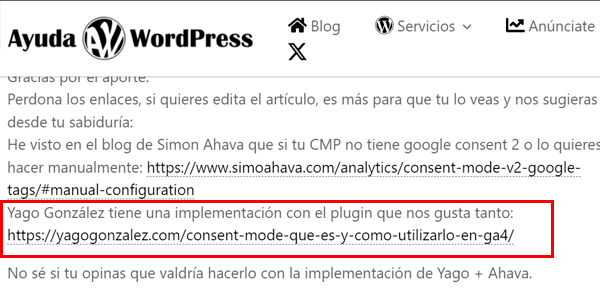
Thanks to being linked from some websites:
Directly in the content:
Or as UGC content:
Infographics and visual content
Related to the previous method, although fairly out of use nowadays, visual content such as infographics tends to be shared quite a lot, both on other blogs and, above all, on social media.
Really, more branding than SEO as such, but brand recognition also helps SEO, so it is not a bad formula if you are good at creating this type of content.
Broken-link recovery
This technique consists of searching for —and finding— broken links on other websites, that is, links pointing to content that once existed but no longer does.
Then you can offer content from your website as an alternative.
Again, a win-win.
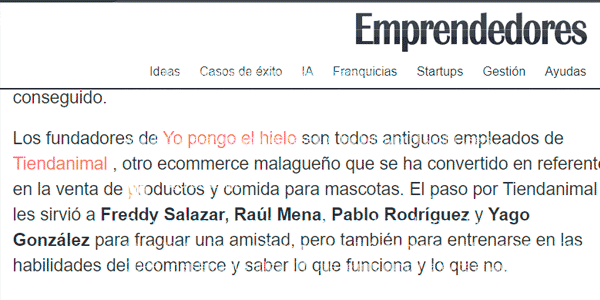
PR and press office
A method I love, because the results it delivers are wonderful… when you manage to get them, which is not easy.
The idea is for you or your business to be “newsworthy”, so that journalists use you as a source of data, as experts, or talk about you.
If you have something innovative on your hands it is easier, but if not, it can still be achieved. That said, as I say, it is not easy, so it is often easier to outsource this service than to do it in-house.
In return, you can obtain links that you could not get in any other way.
For example:
Tools for link building
Let’s start with the typical ones (which are not the ones I use):
Ahrefs
A powerful tool for all kinds of SEO tasks, including analysing your site’s link profile and that of your competitors. Ahrefs helps you find link-building opportunities and monitor your backlinks.
Moz Link Explorer
It has a limited free plan and lets you analyse links to your site and discover new possibilities. It also measures domain authority and page authority.
Majestic SEO
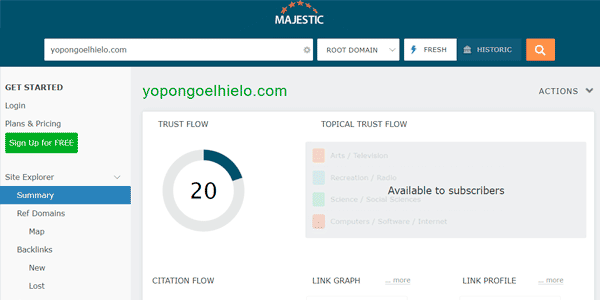
Very well known for its extensive and detailed link index. It also provides its own metrics such as Trust Flow and Citation Flow to assess link quality.
Right, those are some classic tools. But they are not the ones I use, which are these:
SEMrush

It offers us a very, very complete suite of SEO tools that, of course, includes backlink analysis.
In addition, the free plan may be enough in many cases.
Backlink Checker / SEO Spyglass
https://www.link-assistant.com/es/seo-spyglass
I’ve given it two names because it is changing right now and you can find it under either one.
It is part of a very complete SEO suite.
The free plan is powerful, but I take advantage of the occasional 70% discounts to grab the licence because, at the resulting price, I find it very worthwhile.
Google Search Console
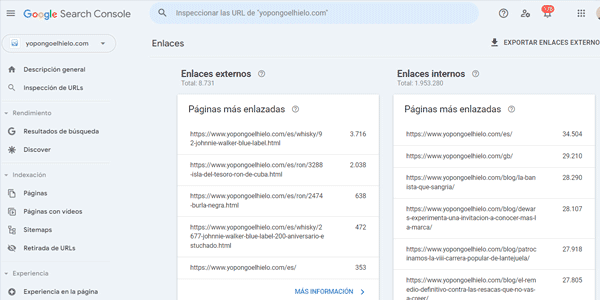
Google’s SEO platform is not the best at almost anything —not for link building either— but hey, it is free and it does provide some information, although it is far behind the others in the number of links detected.
Measurement and analysis
If you carry out a link-building strategy, the logical thing is to measure its performance, so I’m going to explain how.
How to measure the success of link-building campaigns
To assess the success of your campaigns, besides monitoring the quantity and quality of the backlinks obtained, you should look at a couple of other things:
- The evolution of search-engine rankings for the keywords and URLs you are using in your campaigns.
- The impact on your organic traffic.
- The increase in sales. That is the main objective, whatever anyone tells you.
KPIs in link building
They go hand in hand with the above and we can divide them into two groups.
Primary:
- Sales from the organic channel.
- Traffic from the organic channel.
- Rankings for the keywords worked on.
Secondary:
- Domain authority.
- Number of backlinks.
- Referral traffic.
Continuous adjustments and improvements
While you are running an active campaign, especially if you allocate budget to buying links, you should review monthly your link-building strategy.
Analyse which tactics are working and which are not. Know what you could add and which link you would be interested in getting next.
That said, there will come a point when your web project is more than established and you will stop working on link building to devote effort to other areas. But while you are working on it, measure it.
Some more things you should know about link building
A few topics I want to cover in the article before finishing.
Buying links
In theory, buying links to improve rankings is a practice prohibited by Google and, if you are caught, you could be penalised.
And yet all the projects in the top positions do it. Because otherwise it is very difficult to reach the top 3 for business keywords.
Of course, you need to know how to do it and that is why I launched my link-building course for ecommerce and commercial websites, where I explain what you have to do to play it safe.
Link exchanges
Exchanging links with other sites (reciprocal links, as I called them earlier) can be seen by the crawler as ranking manipulation.
In fact, that is how it was in the early days of SEO. The easiest form of link building.
However, just like buying links, you need to know what you are doing (I explain it simply in the course). And if you do not, don’t do it.
Link farms
They are sites created exclusively to generate backlinks. Although people have been trying to stamp them out for years, they still exist.
And putting a URL from your website there is a terrible idea.
Conclusions
Link building is an essential strategy for improving your SEO and increasing traffic to your website.
In fact, it is essential for ranking for the most relevant business keywords.
A well-executed link-building strategy can significantly improve your search-engine rankings, increase your web traffic and sales, and strengthen your domain authority.
For that reason, you should consider it as soon as possible, because SEO is an essential source of cheap traffic for almost any digital project.
To do that, I would tell you to:
- Focus on creating high-quality content.
- Use various strategies to obtain backlinks, including buying links.
- Review the evolution of the KPIs mentioned above.
- Buy my link-building course.
Well, that last one isn’t essential, but you’ll thank me.
And if, rather than buying, what you want is to read more articles like this one, subscribe here and every Thursday you’ll get a new one in your email.

Leave a Reply