
This week has been crazy in the world of AI.
And bitcoin.
I don't know which of the two has surprised / entertained me more.
I'll tell you why soon.
Because today I'm here to talk about something more mundane. And something that will probably have a greater impact on the business: what profitability means and how to improve it.
The truth is that most digital businesses, although they think otherwise, do not really have a visibility or technology problem.
The real problem usually lies further down: poorly measured profitability, unrealistic targets and decisions made without data.
If you don't know which line of business makes money, which one burns it or which campaigns generate a real return, you're operating blind.
This very brief article presents a method for auditing and analysing business profitability, which is the first step before improving it, since this analysis is where ideas for improvement actions will come from.
For this audit, I suggest using the two templates I use with my clients:
- Business profitability self-assessment: an Excel spreadsheet aimed at all types of companies and businesses.
- Profitability questionnaire: a Word document aimed more at digital businesses, although it will also be useful if you have another type of business or company.
What profitability really means in a digital business
Profitability is not about billing more. It is about understanding the margin, operational efficiency and return of each business line .
The most common mistakes here include:
- Confusing increased sales with increased profit.
- Not calculating the actual hours worked.
- Misattributing campaigns, whether in terms of results or costs.
- Obsessing over traffic instead of margin.
- Keeping projects that consume focus and resources without a clear return.
So, the first thing to understand is that there are only two ways to become more profitable:
- Increase revenue.
- Reduce costs.
That's it. Initiatives that are not aligned with either of these points will not improve profitability. They will make it worse.
Company assessment
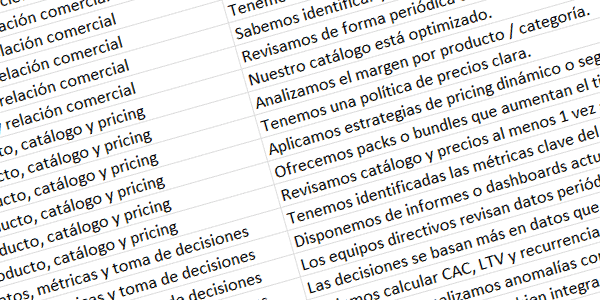
With the two previous objectives in mind, open the self-assessment Excel spreadsheet and rate each aspect of your company, or your client's company, from one to 10.
Don't fool yourself. Be honest with your answers, otherwise this exercise will be pointless.
Once you have completed it, you will see where you are failing most and where you have room for improvement.
And yes, there are many points. And your company probably has room for improvement in quite a few of them.
That is why it is up to you to prioritise each point in the spreadsheet based on the improvements you forecast and how difficult they will be to implement.
I won't lie to you: it isn't easy.
Because no points are more important than others.
Nor is there one route that always works.
Not at all. There is no route here that is better than another: every company and its people are different, so getting this prioritisation right will determine whether profitability increases or not.
That said, to help you prioritise, I offer you the following.
Questionnaire to improve profitability
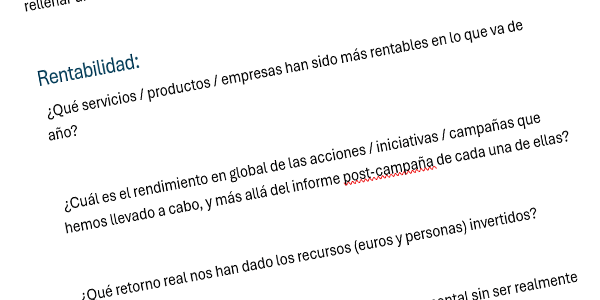
As you will see, the previous document is more general and this questionnaire is perhaps more focused on digital businesses, although you can also benefit from it in physical businesses.
In addition, the first is focused on the initial audit. This one, however, will give you more analysis and possible actions.
The document is structured into three blocks:
- Profitability.
- Achievement of objectives.
- Future actions.
It is a simple framework, but it allows you to identify what to maintain, what to scale and what to eliminate.
#1. Profitability analysis
The aim is to identify where you make money, where you lose it and where you are stuck.
To analyse business lines, channels, projects and people.
With numbers.
And to be clear about what needs watering and what needs cutting.
#2. Achievement of objectives
Revenue is analysed: whether it comes from one-off or recurring clients, deviations from the annual target and realistic scenarios.
We will analyse whether we are currently where we intended to be at the beginning of the year and, if not, whether it is worth activating tactical actions.
#3. Future actions to improve profitability
Review which channels bring in the best clients.
Which campaigns can be reused, given their strong performance.
What lessons to apply and what real resources you have for the promotional season. Profitability can break down when you try to execute more than you can sustain.
Profitable business vs busy business
After all the thought you will have put into your business to complete the templates, you will already have gained a great deal.
Ideally, you will go from being a busy business to a (more) profitable one.
What does that mean? Well, here it is:
Busy business:
- Lots of open fronts.
- Little clarity in every area.
- Inconsistent returns.
Profitable business:
- Few channels, but highly optimised.
- Data-driven decisions.
- (Relatively) predictable returns.
You can see the difference, right?
Exactly.
Conclusion and closing thoughts
Anyway, in fewer than a thousand words, I hope I have explained a method for improving the profitability of your project.
Yes, the assessment and questionnaire probably contain uncomfortable questions whose answers you have put off for a long time for that very reason.
But the thing is profitability usually goes hand in hand with discomfort.
Always, not just at the start of the business.
Get that firmly into your head.
To wrap up, below the FAQs you have the subscription form so you don't miss the next articles. And my YouTube channel.
Because I think being on both is good for you, even if they are uncomfortable.
Frequently asked questions
How can I tell whether my digital business is truly profitable?
Analyse three elements: margin by business line, the real cost of the team's time and the return from each channel. If you cannot calculate all three, you do not know whether you are profitable.
What is the most common mistake when measuring profitability in digital business?
Confusing revenue with profit. Many people think they are “selling more”, but their costs (time, Ads, team, tools) grow faster.
How often should I review the profitability of the business?
At least quarterly. Monthly if you depend on Ads or highly volatile channels.
How do I know whether a channel is profitable?
Quick answer: LTV > CAC + operating cost.
Lots of services or just a few?
A few profitable ones.
How do I prioritise what to improve if everything seems important?
Use this criterion: estimated impact on margin / difficulty of implementation. If you do not, you will act on intuition rather than data.
Do the questionnaire and Excel spreadsheet work for non-digital businesses?
Yes. The Excel spreadsheet is cross-functional and the questionnaire is geared towards digital business, but it works for any company that wants to analyse margin, objectives and future actions.
How do I avoid becoming a “busy business”?
By reducing open fronts, eliminating projects without a clear return and focusing on a few well-optimised channels.
What should I do if the audit brings uncomfortable things to light?
Accept them. Profitability is uncomfortable by definition because it forces you to cut back, prioritise and say no to things that are “exciting” but do not make money.

Leave a Reply