
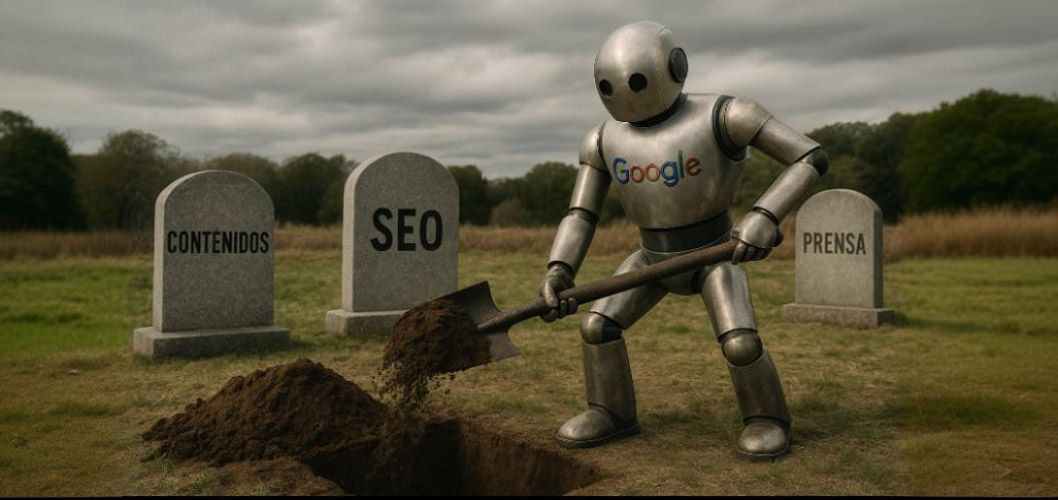
This had been brewing ever since ChatGPT suddenly appeared in our lives, and from that moment AI invaded everything.
But I think what Google unveiled at this year’s I/O—its annual developer conference—will be remembered as a milestone, given the impact it could have.
And what the big G has shown has set off absolutely every alarm bell for the owners and managers of many digital businesses, or businesses that at least have a digital side.
No wonder, because although we will have to see the final reach, it looks as though the change could be similar to what we experienced when we moved away from browsing news portals (if you are old enough, you will remember Terra or Lycos) and how the newly born Google wiped the floor with them through its concept of indexing thousands of domains and letting us navigate among them through searches.
Back then, the paradigm shift was from a single source that told you everything—the news portal—to a search engine that sent you to the most suitable source.
Now the model could be reversed: it looks as though we are returning to the original model of a single source of information for everything.
Except that in this case the source is Google itself.
Which, as you can see, always wins. No matter whom it steamrolls along the way.
Keep this idea in mind: it is more than possible that before too long, we will barely visit websites, because the “search engine” itself will give us everything we need.
Does that sound exaggerated?
Let’s talk again in 12 months.
In the meantime, let me tell you that this first article in a two-part series is precisely about that.
About why we are inexorably heading towards that model unless someone stops it.
Here I am going to focus on explaining what appears to mean for the digital marketing of businesses.
I will complete my view of this huge change with the second article. In it, I will outline what it could mean for digital business consulting services, because they are going to be forced to change.
This affects me professionally. Quite a lot, obviously. So I had better get my head around it as soon as possible.
So, if you have a website and organic traffic matters to you, this concerns you.
If you also make a living from advertising, even more so. The cookie problem will look like a joke.
And if you are an SEO or digital consultant, I do not think I need to tell you anything.
But do we really need to be this alarmist?
Take a look at this and then tell me.
AI in Google Search
Until very recently, Google’s use of AI in its search engine had been limited to what it calls AI Overviews or “AI-generated overviews”.
They were little more than a kind of AI-generated position-zero snippet that answered the user’s query:
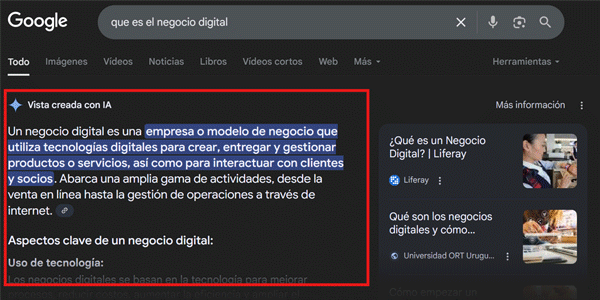
Up to this point, it might have seemed like just another blow to media outlets and content creators, with yet another new search-engine-owned block —like text ads, maps or questions—that forced users to scroll even farther down the results page if they wanted to see the first organic result.
Nothing new, although it has had a sizeable impact, as we will see.
However, what Google presented at I/O is not this. Not at all. It is a new way of using the search engine: by having a conversation with it.
With AI-generated answers, of course:
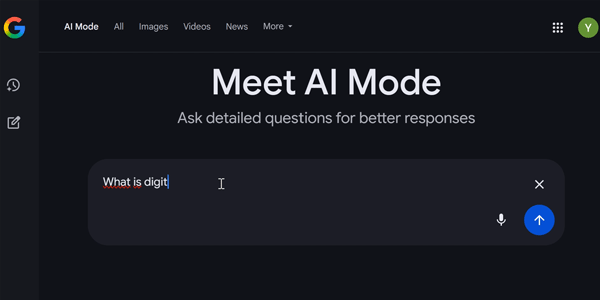
For now, the formula is similar to ChatGPT’s, except that on the right you can see the results—the URLs—Google used to generate its answer.
Un inciso: si quieres utilizar el AI Mode desde España en el artículo enlazado te explico cómo hacerlo, con vídeo de 3 minutos para que puedas empezar a usarla ya hoy desde España. Y si no quieres probar la herramienta, sino sólo ver cómo funciona, al final del vídeo tienes la prueba.Let’s continue with the article.
The thing is, given Google’s penetration into our lives—Android, Chrome, YouTube and Google itself—it is quite possible that adoption of Google’s AI Mode will be even greater than ChatGPT’s, which, as of today, is the fifth most visited website in the world.
That is the scale we are talking about.
And what all content creators fear—we fear—is that it will become the preferred search option for most queries, causing the traffic that reaches our websites from the search engine to fall drastically.
Drastically as in a “95% loss of traffic”. That dramatic.
And naturally, the digital ecosystem has started to shake. Example:
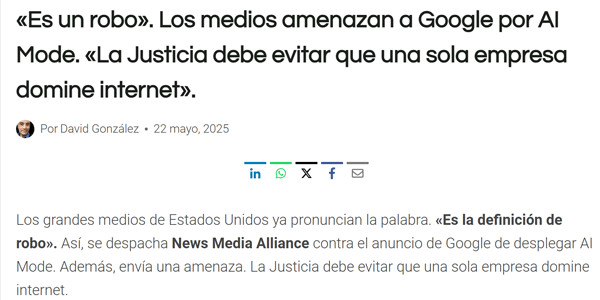
For more examples, here is the case of the online magazine DMARGE, Australia’s longest-established men’s lifestyle publication, whose owner published his case on Medium.
He provided hard figures that are enough to make anyone tremble. And the worst part is that his case is representative of everything that is still to come.
Lastly, here is what I consider the exemplary JotDown editorial, from one of Spain’s best online publications, whose founder I met at an event some time ago.
Read it, because I think it is well worth your time:
What to do when nobody searches for us.
We will see how that approach works out for them. For now, I am close to subscribing, even though many of the subjects they cover do not resonate with me, despite their undeniable journalistic quality.
But why are these people saying what they are saying? Is it baseless whining, or do they have real reasons to react like this?
Results in numbers: the impact Google’s AI has already had—and what may come next
Yes, there are two things to examine here:
- What AI Overviews have already done. Since it has been active for several weeks, we already have real data to analyse.
- What we assume / estimate / imagine AI Mode will mean, based on previous experience.
The small change: the effects of AI Overviews on search traffic
Starting with what we know for certain, what has been demonstrated so far is explained very well, among others, in this Semrush study:
- Searches returning this type of result are increasing: 6.49% in January 2025 versus 13.14% in May of the same year.
- It affects not only informational searches, but also navigational searches, although to a much smaller extent—1.43%, but rising.
- Science, health, society and law are the fields where these results are growing fastest. This means users rely on them in areas requiring a degree of trust and where information is abundant: are they the new experts/consultants? Pay attention here, because it matters. I will return to it in the next article, which focuses more closely on how AI affects consulting services.
- Increase in zero-click searches: yes, queries that generate these AI snippets have a higher zero-click rate—that is, users do not click any result. Although the study explains that even BEFORE AI Overviews appeared, the click rate for these same searches was already trending downwards.
As the article explains, this data makes it clear that Google is no longer just a search engine , but also a search + answering engine, in other words, both a search and an answer engine.
Remember what I said above about returning to a single source of information?
Exactly.
And of course, depending on the sector and project, the impact on traffic can look like this:
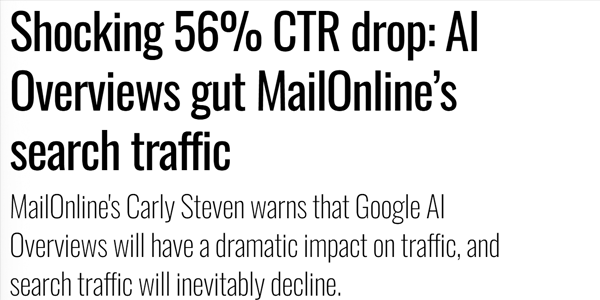
That is while retaining position 1 in the rankings. You can find all the details in this Search Engine Land article.
A fall of 56% in organic traffic depending on the keyword can be brutal, but I think Google has taken this possible impact into account.
I say that because, for now, AI Overviews focus on long-tail informational keywords, in other words, keywords with relatively low search volumes.
For now—and I stress for now— high-volume transactional keywords do not trigger them.
But of course, this is only the beginning. Google knows that and has only put the tip in.
Because targeting transactional keywords would have caused a cataclysm in the sector unlike anything seen before. Google cannot afford that, because every institution would turn on it: governments, media outlets, competitors, judges…
So I think it will proceed steadily, without rushing but without stopping. Watching how we react to the changes while testing new advertising formulas.
I have no doubt whatsoever.
By the way, if you are wondering whether this AIO snippet is replacing the old ones—image carousels, videos, questions and so on—the answer is no: what it does is appear above them. This pushes the organic results even farther down the page.
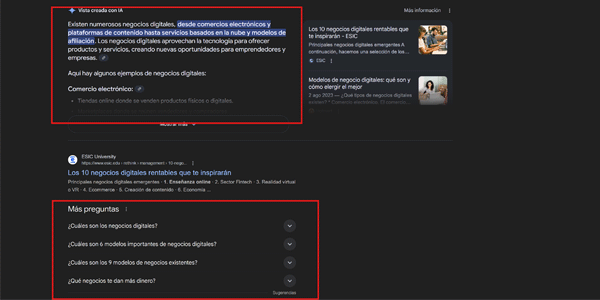
Well, this is the small change.
What comes next is the change that truly has the potential to transform the entire online sector.
The big one: expected, estimated and perhaps imagined effects of AI Mode
Although AI Overviews may seem like “just” another nail in the coffin of informational content, what will probably finish the job is this: the emergence of Google’s conversational mode .
Here the search engine transforms: no more answers with ten blue links and rich snippets.
No.
Now it is a conversation —written or spoken—with Google. Like the ones you have with ChatGPT.
And what happens then? Is it not the same as what already happens with OpenAI’s tool, which coexists with Google, with everyone using whichever one they prefer?
No, it is not the same.
Because for now ChatGPT is light-years behind Google in visibility. According to Digital Trends data, from April 2024 to March 2025:
- Google received 1.63 trillion visits, an average of 136 billion per month.
- ChatGPT received 47.7 billion visits, around 4 billion per month.
It is not that Google is used twice or three times as much as ChatGPT; it is used 35 times as much. There is no comparison. Not yet, even though, as I mentioned earlier, it is currently the fifth most visited website in the world.
As you can see, there is a whole world between first and fifth.
That is why Google adding this mode matters so much: it will make conversational interaction with machines far more mainstream. As we said before, Google will no longer be merely a search engine, it will also be an answer engine. And a conversational partner.
And yes, AI mode will probably begin in a separate area of the search engine, as Google Shopping does, but I can easily imagine it becoming the default option for certain queries before long.
Whether because people choose it or because Google imposes it.
So if first place loses 57% of its traffic with AI Overviews alone, with AI Mode as the default it will lose 99%. Or 99.9%.
Obviously.
That harsh.
So what can we do about what appears to be coming?
What to do with your business marketing as Google’s AI arrives
As always in the online sector, there are many things we can do.
What some people see as threats, others see as opportunities.
One thing must be clear: things are going to change. But by how much? And when?
It is still too early to know.
But the things we can start doing fall into three areas:
- Analysis.
- Tactics.
- Strategy.
#1. Analysis
Before knowing what we can or should do in the short and medium term—talking about the long term in digital marketing or business is a euphemism—we need data.
Information that allows us to make decisions.
And what data can we obtain right now?
Estimating the real, current reach for each project
The first thing is that the impact of Google’s AI is already showing up in SEO. And, as we have seen, for now it affects informational searches.
As for sectors, we noted above that right now science, health, society and law are the areas most affected by AI Overviews, so the current reach varies from one project to another.
That said, what should we examine?
Organic traffic
The most direct metric.
Try to answer these three questions for your project:
- Is organic traffic falling?
- By how much?
- Do you know which of these three factors is responsible?
- A lower CTR.
- A drop in rankings.
- A fall in search demand.
If it is clearly due to the first, we are seeing the effect of AI Overviews.
If it is the second, positions have changed because of traditional SEO. So it is time to review what can be improved.
If we are talking about the third, it may be due to seasonality —compare with previous years—or to a change in search trends . In either case, there is little you can do beyond the usual: try to gain positions and obtain more traffic.
So once we have answers to these three questions, we will know how to quantify the effect Google’s new feature is having on traffic in our particular case.
But although traffic is where you will notice the most immediate effect, it is not what should concern you most…
Organic conversions
This is what should really concern you.
What has this loss of sessions meant for your business?
Although the supposed loss of brand awareness is difficult to estimate, what is easier to measure is the loss of conversions from the organic channel.
And to do that, you need to consider several points:
- First, you need to know whether we have lost conversions from this channel. If we have not—compared with previous years’ trends, for example—we can be reasonably confident that, for now, the business has been affected very little. If we see no decline, we need to remain alert. If, on the other hand, we have seen one, we need to investigate further…
- Next, analyse which parts of the website are losing traffic. This is usually concentrated somewhere specific—certain URLs, the blog section or the FAQs. In Google Search Console you can see how clicks fall for the affected section of the site despite the same number of impressions:
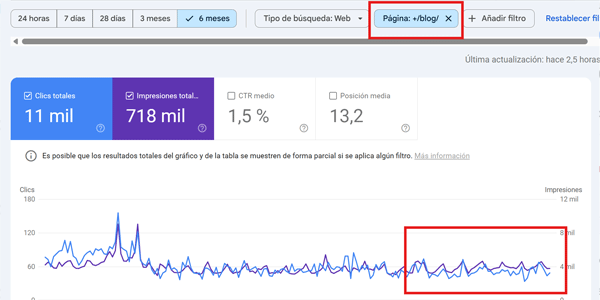
- Once we have located it, we analyse whether the relationship between falling traffic and conversions is direct or indirect:
- Direct: this happens when the decline affects transactional landing pages or pages that generate an immediate conversion. Less traffic means fewer conversions. Simple as that. We can see this in Google Analytics, in any report showing the organic channel’s landing pages and the conversions they generate.
- Indirect: this occurs in longer conversion processes. Perhaps we use the blog to capture an email address and then send emails leading to the ecommerce site. Or perhaps we publish information useful to the purchase—product comparisons—that is not on the pages where conversion ultimately occurs. Measuring the effect of falling traffic here is less immediate; you need to create segments in custom reports—or have audiences set up in advance— that show traffic which lands—not merely “passes through”, but “lands”—on these landing pages at some point in GA4. Farther down I explain how to create these audiences or segments.
- The last point is to decide whether our analysis of declining organic conversions should include traffic to the homepage. This is because, in most cases, it is branded traffic from users who already know us. So depending on how we believe brand awareness is generated, we will or will not include conversions from the homepage when measuring AI’s effect.
- If brand awareness is generated through organic traffic —the previous point will give us a clue—we can include homepage conversions.
- If the brand is generated through other channels —SEM, social media, television and so on—or if we consider that most of it comes from users who already know us, it is better to exclude these conversions from the analysis.
We put all these variables in the blender and, with the resulting juice, we can determine the extent to which the appearance of AI Overviews is already affecting our business.
In hard cash.
Estimating the future reach
Although analysing the current effect of Google’s AI on our businesses can give us more or less realistic data, speculating about what may happen involves a large amount of guesswork. And plenty of divergence from reality once it arrives.
But we need to do it, and soon, before it catches us off guard. That way we can outline different scenarios and consider the alternatives for each one.
Realistically, AI Overviews will probably move very soon from low-competition informational searches to transactional ones.
And from there they may reach SEM. We will have to see how that affects it—will it become more expensive because organic performs worse??).
To me, at least, that looks like a clear roadmap .
So the question you need to try to answer here is:
If I continue doing everything as I do now, where will I be in one year? And in two?
And act according to what you believe.
But while that future moment approaches, there are things we can start doing…
#2. Tactics
For now, we can adjust two things without overthinking it: analytics and SEO.
Analytics
I said earlier that we need to measure the impact, and I explained how.
But looking ahead, there are a couple of areas we can improve.
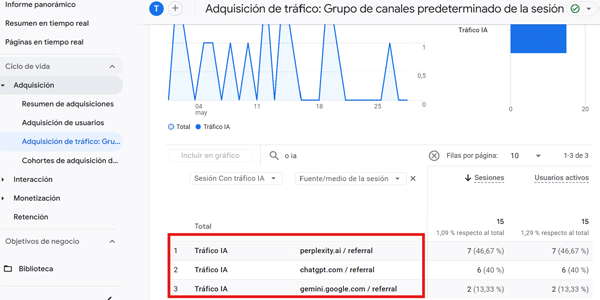
AI channel grouping in GA4
Here I explain how to create a channel group for AI traffic in Google Analytics.
Once it is done, we can quickly see how the traffic reaching us from AI tools evolves:
Audiences or URL-based segments in GA4
This helps you measure the indirect decline in organic-channel conversions that I discussed earlier.
The idea is to have one or more audiences in GA4 containing users who, at some point in their journey, landed organically on pages that we believe or know contribute to conversion.
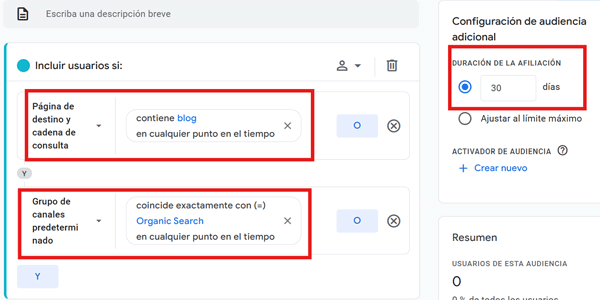
One example would be the blog. If we think users land on an article before converting, we would create an audience from the GA4 administration area like this:
- Rule 1: dimension “Landing page”, with the match type and content appropriate to your case. Here it is “contains 'blog'”.
- Rule 2: dimension “Session default channel group”, with the match set to “exactly matches 'Organic Search'”.
- Membership duration: 30 days. This will vary depending on whether your users’ journey is longer or shorter.
This audience is simple, but it could become more complex if you want to measure specific URLs. The easiest approach is to add “or” conditions:
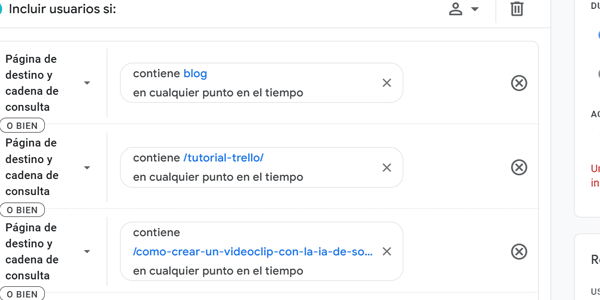
You could also use regular expressions to keep it cleaner.
From the moment you create the audience, you will be able to track both the traffic and conversions of this audience in the standard reports. Segments let you examine it at any time, but only in custom reports.
In both cases, you will check whether this group of users has converted less effectively since AI Overviews appeared.
But let us not blame AI Overviews for everything. If this group is converting less, the decline may be caused by AI Overviews—or by a drop in rankings.
To rule out the second possibility, we need to go one step further.
Google Search Console
I mention this tool because it is free, but any other would work—for example, Rank Tracker.
The aim here is to track the URLs from the previous audience and see how they evolve. We can filter by the relevant URL or URLs and observe the effect. Here is the previous image again:
In this example I am filtering all the blog URLs, and what I have marked in red is the “split”. In other words, the clicks-to-impressions ratio starts to reverse, which is a clear sign of AI Overviews.
Once you reach this point, if the group of users who pass through the blog is generating fewer conversions, you can now state that AI Overviews are affecting your business.
Then—and only then. In other words, after carrying out every step in this analysis.
So, as you can see, these three actions would cover almost all the monitoring of Google’s AI and its effects.
Translations in AI Overviews
Because there is one more point, and it is a good one.
When Google detects that a user’s query can be answered with AI but cannot find sources in the user’s original language, it uses content from websites in other languages and publishes it FROM ITS OWN DOMAIN.
In other words, it does not send traffic to your website and translate the page as it would when someone uses Google Translate.
No.
It takes your content.
Translates it.
And presents it as its own inside the corresponding AI Overview.
How about that!
So, if you want to recover this traffic that should be yours—and I stress “if you want”, because it is not essential—there are solutions.
With this script by Natzir Turrado we can redirect traffic from AI-translated content to our website and recover it.
Here you can see how it actually works in the original post.
Tell me this is not getting interesting…
But let us leave analytics aside and move to the second tactical factor: SEO.
SEO
If we want to become a reference source for AI because we believe it will pay off more than abandoning SEO, we will have to adapt to the new rules and optimise accordingly.
SEO for visibility in AI Overviews
It has been shown that, as of today, several things can be done to appear in AI Overviews:
At the content level:
- Create high-quality content that answers specific user questions.
- Content that generates engagement: images, charts, infographics…
- At present, AI answers the “what”. It does not answer the “how” and “why” as well, so that is where we should aim.
- Target long-tail keywords with a clear informational intent.
- Add original content that nobody else can provide.
- Focus on becoming the reference and building authority on the topic you want to rank for.
At the website architecture level:
- A clear overall website structure.
- Within each URL: a correct heading structure. Semantic markup everywhere.
- Marcado semántico a tope.
- Loading-speed optimisation.
At the level of other digital products besides the website:
- If local SEO matters to you, and knowing that your Foursquare listing—seriously—is relevant to ChatGPT, Google Maps probably matters to Google’s AI. Although this has not yet been demonstrated, I think it is a matter of days. So you know what to do: optimise your profile.
New SEO metrics
As a consequence of the above, we will need to measure:
- Traffic from AI.
- Its conversions.
- The queries for which we are cited.
This will give us the key to all of this, because we will be able to:
- See how this affects sales under the new distribution of traffic generated by our content: what we lose from organic versus what we gain from AI.
- Estimate the cost of producing that content much more accurately.
And by combining both pieces of data, we can obtain what we want: estimate the new profitability of creating content for AI SEO.
Once you have calculated it, what do we do?
#3. Strategy
First of all, let me tell you that if your website lives off advertising generated by traffic, you will be terrified. You have already seen what the owners of major media outlets think… And it is normal to feel concern fear.
You face a difficult dilemma over what to do:
- Keep feeding the beast with your content.
- Stop doing so and find new sources of traffic… and/or monetisation.
- Pray.
Your situation is not easy. Not at all.
And neither I nor anyone else has answers for you.
But if that is not your case and your website sells products or services, for now the situation is not so serious.
At this point, you need to do three things to develop your short-term strategy:
- Analyse.
- Think.
- Act.
What you have been doing all your life.
Step 1: analyse
We ended the tactical section by saying that you already had the data needed to estimate the new profitability of creating content.
But of course, that profitability focused exclusively on conversions from the organic traffic the content generates.
However, creating content has more value, because if it is good and written for humans rather than only for Google’s bot, it will probably generate things such as reputation and authority. Over the medium term, both bring in customers.
Because you will usually publish this content:
- On social media.
- Turn it into a YouTube video.
- Or a podcast.
- Send it to your mailing list.
- Or use it as the basis for a lesson in a course.
In this way, you capitalise on the creation of content such as tutorials, guides, analyses, reviews and informational articles much more effectively.
Step 2: think
You know what worked until now. But one important thing at this point is to consider a scenario that may be new…
Can my content be monetised directly?
In other words:
“Would people be willing to pay for the content I have been producing until now?”
Bear in mind that we are talking about users as well as brands and sponsorships.
And if the honest, carefully considered answer is yes, we move to the next point:
“In what format?”
Subscription, membership, paid newsletter, paid podcast…
“How often do I create content?”
A key question for measuring the effort required.
And the final, very important question:
“What price should I charge?”
Low because I have a large potential audience?
High so it can be profitable with only a few sign-ups?
In short, several questions that will make you think and reconsider. That is why this stage of the strategy has this name.
Speculating about where things may be heading
Next, spend some time now—and every week— keeping up with new developments. For example:
- Gathering information about the kind of SEO we need to do: structured data? More focused content blocks? Customer reviews?
- Studying what kinds of content work for appearing in AI tools.
- Thinking about the real reach, both in my business and globally:
- Will everyone stop creating content?
- ¿Eso no sería una oportunidad para los que continúen haciéndolo?
- Is continuing as before an ostrich strategy?
Yes, as the heading says, these are speculations, not facts.
But we are paid to think about them.
Constantly reassessing whether feeding the beast is worth it
We need to keep repeating the same exercise we are doing now:
- Reasons in favour of creating “AI-friendly”:
- ” content: getting AI to mention us.
- Ser referentes.
- Sales?
- Reasons against:
- Negative or unmeasurable financial returns.
- Necesidad de formación y recursos.
- The possibility of opening other marketing or monetisation channels that are more profitable for my business.
Rethinking how we create content
Finally, the last thing you need to consider is whether the way you currently create content is right for the scenario ahead.
Now let us look at it in more depth.
Step 3: act
We have analysed the terrain and the new rules of the game.
We have considered whether to enter the game and what the alternatives might be.
Now comes the final step: execution.
A new way to create content
I think it is perfectly clear that everyone who relies on the organic channel, large and small, will have to change how we create content:
- To make it more profitable.
- By creating more synergies between channels.
- By considering, for example, translating the website into other languages. Thanks to the simultaneous translation for video calls that Google has presented, language will no longer be an insurmountable barrier to entering other markets.
- We need to think about how we can optimise it with AI.
- Focus it on several channels, not just the blog.
New traffic channels
To offset what we are going to lose because of this paradigm shift.
Here are the ones I have thought of for my business:
YouTube
For now, AI does not digest video as well as text—audio sits somewhere in between.
So YouTube and its long-form videos—not necessarily 15 or 30 seconds—seem to me the easiest transition from a blog. Here, “easy” refers to creating the same kind of informational content rather than something “entertaining”.
Social media
This involves more of a transition: the conventions and type of content change. But making the leap is feasible.
Prioritising owned media even more
Look, I create good content that users can access through my own channels, such as:
- The email list.
- Communities—my own Telegram or Discord channels, and even social media.
- Paid subscriptions and memberships, as I mentioned earlier.
Paid channels
Google obviously is not going to kill the goose that lays the golden eggs. So Google Ads will continue to work very well.
And if you had not considered it before, perhaps under the new rules—and after doing the maths—it will make more sense to start using paid channels than to keep producing AI-friendly content as before.
New ways to monetise content
Finally, if after considering the previous point we are clear that our content can be monetised, here are several possible routes:
- Micro-subscriptions : like the ones media outlets offer when we refuse cookies. Now applied to every user, because in this new environment cookies may cease to matter—the advertising model’s inevitable decline.
- Courses: they require a layer of strategy beyond content creation, but the underlying process does not change that much. Instead of creating weekly articles from an editorial calendar, we create them from the structure of a course, for example.
- Books: very similar to the previous option, except a book is usually more informative and less practical than a course. It is also normally much cheaper.
- Multiple languages: the technology for communicating with other markets at every level is already here.
- Subscriptions and memberships: similar to courses, except they are not a specific, closed product. If we believe the content we have been creating until now is highly monetisable, moving to this system should not be very difficult provided we have a solid user base.
This was the last aspect you need to assess, and it will help you design your business’s content strategy for the coming months. Meanwhile, you will continue gathering data and information that clarify the emerging context.
As you can see, it looks as though we are going to have some fun soon…
Conclusions
Clearly, this has turned into a dense article. But the subject deserved it.
This is a major turning point in the digital ecosystem. Many things are going to change from now on.
To summarise them, I will focus on three areas.
#1. The advertising model of news media will be forced to change.
And we will certainly see some of these four paths:
- It may begin to resemble the traditional model more closely: if you want current information, you will have to pay for it.
- We are also likely to see agreements between the major AI companies—Google and OpenAI—and large media outlets, allowing bots to take the information they produce. Small media outlets, however, are in serious trouble.
- The alternative would be a (larger) subsidy for the press from public authorities.
- The final and saddest option: the disappearance of media outlets.
What a mess they have ahead of them.
Anyway.
On the other hand, I think social media and YouTube will get a boost, driven by people or businesses that are unhappy with the new results produced by the current way of creating content.
If your traffic falls by 56% on key pages despite ranking number one on Google… are you really going to work to reach that position? Would it be profitable?
#3. The search engine’s ten-link model has an expiry date
Sooner rather than later, transactional results will be displaced by AI, just as informational ones are being displaced now.
And with them, the way SEO is done.
Again.
After giving you my point of view, I do not know what you think about all this.
Do you agree? Is there anything I have missed?
I would be delighted to read your thoughts in the comments.
And to finish, I invite you to read part two of this series: how this Google change will affect digital marketing and business consultants and agencies.
They too will have to adapt or die.

Leave a Reply