
Snyder originally conceived Endgame as the finale of his run. And that explains a lot.
Its epic scale, the ambition of the archenemy's threat and a sufficiently definitive conclusion would have worked wonderfully as a farewell.
But it wasn't.
Snyder and Capullo continued the series, and what could have been a magnificent finale ended up becoming just another story arc along the way..
And that lowers my rating and makes the overall impression worse. Here's why.
The Joker returns with an enormous threat
After Death of the Family, the Joker returns with even more destructive intentions. His confrontation with Batman reaches an even greater scale. Right from the opening pages, when he manages to turn several Justice League members against Batman.
It's a spectacular opening. Snyder knows how to grab our attention and sets up a threat that—as always—seems impossible to overcome. He also brings back that unhealthy relationship between Batman and the Joker particularly well, one of the most interesting aspects of his run.
But we also begin to run into the writer's usual problems.
First, every major arc is an Everest. In The Court of Owls, in the Joker's aforementioned previous appearance and, of course, in Zero Year, Bruce Wayne faces ultimate threats. And now comes Endgame, determined to raise the bar yet again.
The problem is that if every story is extraordinary, none of them ends up feeling quite so special. Batman needs to face major threats, of course, but there should also be room for smaller conflicts.
In fact, some of the short stories in Graveyard Shift showed that Gotham doesn't always need to be on the brink of disaster.
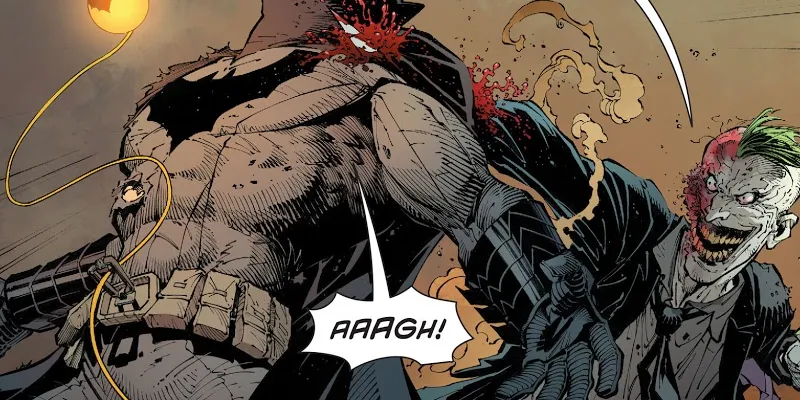
An overpowered Joker
Can the Joker really poison heroes like Superman and Wonder Woman so easily? I understand we're reading a superhero comic and that the villain has prepared an especially dangerous toxin, but I find it hard to believe he can neutralize characters so much more powerful than himself..
It's an effective way to announce that we're facing a formidable threat. The trouble is that the sheer scale of that threat starts to feel unconvincing.
And there's something else that doesn't quite add up for me: his physical abilities..
Historically, his greatest danger has come from his intelligence, cruelty, unpredictability and ability to manipulate others. He's never needed to compete physically with Batman to become his most fearsome enemy.
Here, however, we get a Joker with extraordinary stamina and speed, capable of taking on the protagonist in situations that would normally be beyond him.
The comic introduces elements meant to explain these abilities, particularly those connected to a mysterious regenerative substance. But just because the script comes up with an explanation doesn't mean it's convincing..
And I think Snyder makes a bit of a mistake by exaggerating his powers so much. The Joker was already dangerous enough without turning him into something almost superhuman.
A threat bigger than the story behind it
None of this means that Endgame is a bad comic. Far from it.
Snyder continues to show how well he knows Batman and his supporting cast. Bruce's relationship with the Joker is handled well and evolves, the story has strong moments, and it's hard to stop reading because something is always happening.
The problem is that the threat seems bigger than the story that's supposed to develop it. Extreme situations, revelations and spectacular confrontations pile up, but eventually it's hard to feel the seriousness of everything that's happening.
Here again, we get the feeling we're constantly witnessing Batman's ultimate challenge. Just like in every previous arc.
And what's more, the confrontation with the Joker comes relatively soon after Death of the Family, another arc that had already explored the relationship between the two.
With more distance between the two stories, the villain's return would probably have had a greater impact.
And it's worth remembering that the original idea was for this to be the final adventure of the run—hence the title. The epic ending, Batman's journey as a hero and this last battle all fitted that idea beautifully.
In fact, that's the feeling the comic's ending leaves you with. It would have been a very good, almost outstanding conclusion to a great run on the character.
But it wasn't. And that affects the impression it leaves.
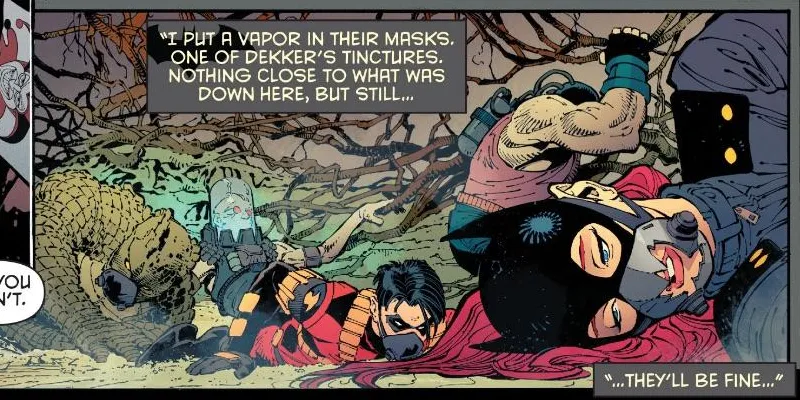
Greg Capullo continues to deliver outstanding work
Visually, I have few complaints.
Greg Capullo once again shows that he understands exactly the kind of Batman Snyder wants to portray. His action scenes work brilliantly, the characters convey emotion and strength, and the compositions match the script's oversized ambition.
He also portrays the Joker extremely well, alternating his grotesque appearance with genuinely terrifying moments.
That said, he hasn't reached the heights of Zero Year, where the artwork and coloring achieved extraordinary things. He's still operating at a very high level here, but that was something else entirely.
The best of Batman: Endgame
- The relationship between Batman and the Joker, which Snyder continues to develop very effectively.
- The ambition of the confrontation, especially if we see it as a story originally intended to conclude a run. Because…
- It would have been a great ending to the run.
The worst of Batman: Endgame
- But it isn't. And because it's such an epic intermediate arc, it ends up reducing the impact of every new story arc.
- The Joker's abilities, especially how easily he neutralizes the Justice League and physically competes with Batman.
Conclusion: a great ending that comes too soon
Batman: Endgame is, once again, a good Batman comic, like the rest of Snyder and Capullo's run, with well-developed characters, an engaging threat and impressive artwork.
But it also doubles down on this run's excesses. The Joker seems too powerful, some situations are hard to believe, and the epic scale starts to lose its impact because we've spent too many volumes at maximum intensity.
Knowing that Snyder originally conceived it as his farewell, I understand the approach much better. As an intermediate arc, though, I feel Snyder is once again bringing out all the big guns when he still has stories left to tell.
And not every Batman adventure has to be the end of the world to be worth reading.
Batman – Endgame: technical details
| Detail | Information |
| Original title | Batman: Endgame |
| Edition reviewed (United States) | Batman Vol. 7: Endgame |
| Original publisher | DC Comics |
| Writer | Scott Snyder |
| Artist | Greg Capullo |
| Inker | Danny Miki |
| Colorist | FCO Plascencia |
| Collected edition published | 2015 |
| Collects | Batman #35–40 |
| Pages | 192, US hardcover edition |
| Genre | Superheroes, action and thriller |
Rating
Who it is for
✔️ For readers following Scott Snyder and Greg Capullo's run.✔️ For Joker fans who enjoy his most extreme clashes with Batman.
Who it is not for
❌ For readers who prefer Batman detective stories with more restrained threats.❌ For anyone tired of the constant escalation of danger during this run.
Frequently asked questions
What is Batman: Endgame?
It's the seventh volume of Scott Snyder and Greg Capullo's Batman run, originally published as Batman Vol. 7: Endgame. It features another confrontation between Batman and the Joker.
Which issues are included in Batman: Endgame?
The US hardcover collection contains Batman #35–40 and runs to 192 pages.
Do you need to read Death of the Family before Endgame?
It's recommended. Both arcs explore the relationship between Batman and the Joker, so knowing about their earlier clash helps you better understand the new story.
Why can the Joker take on the Justice League?
The Joker uses a specially prepared toxin to alter the behavior of several heroes. It's one of the story's most spectacular devices, but also one of its least convincing.
Does the Joker have powers in Batman: Endgame?
The comic gives the Joker unusual physical abilities and develops an explanation involving a regenerative substance.
Was Endgame supposed to be the end of Scott Snyder's run?
Yes. Snyder explained that he initially conceived Endgame as his final Batman story, although he later decided to continue the series with Greg Capullo.
What story comes after Batman: Endgame?
The next major arc is Superheavy, known in Spanish as Superpesado, which introduces a major change to Batman's identity.
Is Batman: Endgame worth reading?
Yes. It's a good comic, with well-developed characters and impressive artwork, although it exaggerates both the Joker's abilities and the magnitude of the threat.

Leave a Reply