
Death of the Family is the third US volume in Scott Snyder and Greg Capullo's Batman run, collecting Batman #13–17, originally published between 2012 and 2013. After facing the Court of Owls, it's time to bring back Batman's best-known villain, good old Joker, who returns, as always, full of malice.
It's worth pointing out that Death of the Family deliberately echoes the title of A Death in the Family, the famous comic by Jim Starlin and Jim Aparo in which the Joker also played a crucial role. Snyder deliberately chooses a very similar title to play on readers' memories of that story and their expectations.
As we'll see, that comparison makes plenty of sense.
By the way, this review is part of my look back at Scott Snyder's Batman run. I'm also focusing exclusively on the five issues of the main series, not the crossovers with other Bat-family titles.
The Joker returns
After a long absence, the Joker comes back to Gotham with a clear objective: to prove to Batman that the people around him are a weakness. His goal is to destroy the Bat-family and Bruce's relationship with his allies.
The Joker seems convinced that he knows Batman better than anyone and, in his twisted view of things, his companions have led him away from what he ought to be. He has a duty to set him back on the right path.
Snyder explores that obsession with a few interesting ideas. The Joker sees the Bat-family as an unwanted intrusion into his relationship with Batman, hints that he knows personal secrets and even casts himself as a kind of court jester serving Gotham's king.
These are extra layers to the character that work within this story arc, but I don't think they really redefine the relationship between the two. I suspect they'll stay here, like so many other interpretations of the Joker we've seen over the years.
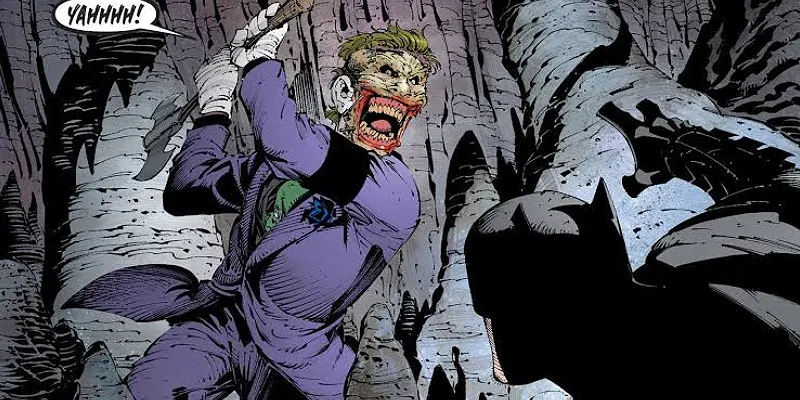
A doubly terrifying Joker: Snyder's dialogue and Capullo's artwork
The best thing about Death of the Family is its approach to horror..
I've said before how much I liked Greg Capullo's work on Spawn, and here he shows once again that this kind of story is right up his alley. His art has an incredible knack for creating disturbing settings, expressive characters and oppressive situations.
And of course, the Joker's design helps.
His face, which was cut off and which he now wears like a mask, haphazardly fastened in place, is a genuinely disturbing sight. Capullo makes him revolting even when he's simply talking, without needing to fill every page with graphic violence.
Although I think the most unsettling thing about Snyder's Joker isn't just his appearance, but his dialogue.
His conversations with Harley Quinn or Alfred contain some genuinely threatening moments. Snyder writes a Joker who seems to savor every word because he knows exactly how much harm he can cause, even before doing anything, simply by threatening to follow through.
There's some very effective psychological cruelty here, and at times you wonder what the writer could have done with this story if he'd had the freedom of a comic aimed at a more adult audience..
Pure gore.
The scene in which police officers are murdered at the station is another good example, though it doesn't quite reach the heights of those earlier exchanges. It's a fairly typical Joker sequence, but here it's particularly brutal because of how casually and naturally he uses violence, and because the officers are powerless to stop him.
Between them, Snyder and Capullo make the Joker genuinely frightening, which isn't always easy with a villain we've watched commit atrocities for decades.
A premise that promises more than it delivers
Snyder once again proves he knows how to hook readers. The pacing across the five issues is excellent, the tension holds and the comic is a quick read. He also handles cliffhangers well, although his habit of ending issue after issue with an apparently definitive threat becomes less effective once you've followed his run for a while.
My main problem with Death of the Family is much the same as with The Court of Owls: the setup and development are better than the payoff.
For much of the arc, Snyder makes you believe the Joker is ready to cross certain lines and that his actions will finally have serious consequences. But when it's time to deliver on those promises, the script turns out to be much more conservative. Probably because the publisher wouldn't let him cross those lines..
I won't go into details to avoid spoilers, but I miss lasting consequences. Think of The Killing Joke, for instance: there the Joker's violence left a mark on the characters that outlived the story itself. Here the threat feels just as huge while you're reading, but afterward everything remains contained. The previous status quo is left intact.
The treatment of the Bat-family doesn't help much either, at least in the Batman issues. Alfred does play a major role, and his relationship with Bruce lends real emotional weight, but the other characters and their relationships with Batman barely get developed.
In the end, you're left with the feeling that Snyder has once again built a magnificent threat, but needs to resolve it without changing too much of the usual conventions of Batman's universe.
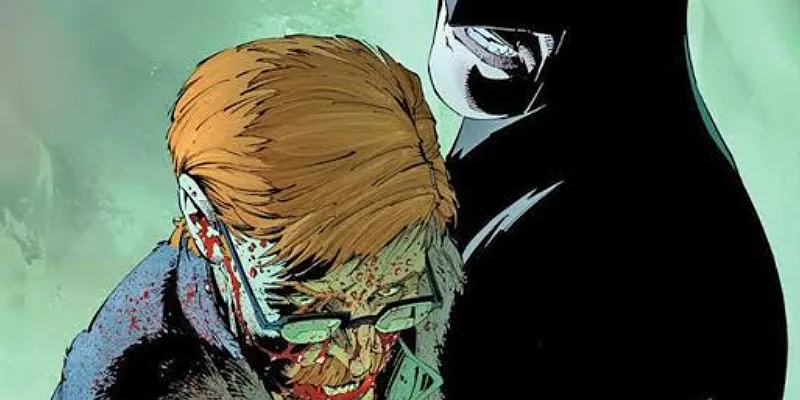
The best of Death of the Family
What stands out for me is the Joker, and how Snyder and Capullo push him into horror territory. His appearance is appalling, his dialogue feels truly menacing and some genuinely uncomfortable scenes work extremely well.
I'd also highlight the pacing. All five issues hold your interest, and the story keeps increasing the tension without dragging.
The worst of Death of the Family
The biggest flaw is the gap between what the story promises and what actually happens. Snyder sets up a terrifying psychological and physical attack on Batman and his loved ones, but the consequences don't live up to the threat.
What's more, the Bat-family gets little development in the main series, and although some ideas about Batman and the Joker's relationship are interesting, they don't go as deep as I'd have liked.
Conclusion and verdict
Death of the Family is a good Joker story, especially if you enjoy his most disturbing side. Snyder writes some magnificent dialogue, Capullo is entirely at home with horror, and the pacing means you can practically read the five issues in one sitting.
Still, I think it falls a notch below The Court of Owls. That arc was more ambitious and left a stronger impression thanks to everything it added to Gotham and Batman himself. Here we get some disturbing ideas about the hero's relationship with his arch-enemy, but I don't think they ultimately amount to much.
It's also hard to avoid comparing it to The Killing Joke or A Death in the Family, because Snyder hints at a story with grave, lasting consequences but ultimately doesn't go as far as those works did.
Even so, I'd recommend it both to longtime readers and to anyone meeting the Joker for the first time. It's entertaining, beautifully drawn and, for much of its length, brings back that feeling that the villain is capable of absolutely any atrocity.
It's a shame that, in the end, it doesn't dare do as much as it promises.
More articles on Scott Snyder's Batman
- Batman – The Court of Owls
- Batman – Death of the Family
- Batman – Zero Year
- Batman – Endgame
- Batman – Superheavy / Bloom
- Scott Snyder's Batman: a review of his entire run
Batman – Death of the Family: comic details
| Item | Information |
| Title | Batman – Death of the Family |
| Original title | Batman Vol. 3: Death of the Family |
| Main writer | Scott Snyder |
| Main artist | Greg Capullo |
| Additional stories | James Tynion IV and Jock |
| Main inker | Jonathan Glapion |
| Main colorist | FCO Plascencia |
| Original publisher | DC Comics |
| Original publication | 2012–2013 |
| Series | Batman – The New 52 |
| Issues collected | Batman #13–17 |
| Genre | Superheroes, horror, psychological thriller and action |
Rating
Who it is for
✔️ For readers who enjoy Joker stories, especially when they edge into psychological horror.✔️ For anyone looking for a fast-paced Batman story that keeps the tension high.
✔️ For those following Scott Snyder's Batman run, as this is one of its major story arcs.
Who it is not for
❌ For anyone expecting a story that radically changes Batman and the Joker's relationship.❌ For anyone wanting a story centered on the whole Bat-family, since the main series barely develops its members apart from Alfred.
❌ For readers who dislike horror or disturbing imagery, as Snyder and Capullo deliver one of the most unsettling Jokers of their run.
Frequently asked questions
What is Batman – Death of the Family?
It's a Scott Snyder and Greg Capullo story arc in which the Joker returns to Gotham determined to attack Batman's relationships with his allies and prove that his family has weakened him.
Is Death of the Family the same as A Death in the Family?
No. A Death in the Family is a classic Batman story involving Jason Todd, whereas Death of the Family belongs to Scott Snyder's run and deliberately plays on that earlier title.
Which comics are included in Batman – Death of the Family?
The main volume collects Batman #13–17, written by Scott Snyder and drawn primarily by Greg Capullo.
Do I need to read the crossovers with other series to understand Death of the Family?
No. You can follow the main story through the five Batman issues, although the crossovers expand on what happens to other members of the Bat-family.
Should I read The Court of Owls before Death of the Family?
It's not essential, but I'd recommend it, since both belong to the same run and it helps you follow how Snyder and Capullo's Batman evolves.
Is Death of the Family a horror comic?
It has a pronounced horror element, particularly in the Joker's appearance, his threats and some scenes of violence. It is still a superhero story, but with a decidedly disturbing atmosphere.
Is Death of the Family better than The Court of Owls?
Both are good arcs, but The Court of Owls is more ambitious and leaves a deeper impression. Death of the Family stands out especially for its terrifying portrayal of the Joker.
Is Batman – Death of the Family worth reading?
Yes. It's entertaining and well-paced, with a genuinely unsettling Joker and superb artwork by Capullo, although its resolution is less powerful than its setup.

Leave a Reply