
I think it is pretty clear to all of us by now that AI is here to stay.
It is not just here to stay, but to take over. In many sectors –almost any we can think of– and at every level.
So the sooner we start applying it in our day-to-day work, the better. That is experience we will already have under our belt when it becomes truly essential, because as of today (April 2023), it still isn’t.
But it will be. I have no doubt.
That is why I want to explain in this article how I am using it in my day-to-day ecommerce work, in case it gives you ideas for how you can use it yourself..
I will also keep adding use cases as I apply them, so this promises to become quite a long piece.
But that will come later. For now, let’s see how it can already be used.
How to use AI to generate ecommerce content
Let’s start with the basics.
Generative AIs are the ones that opened the floodgates, allowing us to create all kinds of content relatively easily. You only have to tell it what you need – what is known as writing a prompt – for the AI tool to return the requested piece.
Whether it is text, music or an image.
For now, we will have to wait when it comes to video. There are a few projects, but they are so, so basic that they are not usable professionally. Not yet.
Now that we have introduced the topic, let’s look at the specific uses of AI for content creation.
Writing and improving old product pages
Let me give you some context:
When we launched Yo pongo el hielo, we faced a challenge: upload more than a thousand products from one of our main suppliers to the website so they could be sold as soon as possible.
If you have ever created an ecommerce product page, you will know that, although it may be simple, it always involves several steps, such as categorisation, adding features, uploading the right images , writing the descriptions, handling SEO and setting the price, among other things.
All of that takes time.
A lot of time.
And descriptions take the most time of all.
The point is that you can choose to:
- Leave the product without a description and leave users to make do with the images and features. Think about that option for a moment and see what you make of it. It is more common than you might think.
- Upload the manufacturer’s descriptions. As they are, without changing them. But you have to find them (which takes some time), it is bad for SEO (duplicate content) and bad for conversion (imagine what a user who does not know your website thinks when they see that you have copied and pasted the supplier’s exact description).
- Write every description one by one. The ideal solution, provided you have plenty of time or a large budget to have them written (no less than three or four euros per “decent” product description). If you have a thousand, as we did, do the maths.
- Create an automatic description. One that takes each product’s variables (category, type, country of origin, sales, price…) and produces a basic but accurate and different description for every product. Yes, in some cases it might be considered thin content, but on the other hand you would have almost three thousand different URLs in your sitemap (more than a thousand per language) in under a week. And that is the option we chose.
Although we later began manually writing several of these pages, we still had 1,300 left to tackle.
And then along came ChatGPT.
So, thanks to this tool’s integration with Google Sheets, we exported a CSV from the database containing all the products whose descriptions we needed to improve and created a file like this:

Here is a breakdown of what each column contains:
- The PrestaShop product ID, so it can then be imported easily.
- The product URL with the automatic description.
- The prompt. We tried several and, for what we wanted, the best fit was this: “You are a copywriter. Can you help me improve this ecommerce product description? The goal is to improve conversion and describe the product in detail. Write at least 500 words and return the result in HTML. Omit the description title.” In any case, we know there is room for improvement here.
- The formula. Here comes the magic: by connecting Google Sheets to the ChatGPT API, we can create an extremely simple formula ( “=GPT(C2;B2)” ) that uses the previous prompt and adds the product URL as a parameter. The AI tool then writes the description, and you can see the result in the cells in this column. We also ask it to return the text in HTML so we can insert it into the database without any manual processing.
- The English translation. We use the result from the previous cell to ask ChatGPT to translate the description. And, of course, to return it in HTML.
- The French translation. Exactly the same as the previous case.
So, with this and less than ten euros spent using the ChatGPT API, we have a basic description in three languages for thirteen hundred items that is far better than what we had.
And in a single day.
I think there is little else to add.
Writing product pages for new products
Here we have two options: use ChatGPT normally or use its API.
Using ChatGPT normally through its web interface or Bing
The easy but lengthy option, as it involves writing a series of prompts every time we want to create a new product page..
The first step would be to give the tool a sample description to the tool.
We copy one we like from our store and paste it after a prompt like this:
““Here is a sample product description: …” and replace the ellipsis with our model description:
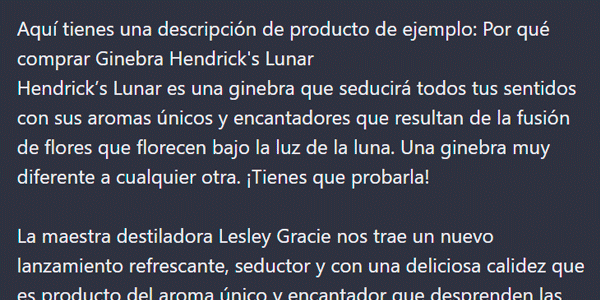
Although ChatGPT will return an “improved” version (according to it) of the sample description, that is not what we want; we want it to use it as a model for a new product.
To do that, we search for the new product online and copy the description from any website..
In our case, we want it to write the description for “Mermaid Small Batch Pin Gin”, so we search for it and find this one:
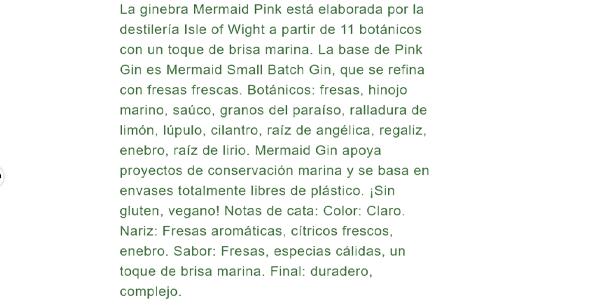
We copy it and create our second prompt::
““You are a copywriter and, using the previous description and its structure as an example, I want you to create a detailed description to sell this product: …” and once again replace the ellipsis with the description we copied:

Although the image cuts off, when we tell it we want a “detailed” description, ChatGPT’s response runs to nearly 500 words:

Is it great copy? For now, the free version currently available is 3.5 and it is not wonderful (version 4, available to paying users, is considerably better), but it serves us very well as a starting point..
In fact, we do not ask for HTML because it is only meant to be a skeleton that helps us structure and write the product page. We then build on it by adding the missing information and our brand voice. Even so, I am sure many online stores could use it almost as-is.
Not bad for a minute and a half of work.
But, well, everything can be improved…
Adding the tool to the online store’s back office
And if I can avoid writing both prompts because I call the API and it integrates everything straight into PrestaShop’s WYSIWYG (the content editor), all the better, right?
So we got to work:

We have developed this little module, which appears on each product page on our website, so the writer can work faster when creating the product description. And without needing to know anything about ChatGPT, AI or prompts.
And that is as far as we have got with AI helping us create and improve product descriptions, but this has only just begun.
Creating ecommerce images with AI
The other most common use case. An online store needs images to sell products, no matter what.
For now, in our case, we use the renders provided by the distributor as product images, but we use Midjourney or Stable Diffusion for:
- Photos in a lifestyle
- Banners
- Social media
Here are a couple of examples we have used. The first was made with Midjourney.:

The second, with Stable Diffusion version 2.1.:

Translations
Okay, I have told you how we have used ChatGPT to translate product descriptions automatically.
But it is not the only tool.
In fact, I use another one more often and, for now, I think it works quite well: DeepL.
This tool is not new at all, but since it launched, in my opinion it has worked much better than the tool that had previously led the sector: Google Translate.
It uses neural networks and AI to capture more nuances than the others..
It has a web version and an installable version, both with a free plan.
I prefer the installable version for a very basic but very useful reason: if you select any text and press Ctrl+C twice in a row, DeepL automatically comes to the foreground and translates the selected text..
Simply wonderful when, as in my case, I have to translate several campaigns every week, with lots of copy in each one. It saves a considerable number of clicks and a lot of time.
Besides this, there are more practical applications for ecommerce.
For example, our customer service department uses it to u understand and answer emails from foreign customers..
Obviously, it is worse than having a native-speaking customer service agent, but it is also infinitely cheaper.
It will not be long before an app arrives for simultaneous translation of phone conversations (as I write this, the “universal translator” from Star Trek comes to mind), and then the need for native agents really will become a thing of the past.
Daily emails
If you have been reading me for a while, you will know that I think sending a daily email is one of the best techniques you can use in your project.
But some people find writing harder than others.
And while you practise day after day until it becomes natural, you still have to send that day’s email to your audience.
Well, unsurprisingly, ChatGPT helps us with this too.
The process is similar to the one we used to write the product page:
First, give it one of our emails that we liked:

It will respond with a rewritten version, which is not what we want. Once it finishes, we tell it to write an email similar to ours, but about the product we want to promote.
In this example, I gave it the daily email for 100 Pipers whisky and asked it to write one about Jack Daniel’s:

I am pasting it in full below so you can see the result:
““Hello,
Did you know that the name "Jack Daniel's" represents not only a world-famous American whisky brand, but also the story of a brave and passionate man?
Jasper Newton Daniel, known as Jack Daniel, was born in Lynchburg, Tennessee, in 1850. From a young age, he showed an interest in the art of distillation, and at the age of 13 he began working for a local distiller. It was there that he learned everything he needed to know to create his own whisky.
At 18, Jack set himself up as an independent distiller and began creating his own whisky. With unwavering perfectionism, he spent years experimenting with different recipes and distillation methods. Finally, in 1866, he managed to create the distinctive flavour we now know as Jack Daniel's Old No. 7.
But Jack’s story is not only about creating an exceptional whisky. It is also about a man who overcame adversity and persevered. In 1905, he suffered a foot injury that became infected and eventually killed him. Nevertheless, his legacy and his whisky endure to this day.
Jack Daniel's whisky is a tribute to the dedication, perseverance and courage embodied by its creator. With its distinctive flavour, combining notes of vanilla, caramel and oak, it is a favourite among whisky lovers around the world.
If you have not yet tried this iconic American whisky, why not give it a go? In today’s flash offer, you can get a bottle of Jack Daniel's Old No. 7 for just €19.99. Try it neat or mixed into your favourite cocktail and discover why this whisky is so special.
Kind regards,
[Sender’s name]”
As always, it will not win any competitions, but it is a good starting point. In fact, it is more than that, because with fewer tweaks than the product page, we will already have something respectable.
Now tell me you do not have time to write one email a day for your online store…
One thing: I do not want to mislead you, it works much better with famous products than with unknown ones. Also, as I imagine you know, the tool was trained on information from before 2022, so anything you ask it about products –or topics– released after that date is very likely to be made up.
Bear that in mind.
We could not close the content creation section without mentioning social media.
Well, we mentioned it when discussing image creation, but we can also write the copy with our ever-present ChatGPT. It is incredibly simple.
Continuing with our previous example, I asked the AI to write Instagram copy that we would publish on the same day as the daily email, so the flash offer reaches more people:

Again, I am pasting it below so you can judge the result of ten seconds of work for yourself:
“¿Do you like whisky? Then you have surely heard of Jack Daniel's, one of the most famous whiskies in the United States and the whole world. But do you know the story behind this iconic brand?
Jack Daniel, its founder, was a passionate and dedicated man. At 18, he set himself up as an independent distiller and spent years perfecting his recipe until he achieved the distinctive flavour we now know as Jack Daniel's Old No. 7.
But his story is not only about creating an exceptional whisky. It is also about a man who overcame adversity and persevered. Although he died from a foot injury in 1905, his legacy and his whisky endure to this day.
Want to try the whisky that bears his name? Do not miss this flash offer! Get a bottle of Jack Daniel's Old No. 7 for just €19.99 and enjoy its distinctive flavour with notes of vanilla, caramel and oak. Cheers! 🥃
#jackdaniels #oldno7 #whisky #distilledspirit #history #perfection #dedication #perseverance #flavour #flashoffer #promotion #drink #cheers”
It is so simple that, in fact, next week we will start using it on our Telegram channel too.
How to use AI to improve an ecommerce site’s SEO
Everything I have told you about content also applies to the online store’s blog.
So, we could:
- Improve, update or expand old articles.
- Create the basis for new articles (I will explain in a moment how to generate ideas with AI).
- Add images.
- Translate blog articles into other languages so they can rank there too.
So, since the process would basically be the same as for product pages or the daily email, I am not going to repeat it. I am sure you can work out how to replicate it.
But SEO does not live on content alone. There are many more parts of the strategy where AI can be applied. Here are some of them.
AI assistance with preliminary SEO analysis
Inspiration.
We do not always have it.
And fortunately, when we do not have it, we no longer need it.
Thank you, AI!
Blog ideas
Here is the thing: when working on SEO, you need to find out what topics related to your project your audience searches for on Google. So you can ask ChatGPT:
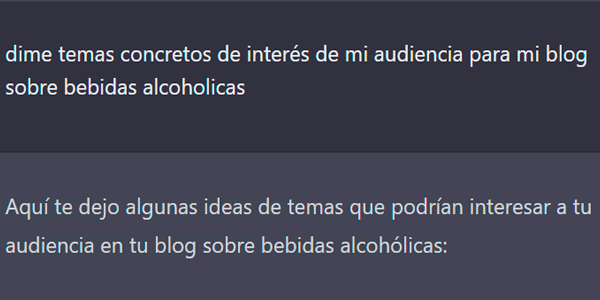
And this is its answer:
“1. Stories behind iconic drinks:
· The origins of beer and its evolution throughout history.
· The story behind the martini and its popularity in pop culture.
· The true story behind the mojito and how it became such a popular drink.
2. How to make cocktails at home:
· Easy recipes for making classic cocktails such as the Margarita, Piña Colada or Daiquiri.
· Techniques for preparing a good Bloody Mary or Gin & Tonic.
· How to use local or seasonal ingredients in your cocktails to give them a unique touch.
3. Pairing drinks and food:
· Tips for pairing wines with different types of cheese.
· How to choose the right beer to accompany a spicy dish or a barbecue.
· Which type of whisky goes best with a charcuterie board or a barbecue.
4. Food and drink travel:
· The best wine regions to visit in Europe.
· Craft beers you should try on your next trip to the United States.
· Whisky destinations in Scotland that you should not miss.
5. How to taste and appreciate alcoholic drinks:
· How to taste wine and appreciate its different aromas and flavours.
· What characteristics a good whisky should have and how to identify them in a tasting.
· How to distinguish the different types of beer and choose the one you like best.
6. New trends in the alcoholic drinks industry:
· Low-alcohol drinks such as vermouth or the Aperol Spritz.
· Craft and local beers: what they are and why they are booming.
· Alcohol-free cocktails: how to prepare flavourful drinks without alcohol.
7. Interviews with industry experts:
· Interview a winemaker who explains the wine-making process.
· How craft beer is made: interview with a brewer.
· The secrets behind Scotch whisky: interview with a distiller.
That is quite a response.
Here we have enough content to fill several months of the editorial calendar.…
Specific titles for blog posts
But if we are really short of inspiration, this is not enough. We can go one step further and ask it for titles for each post:

Here is the full result:
“
- "The best cocktails to impress at a Christmas dinner"
- "The story behind the creation of bourbon whiskey"
- "Discovering the flavours of tequila: from the traditional Margarita to the smooth Paloma"
- "A beginner’s guide: how to choose and enjoy a good wine"
- "The art of pairing: how to combine spirits and appetisers to surprise your guests"
- "The evolution of gin: from London Dry Gin to craft gins"
- "The charm of classic cocktails: Martini, Manhattan and Old Fashioned"
- "Myths and truths about alcohol consumption: how much is too much?"
- "Exploring the world of herbal liqueurs: from Jägermeister to Fernet"
- "The boom in craft spirits: what makes them so special?"
”
Honestly, they could perfectly well be articles for our blog.
Keyword ideas
But we can go even further.
If we increase the granularity, we are interested not only in general topics, but also in the specific keywords they search for.
Since we have no idea where ChatGPT gets its sources from, we want to verify that those topics actually receive searches, so we can ask it for a few keywords:

“Christmas cocktails: Christmas cocktails, Christmas dinner drinks, Christmas party drinks, spiced drinks, cinnamon drinks, rum drinks.
Bourbon whiskey: bourbon whiskey, whiskey distillation, bourbon production, American whiskey, Tennessee whiskey, oak flavour, vanilla notes.
Tequila: tequila, Margarita, Paloma, Mexican drinks, tequila distillation, tequila flavours, mezcal.
Wine: wine, wine guide, wine for beginners, red wine, white wine, rosé wine, how to taste wine, wine pairing.
Spirits pairing: spirits pairing, appetisers, spirits for guests, drink combinations, cocktail drinks, party drinks.
Gin: gin, evolution of gin, London Dry Gin, craft gins, gin drinks, gin distillation, juniper notes.
Classic cocktails: classic cocktails, Martini, Manhattan, Old Fashioned, bourbon drinks, vermouth drinks, whisky drinks, rum drinks.
Myths and truths about alcohol: alcohol, alcohol consumption, alcohol myths, truths about alcohol, alcohol limits, effects of alcohol.
Herbal liqueurs: herbal liqueurs, Jägermeister, Fernet, digestifs, bitter drinks, after-dinner drinks.
Craft spirits: craft spirits, spirits boom, specialist spirits, spirits production, drinks with spirits, craft liqueurs.
With these, we go, for example, to Google Keyword Planner, enter them and look at the number of searches for each one.
Interestingly, even though the AI does not always point us in the right direction, it does not restrict itself to the most searched terms. It suggests head keywords:

It also suggests medium-tail keywords:

And long-tail keywords:

It is up to us to decide which one we want to target and how. For example, in our case, we target all the head terms through the ecommerce site and leave the medium- and long-tail terms for the blog.
Buuuut wait: if you have doubts, what comes next might clear them up.
Search intent
If you know a little about SEO, you will know that behind every keyword there is a search intent, which Google classifies into four types:
- Informational.
- Navigational.
- Commercial.
- Transactional (yes, the difference from the previous one is a matter of nuance).
Well, to find out the search intent of each keyword, you could:
- Use SEO software such as Semrush.
- Use the browser in incognito mode, search for the keyword and analyse the SERP results returned by Google. That way, you could see what type of content was ranking (blog posts, online stores, company pages…).
Now we add one more tool to our arsenal: AI.
So we can tell ChatGPT to add this intent to our previous list:

The point is that it gives us an idea, although it is still not at the desired level. But it will get there.
AI assistance with SEO execution
Once everything is planned, it is time to execute. And, of course, we are going to get help here too.
Generate SEO-friendly URLs with ChatGPT
We have already seen how to obtain article titles, but we can ask ChatGPT for help with many more SEO optimisations.
For example, ask it to generate the URLs for the articles it gave us before:

In reality, this is very basic and WordPress does it quite well by default, but just in case you are using another CMS for the blog (seriously?) our friend comes to the rescue:

Generate an SEO title and meta description with ChatGPT
Likewise, if we do not know how to fill in the Yoast module properly in our article, we simply ask it:

Add an FAQ section to the blog post
So far, all the SEO execution has been very basic.
Nothing that would save someone with a little experience much time.
This next use case is a little more advanced:
It consists of adding an FAQ section to an article, helping us rank when users search for one of the questions it includes.
The way to do it is the same as always: ask the AI:

Here is the complete returned code:
<section class="faq-section">

 <h2>Preguntas frecuentes</h2>

 <div itemscope itemtype="https://schema.org/FAQPage">

 <div itemprop="mainEntity" itemscope itemtype="https://schema.org/Question">

 <h3 itemprop="name">¿Cuál es la diferencia entre un tequila reposado y un tequila añejo?</h3>

 <div itemprop="acceptedAnswer" itemscope itemtype="https://schema.org/Answer">

 <p itemprop="text">El tequila reposado se envejece entre 2 y 12 meses en barricas de roble, mientras que el tequila añejo se envejece durante al menos un año en barricas de roble. Esto le da al tequila añejo un sabor más suave y complejo.</p>

 </div>

 </div>

 <div itemprop="mainEntity" itemscope itemtype="https://schema.org/Question">

 <h3 itemprop="name">¿Cuál es la mejor forma de disfrutar de un tequila?</h3>

 <div itemprop="acceptedAnswer" itemscope itemtype="https://schema.org/Answer">

 <p itemprop="text">Depende del tipo de tequila que estés bebiendo. Un tequila blanco es ideal para cocteles como la Margarita, mientras que un tequila reposado es mejor para beber solo o en cócteles más suaves como la Paloma. Si quieres probar el sabor del tequila sin mezclarlo, pruébalo en un vaso corto o de chupito.</p>

 </div>

 </div>

 <div itemprop="mainEntity" itemscope itemtype="https://schema.org/Question">

 <h3 itemprop="name">¿Es cierto que el tequila es un estimulante?</h3>

 <div itemprop="acceptedAnswer" itemscope itemtype="https://schema.org/Answer">

 <p itemprop="text">No, esto es un mito. El tequila es una bebida alcohólica y tiene los mismos efectos que otras bebidas alcohólicas. El contenido de alcohol del tequila varía según la marca y el tipo, por lo que es importante beber con moderación.</p>

 </div>

 </div>

 </div>

</section>
And you should know that if you prefer the JSON-LD format for semantic markup, it provides that too. If you ask, of course.
Writing the semantic markup for a recipe
In the same way as with FAQs, we can also write a recipe article and ask ChatGPT to generate each recipe with its corresponding semantic markup:

Here is the code again:
<div itemscope itemtype="https://schema.org/Recipe">

<h2 itemprop="name">Margarita</h2>

<h3>Ingredientes</h3>

<ul>

<li itemprop="recipeIngredient">2 oz de tequila</li>

<li itemprop="recipeIngredient">1 oz de jugo de lima fresco</li>

<li itemprop="recipeIngredient">1 oz de triple sec</li>

<li itemprop="recipeIngredient">Hielo</li>

<li itemprop="recipeIngredient">Sal (opcional)</li>

<li itemprop="recipeIngredient">Rodaja de lima para decorar</li>

</ul>

<h3>Preparación</h3>

<ol>

<li itemprop="recipeInstructions">Moja el borde de una copa de martini con jugo de lima y cúbrelo con sal (opcional).</li>

<li itemprop="recipeInstructions">Llena una coctelera con hielo y agrega el tequila, el jugo de lima y el triple sec.</li>

<li itemprop="recipeInstructions">Agita vigorosamente durante unos segundos.</li>

<li itemprop="recipeInstructions">Cuela la mezcla en la copa de martini.</li>

<li itemprop="recipeInstructions">Decora con una rodaja de lima y disfruta.</li>

</ol>

</div>
Although I have not analysed it properly yet –and therefore have not tested it– I wonder whether it could also be applied to product pages, to help gain traffic from informational keywords, not just transactional ones.
I need to think it through and run tests, because I am not sure whether it would add more value than it takes away.
How to use AI for ecommerce pricing
To be fair, for now the word “work” is a bit generous.
What we can do is carry out a quick analysis of the price range in which a product is selling.
In this case, since ChatGPT cannot connect to the internet at the moment, we are going to use Bing chat in the Edge browser from Microsoft.
What we do is ask it directly for the price of a product:

And Bing returns the first organic results, with a link to each one:

Yes, we could also do it ourselves: run the search and open each result, but this way it is much easier, although also much less flexible.
This is an area that can only improve.
I can imagine the day when you can ask it for the price history of a product in certain ecommerce stores, for example, and the tool gives it back to you.
I do not know, but I suspect current pricing tools will have to seriously raise their game if they do not want to be replaced by something that will work for many small and medium-sized projects.
How to use AI to help with ecommerce development
Beyond the use cases explained for adding semantic markup and helping with SEO, we are studying how to incorporate AI at the development level.
The idea would be to start integrating it into Visual Studio and see how it helps the interns we have.
If the result were positive, we would then add it to the whole team’s workflow.
The problem is that almost none of our code is standard. Everything is highly customised, so we have doubts about whether, at the current stage of the technology, it will really be useful to us.
I will keep adding updates in this area here.
Other uses
In general, ChatGPT and conversational AI are excellent for generating ideas:
- For example, when you want to find a domain with certain characteristics (even though ChatGPT cannot tell you –for now– whether it is available).
- Or the naming of a brand or product.
It is a huge source of ideas of all kinds, and it saves us a great deal of time.
And if you are unsure how to create your own prompts, take a look at this document by Aleyda Solís which may make your life easier.
Conclusions
For now, these are the use cases we are currently applying in our ecommerce business.
As I said in the introduction, as we incorporate new ones –which will happen sooner rather than later– I will add them here so that this article becomes a living guide to the state of AI applied to ecommerce..
If you are interested in the topic and want me to notify you of new developments, all you have to do is subscribe using the form just below and you will receive a small daily tip or trick by email to apply to your digital business.
Frequently asked questions
Which uses of AI have the greatest real impact on ecommerce?
Experience personalisation, demand forecasting, dynamic pricing, automated customer service and the generation of content optimised for conversion.
Does AI replace the marketing team in an ecommerce business?
No. It automates operational tasks, but strategy, positioning and decision-making still depend on people.
How is AI used to improve conversion?
By analysing user behaviour, adapting content in real time and optimising landing pages, copy and product recommendations.
What role does AI play in personalisation?
It allows different products, offers and content to be shown to each user based on their history, behaviour and context.
Can AI be applied to a small ecommerce business, or only to large stores?
Yes. Today there are accessible tools that allow small stores to use AI without major investment.
How does AI help reduce costs in an ecommerce business?
By automating customer service, content generation, inventory management and advertising campaigns.
Does AI improve an ecommerce site’s SEO?
Yes, if it is used properly. It can generate optimised content, identify keyword opportunities and improve the website’s architecture.
What risks come with using AI in ecommerce?
Excessive dependence, loss of differentiation and errors if it is not supervised. AI amplifies both the good and the bad.
How is AI used in stock management?
It forecasts demand and optimises inventory to avoid stockouts or overstocking.
Can AI improve customer service?
Yes, through chatbots and assistants that answer common questions and escalate complex cases to people.
What kind of data does AI need to work well?
User, behaviour, sales and catalogue data. The more data there is, and the better structured it is, the better the results.
Do you need to know how to program to use AI in ecommerce?
No. Many tools are no-code or low-code, although understanding the underlying logic does make a difference.
Can AI help with dynamic pricing?
Yes. It adjusts prices according to demand, competition and user behaviour.
How does AI affect the user experience?
It makes it more relevant and faster, but if overused it can feel invasive or artificial.
What is the biggest mistake when implementing AI in ecommerce?
Applying it without a strategy. Adding AI because it is fashionable, without a clear objective, usually ends in wasted time and money.

Leave a Reply