
I came to this work the way I approach all of Paco Roca’s books: wanting a couple of quiet hours to sit on the sofa and enjoy a good story, with well-built characters, that would stir something in me.
It has happened to me with all his works, from the very good ones (Wrinkles, The House), to the merely good ones (The Winter of the Cartoonist).
And with this one too.
Only here, he adds a layer of epic? to his usual everyday realism, and that raises the level.
A hugely enjoyable and thoughtful comic.
Quick take
Twists of Fate is, without a doubt, one of Paco Roca’s peaks and one of the high points of Spanish comics.
A huge work not only because of the story it tells, but because of the way it makes clear that its protagonists are real people trapped in situations that today feel almost unbelievable to us.
This is one of the comic’s strongest points: reading -and feeling- what those men lived through and thinking how comfortable our current world is by comparison.
Because wars still exist now -obviously- but we look at them from a distance that turns them into something abstract. This book brings them down to earth: here war has a face, fear, exhaustion, hunger and a permanent feeling of having lost everything.
What Twists of Fate is about
The work begins with Miguel Ruiz and La Nueve, the company made up mostly of Spanish Republicans that took part in the liberation of Paris during the Second World War.
That is the historical starting point, but the comic offers much more.
Because although Twists of Fate is clearly positioned in defence of one side, the truth is that it is a story about people from whom war took almost everything.
People from any side. From any country. From any war.
Strong men and women, yes, but not invulnerable: they did what they believed they had to do in a world that pushed them from one defeat to another.
Until a final victory that does not really feel like one.
For me, this is the work’s real power: not telling you whom you should admire, but making you understand what it costs to (survive) a war. Or several.
In this sense, it left me with a feeling similar to La batalla del Ebro by Pérez-Reverte, another essential work for schools.
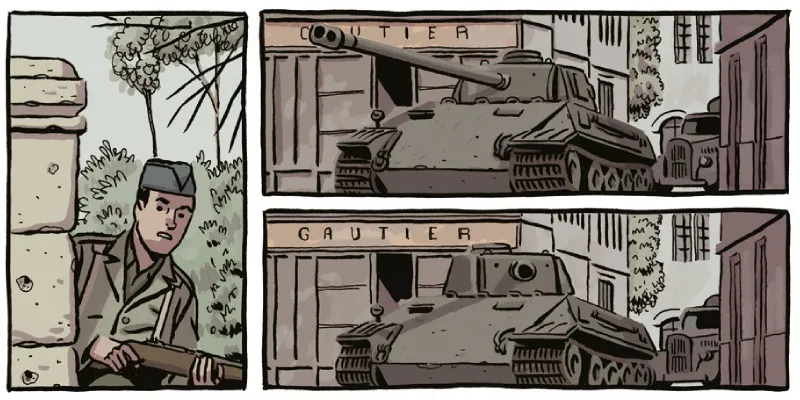
War and those who lose it
What matters about Twists of Fate is not historical memory understood as a fight between sides. At least, that is not what interests me most about the work.
Yes, the story starts with exiled Spanish Republicans. Yes, it talks about La Nueve. Yes, there is a very clear historical dimension. But the background the comic leaves behind is broader and more uncomfortable: all soldiers lose.
Those who die lose, obviously. But those who survive also lose. Those who leave. Those who return. Those who cannot return. Those who do what they believe is right and then discover that the country, the homeland or history gives them back nothing like what they gave.
That is one of the comic’s clearest ideas: what these people gave to one country, or to several, and how little they received in return. And this does not have to apply only to Republican soldiers or only to this particular story. As I said before, there were soldiers on the other side, from other countries and other wars, who were also forgotten, badly remembered or simply erased.
That is why, for me, the work is not, even if perhaps it aims to be, a piece of political combat, but a reflection on the human cost of war. On patriotism misunderstood. On that absurd idea of demanding everything from specific people -their youth, their bodies, their lives, their dead- and then giving them silence in return.
And I am thinking of Ukraine right now as I write.
On the other hand, it is an irony obvious enough to see Spaniards taking part in the liberation of Paris while Spain remained trapped in a dictatorship. The fact stands on its own, but what really matters is what lies underneath: men dragging one war, exile and yet another war behind them, as if history had insisted on not letting them breathe.
And that is why I believe Twists of Fate should be read in schools. Not to memorise names, dates or military units. That can come (or not) later.
The first thing is something else: understanding what a war means for the people who live through it. Understanding that behind any conflict there are people who lose their home, their family, their youth, their love, their country or the possibility of having a normal life.
You do not need to take sides to understand that. You only have to look.
How Paco Roca tells it
The story was already first-rate, but Paco Roca tells it with sublime narrative skill.
The structure between present and past works very well. On one side there is the conversation, the investigation, the attempt to reconstruct what happened. On the other, Miguel Ruiz’s memories and everything those memories carry with them.
The interesting thing is that both parts have weight. You are not wishing the present would end so you can go back to the past, nor do you feel that the past is just a dramatisation of historical data.
You care about both lines. You care about what happened and about how what happened is recovered.
That device allows Paco Roca to mix real events, memory, fiction and historical reconstruction without the whole thing creaking. And that is not easy because, if it leaned too far into documentary, the work could become cold and matter little to us; but if it went the other way and leaned too far into fiction, the story would be merely a backdrop.
Fortunately, the graphic novel finds an ideal balance between both paths.
On the other hand, it is not the first time Paco Roca has handled superbly the device of memory. Again, here it does not appear as a digital recording, but as something organic: you remember some things, cover up others, order them as best you can, and interpret from the present what perhaps, at the time, you merely survived.
That way of telling fits very well with a work that, deep down, is about people trying to make sense of a life broken by the events they had to suffer.
Visually, Paco Roca is in his usual line: sober, clear and highly expressive. He is a master of comics, and it shows in something that seems easy but is not: everything is understood.
The scenes tell, the faces communicate, the silences weigh, and the page and its design are designed to serve the story and not to sit above what is being told.
The use of colour and greys to separate times and tones also works. You notice it, but in a more intuitive than conscious way: it is not a device that pulls you out of the reading to think how clever the author is, but one that simply guides you unconsciously.
Again, this has a lot to do with Paco Roca’s narrative maturity. Twists of Fate does not need big displays or virtuosity. It trusts the story, the characters and the force of what it is telling you.
The best
For me, the best thing about Twists of Fate -and there is plenty to choose from- is the treatment of the characters.
Miguel Ruiz and the men around him are not cardboard figures. They are not generic soldiers or NPCs. They are people, with their virtues and flaws, who live and die through the furrows of fate.
Paco Roca makes you understand that behind every uniform there is someone with fear, pride, exhaustion, contradictions, memories and losses. Strong people who do what they believe they have to do, even when there is often no good option in front of them.
That psychological work is the comic’s great success, because you are not reading the story of a military unit but the story of people whom war pushed out of a normal life.
The second great success is the mix of fiction and history. Paco Roca does not merely illustrate facts; he builds a narrative with pulse, rhythm and scenes that stay with you.
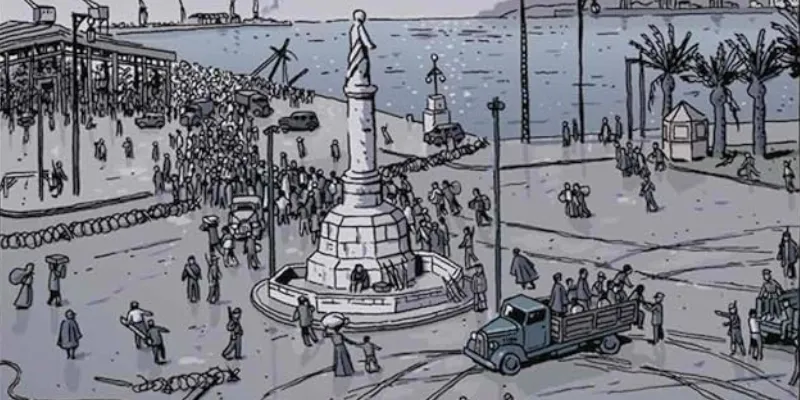
The boat that does not reach the port at the beginning, for example, already sets up very well that feeling of loss and uprooting.
So does the ending with the protagonist’s lover, which illustrates very clearly everything that war and time have been breaking apart.
Finally, the third strong point is the narrative mastery. The work has many characters, several timelines, a lot of historical context and an obvious emotional charge.
In the hands of a less talented author, it could have become heavy or overly explanatory. But no. Everything flows quite well and you want to finish it from start to finish.
This is what separates an important work (not just a comic) from a great work: Twists of Fate not only deals with a relevant subject; it also tells it very well.
The worst
My main reservation is that some stretches can feel somewhat dense.
It is not a serious criticism, but it is there. There are moments with many characters and some difficulty in finding your bearings. Sometimes you need to reposition who is who, where you are and what weight each figure has within the whole.
Of course, and despite the subject matter, it is not ideal reading for someone looking only for action. Although there is war, movement and tension, it is not a war comic understood as combat entertainment. This is not about military epic but about people surviving history.
This may mean that some readers -who do not know the work or Paco Roca- come in expecting a more direct adventure and find a quieter, more human work, more interested in consequences than spectacle.
Even so, these are small objections. The overall pace is right, it hooks you from the beginning and keeps your interest to the end. Even when it becomes a little denser.
Verdict
Twists of Fate is an excellent work. For its value as a comic, for its historical value and, above all, because it is a great story about people dragged along by circumstances they did not choose.
I do not think it should be read to reinforce a view of one side against another. That is not the point.
The point is to understand that in war everyone loses. Even those who survive. Even those who did what they believed was right. Even those who later appear in books, tributes or plaques. Because none of that gives a life back.
Paco Roca does not turn his protagonists into unreachable heroes, but into tired, strong, contradictory and real men who will make you reflect on them and on our current world.
To close, I will repeat myself: we are undoubtedly looking at one of Paco Roca’s peaks and one of the high points of Spanish comics.
Do yourself a favor and read it.
P.S.: the expanded Astiberri edition is worth it, with 24 extra pages of new texts, sketches, photos, new drawn pages and a letter from one of the protagonists. A revised/expanded edition based on new information received by Paco Roca’s publisher.| Field | Data |
|---|---|
| Title | Twists of Fate |
| Author | Paco Roca |
| Year | 2013 |
| Publisher | Astiberri |
| Genre | Historical graphic novel / documentary comic |
| Country | Spain |
| Current edition | 352 pages |
| Available in | Print and digital |
Rating
Who it is for
✔️ For lovers of adult comics (not X-rated).✔️ For readers interested in history, memory and the Spanish Civil War.
✔️ For anyone who simply wants a good story.
✔️ For teenagers, so they really understand the human cost of war.
✔️ For fans of Paco Roca.
Who it is not for
❌ For anyone looking for direct war action.❌ For anyone who wants a light read without too many characters.
❌ For anyone with no interest in stories with a historical background.
Frequently asked questions
What is Twists of Fate about?
It tells the story of Miguel Ruiz and La Nueve, but above all it talks about soldiers, exile, war and broken lives.
Is Twists of Fate based on real events?
Yes. It starts from real events, although Paco Roca mixes history, memory and fiction to build the story.
Is it a comic about historical memory?
Yes, but not only that. For me, what matters is how it shows that in war all soldiers lose.
Do you need to know history to enjoy it?
No. Context helps, but Paco Roca tells it in a clear and very human way.
Is it a difficult read?
It is not difficult, although it has quite a few characters and the occasional slightly dense stretch. Even so, it hooks you from the start.
Is the expanded edition worth it?
Yes, especially if you do not own the work. It adds extra material and is the most complete edition.
Who is it recommended for?
For comics lovers, readers interested in history and anyone who wants a good human story.
Does it have a lot of war action?
It is not an action war adventure. The war is there, but the focus is on people and its consequences.
Is it one of Paco Roca’s best works?
Yes. For me, it is one of his peaks and one of the great works of Spanish comics.

Leave a Reply