
This probably sounds familiar:
There are periods, moments or projects when you feel you are making no progress despite working long hours.
You get frustrated.
You may even start thinking you will never get it done. Or that it is not worth it.
We have all been there.
Do you know the best part?
There are ways out of the loop. And they do not have to be complicated.
The method I am going to explain—the one I have used for years and apply to every project—is proof that well-applied simplicity can be more effective than sophisticated management tools or complicated techniques.
We will use tools, of course. Two at the basic level, plus one at the advanced level. Tools you already know and have almost certainly used.
But the tools are not the core.
No.
It is a method designed by Ivy Lee more than a century ago. More specifically, it was devised in 1918 and remains a benchmark today for anyone who wants to be more productive without overcomplicating things.
That is why it has worked for more than 100 years without losing any of its relevance.
Problems that are more common than they should be
Before we begin with the system, let me go a little deeper into the symptoms we want to eliminate:
- Feeling that you have to work long hours to finish everything you need to do.
- Running flat out all day.
- Task-overload paralysis.
- Missing deadlines.
- Letting people down despite working more hours than you should.
When we do not have a system for organising our tasks, we string together endless lists, rush around all day and often reach the evening feeling that we did not do what mattered.
And it can lead to anxiety.
The worst part is that this does not come from a lack of ability, but from a lack of focus and from allowing urgent—often trivial—work to swallow what is essential.
The saddest part is that we can be incredibly busy without clear results or any sense of achievement. Not for us, nor for our managers, if we have them.
That said, there are certain situations in which it is relatively normal for these problems to appear, always temporarily, of course.
Examples:
At the start of a career, when you are paying attention to every new detail, it is logical to feel overwhelmed.
The same happens when you change roles, take on more responsibility or face a stage or project that is more demanding—or more poorly planned—than it should be.
In these cases, the pressure lasts a few months and then settles down. But if it persists, that is a sign that something needs to change.
Because if you have spent six months or more with that feeling of “never keeping up”, it is time to do something.
Because something is clearly not working.
As I was saying, despite the impostor syndrome we all experience at some point, the problem most likely does not come from your technical skills, but from two key areas:
- A lack of certain soft skills, such as prioritising, deciding, managing attention and communicating assertively.
- The absence of a working methodology that is clear and practical.
So before you think about new apps, complex systems or, worse, training courses that will only make you doubt yourself more, start with something simple and functional.
And this is where the aforementioned Ivy Lee comes in.
The Ivy Lee method: 6 tasks a day
In 1918, Ivy Ledbetter Lee, a public-relations pioneer and consultant, was hired by Charles M. Schwab, president of Bethlehem Steel, to find a way to increase his team's productivity.
Lee proposed meeting the executives for 15 minutes and explaining an extremely simple system:
They should work on just six prioritised tasks each day.
After three months, the method had worked so well that Schwab sent him a cheque for $25,000. To give you a better idea of how exceptional that sum was, it would be equivalent to around $400,000 today.
That is how pleased he was.
How the method works
The mechanics are simple:
Before finishing each day, write down the six most important tasks for the following day, in order of priority.
When the working day begins, tackle the first task and do not move on to the next until you have completed it.
If you have not finished one by the end of the day, carry it over to the next day.
And do this every day, without exception.
Sounds simple, right?
It is. And it works because it relies on powerful principles for improving performance:
- Avoiding decision fatigue (you already know what you have to do).
- Focusing on a single task (no multitasking).
- Creating and maintaining motivation through daily achievements.
We could add a couple of other important points when it comes to prioritising:
You need to know how to clearly separate what is important from what is urgent. You will have to deal with both types of task every day, but urgent work must not consume important work.
The most demanding task, or the one you like least, should be the first one you do. As Brian Tracy explained well in Eat That Frog!, the start of the day is when we have the most energy and the clearest heads for tackling difficult work. If we schedule it later, we will probably not feel like doing it and may end up skipping it that day.
So when prioritising, keep these two points in mind: urgency versus importance, and eat your frogs first thing in the morning.
Finally, Ivy defined 6 tasks, but depending on your work that number may be too high if your tasks take 3 or 4 hours. The opposite can also happen and 6 may be too few, although in my experience that is less common. Here, adapt the number to what your role requires.
And no, tasks that take 5 or 10 minutes do not count.
The three essential tools
This system needs no tool beyond a notebook.
But in my case, and in today's environment, I do not use a notebook; I use digital tools. Three of them, specifically.
#1. Notion
As a replacement for the notebook—and the sticky note.
It is a supercharged digital notebook that is easy to use.
Here we write down every task that comes up, and at the end of the day we use it to prioritise the important ones.
Write down every task to clear your head, because your memory is limited and you should not use it for things you can record. But when prioritising, consider only the relevant ones.
In this respect, if an unplanned task comes in and takes less than 5 minutes to complete, do it as soon as possible, without adding it to Notion unless necessary.
The reason is that it occupies RAM in your brain for no useful purpose. Better to finish it and free up that space.
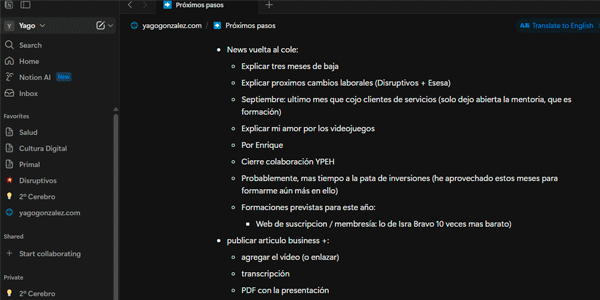
You can use it in your browser or download the mobile and PC apps here:
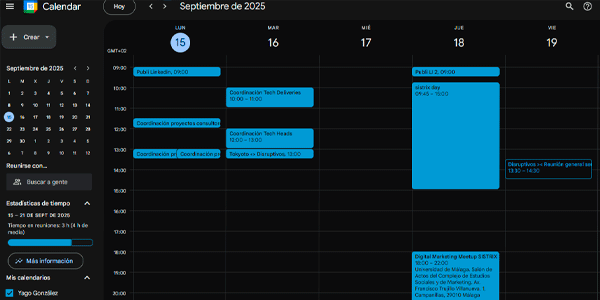
#2. Calendar
Google's, Microsoft's, Apple's, Notion's or whichever one you prefer.
You will use it to block out time, as well as for video calls and reminders.
Keeping your calendar properly updated will prevent problems with colleagues when planning meetings.
These two tools are enough for a basic productivity system. In fact, depending on your work, you may not even need the calendar. In my case, because I work remotely, it is essential, which is why I include it here.
#3. Backlog in Excel
Right, now let us go for top marks.
This is not part of Ivy's method, but a highly valuable technique taken from agile methodology applied to marketing.
Although a backlog is really what you are already doing in Notion by writing down a list of tasks, here we will add the tasks we actually tackle.
We classify them and enter how long they take us.
The result will be a table from which you can extract a huge amount of actionable information:
- How long each type of task takes you on average: extremely useful for estimating correctly and trying to improve if you discover that you take MUCH longer than you thought (things always take a little longer in reality than we estimate).
- How much time each week—or month—you devote to each type, client or project: whether it is the right amount or needs adjusting.
- How much time goes into management: if the percentage is high, perhaps the bureaucracy is excessive…
- You will have a diary of everything you have done: avoiding the feeling of “I have done nothing”. You will only have to review the table to see whether that statement is true.
In short, highly useful and auditable information whose cost of collection is minimal (it takes 10 seconds to add each task).
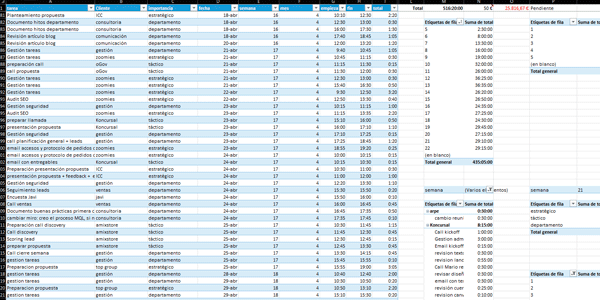
Note that here, unlike the prioritised tasks in Notion, I do add everything I do, provided it takes more than 10 minutes.
Using this system for yourself or your team allows you to improve productivity A LOT. When you see certain information, you start looking for systems that help you save time or automate the most repetitive tasks.
If you think AI is your friend in these cases, there is nothing better than knowing what to prioritise to get the best return.
As I said earlier, I have used it for myself for years and have implemented it in every team I have managed.
Here is the template I use, so you can adapt it to your needs:
It is very simple and will allow you to:
- Add or remove columns.
- Create pivot tables with the information you need.
As you can see, three tools are more than enough for working on productivity, but be clear that the tools are not what matters in this methodology.
The real value lies in consistency and in the attitude of planning every day, learning to prioritise and focusing on one task at a time.
Extra tips
You can complement the Ivy Lee system with other habits.
For example, we have already talked about avoiding multitasking, but avoiding distractions is just as important: check email—or Slack—during certain scheduled blocks and keep mobile and PC notifications muted.
In this respect, you can work in focus blocks and combine this method with techniques such as Pomodoro. I sometimes do this when I need to be very precise with timing if I am going to get everything done, using 55-minute blocks instead of the usual 25.
Finally, whether or not you use Pomodoro, it is worth incorporating active breaks every 55 minutes so that you rest your eyes, reset the RAM in your head and move around a little.
You can walk a little—in large offices—or do 20 squats and/or 20 push-ups if you are at home.
Your back—and your body in general—will thank you.
Conclusion
Be clear that true productivity is not about running flat out all day, but about making progress on what really matters.
Anyone who knows me knows I am a big fan of Work smarter, not harder.
That is why I like this methodology: because of its simplicity, it adapts to any type of office work—less so for warehouse operators; I have tried it.
It forces you to have clear priorities, focus and discipline. That is what matters; the tools are secondary.
That is why, if you suffer from the problems mentioned above—stress, feeling that you are not making progress, not knowing what to do at any given moment—I would tell you to give it a chance: define your six tasks before finishing each day, follow the plan the next day and review the results every week or month.
You will transform your contribution to the project and live—and sleep—better.
And I will not promise the same if you subscribe to my mailing list using the form just below, but I honestly think it could do you a lot of good.
For you and your business. And one thing leads to another…
Frequently asked questions
What is the Ivy Lee method, and why does it still work today?
It is a productivity system based on prioritising a maximum of six daily tasks. It works because it reduces decision fatigue, eliminates multitasking and forces you to focus on what really matters.
Why limit yourself to just six tasks a day?
Because it forces you to prioritise. Add more and you return to chaos. The limit creates clarity and prevents endless lists that never get finished.
What happens if I do not finish all the tasks?
Carry them over to the next day and prioritise again. It is not a failure; it is part of the system. Continuity, not perfection, is the key.
How do I choose which tasks are truly important?
By distinguishing between urgent and important. Important work affects results. Urgent work is often noise if it is not managed properly.
What kind of tasks should I include?
Relevant tasks that require real focus. Do not include five-minute jobs. That only gives you a false sense of productivity.
Why is it better to do the hardest task first?
Because you have more energy and mental clarity first thing in the morning. Leave it until later and you will probably not do it.
Can the number of tasks be adapted?
Yes. Six is a reference point, but you can adjust it to your type of work. What matters is keeping the limit low.
What tools do I need to apply this method?
None are compulsory. You can use a notebook. Digitally, Notion and a calendar are more than enough.
What is a backlog used for in this system?
To measure and improve. It lets you see where you invest your time, estimate more accurately and identify tasks you can optimise or automate.
Does this method work for every type of job?
It works particularly well for office or management jobs. In operational environments, applying it exactly as written may be more difficult.
How do I avoid distractions while applying the method?
Block out time, turn off notifications and avoid checking email or Slack constantly. Focus is a key part of the system.
Can it be combined with other techniques such as Pomodoro?
Yes. In fact, they work very well together. You can use focus blocks to carry out each task more intensely.
How long does it take to notice an improvement?
Within a few days you will notice greater clarity. Within weeks, better results. The real difference comes from consistency.
What mistake do most people make when trying to be more productive?
They overcomplicate things with tools or complex systems instead of focusing on prioritising and executing important work well.

Leave a Reply