

More or less, we all know the famous analysis paralysis.
Yes, the one that gets us stuck at some point and keeps us from finishing a task for reasons such as:
- Fear of the blank page.
- Too much information to tackle a task.
- The ambition of a “perfect” execution.
- And, of course, an abundance of thoughts and “pseudo-analysis” that are nothing more than forms of procrastination.
Well, today I am not going to talk about that one, but about its opposite.
I mean paralysis caused by too many pending tasks. It is not as well known as the former, but it can have the same harmful effect.
You know, that moment when you look at—or think about—your task list and cannot decide which one to tackle. In the end, you open your email in case something urgent has arrived and saves you from having to make a decision right now…
Or you make yourself a coffee to see whether the caffeine wakes you up. It usually does not.
So, since some clients of the mentoring service ask me about productivity and, specifically, about this problem, I am going to give you my view in this article.
I am not a psychologist or a coach—it is not the same as being a mentor, in case you were wondering—but since it has happened to me and still does, I will share the tricks I use to solve it, in case they help you.
Causes
But before the tricks, let us talk a little about why this happens, because the causes are closely related to one another.
To begin with, let us start with a classic among classics.
#1. Lack of organization
I do not know how you organize yourself.
Or even whether you organize yourself at all.
But whether you have a boss or clients, the usual thing is to have several tasks to do every day.
And for some of them to take several days.
You know: either they are very long, there are blockers, or you depend on third parties.
You may be keeping all of them in your head. In that case, I think either you are just starting to work, or you sleep less than you should.
I say this because I started that way, as I imagine almost everyone did. And I know what was going through your head before bed if you wanted everything organized for the next day.
Either that, or you do not mind getting told off for failing to deliver on time, which is also possible.
Some people also prefer this:

And yes, it works for some people, but I think there are better options.
I will tell you about them later.
#2. Lack of prioritization
The next cause is harder to solve.
If you have a competent boss, asking them should be enough to resolve it.
But if your boss is one of those who says “everything is important,” or you have no boss and several clients instead, which one do you choose?
Then you have no choice but to learn to prioritize for yourself. And believe me, it is one of the most valuable professional skills.
#3. Lack of repeatable systems
If you face a new challenge every day, it will be great and very entertaining. You will also learn a lot.
But:
- The chances of analysis paralysis increase.
- It is much harder for your mind to switch off at any point: it will always be thinking about how to solve cases it has never dealt with before, so it will constantly be running at full speed. And that is exhausting.
The same can happen if you follow a different path every time you solve the same recurring problem.
For example, this happens to me a lot when I face the monthly reporting for the analytics of a new project.
The first time I define it and extract the data. But if I am in a hurry and do not document it properly, the following month I have to stop and think again about why I chose that metric and where I got it from.
I have to repeat the entire process and check that I did it the same way, extracting the first month's metrics again to make sure there are no differences in the data.
It is duplicating the work. All because you failed to document the system you established the first time.
Over time, after using the same system to extract the data several times, you will be able to do it with your eyes closed, so the sooner you systematize your processes, the better.
#4. Procrastination
The Parkinson's Law says that work expands to fill the time available for its completion.
And it is very true.
That is why, when you have no deadlines or they are not close, we procrastinate much more than we should:
- Maybe a coffee with a colleague.
- Maybe checking the result of the Champions League draw on Marca.
- Maybe opening my personal email on my phone for a moment.
- Or, even worse, WhatsApp or social media.
All those “moments” add up to a substantial amount of time.
Because, in addition to the time spent on those other activities, you have to add the “task-switching” time that occurs in your brain.
Because if you are doing one thing and want to do another, your brain has to “switch gears” and restructure your thoughts.
And that takes time. It is not immediate: there is an interval before it can engage with the new instruction.
And no, it cannot do two things at once either. At least not consciously.
We are not built for multitasking.
You cannot read your university friends' WhatsApp group while paying attention to a project kickoff call.
Forget it. It is nonsense.
Burn this into your mind:
“The human brain does not multitask.”
It performs one task after another very quickly, but not at the same time.
Yes, there are tasks such as driving, eating or smoking that, through repetition, the brain performs automatically—they move from the cerebral cortex to the lower part—but that does not happen with the work you face in your day-to-day life.
#5. Interruptions
Closely linked to the previous cause are these.
Once again, they cut short our train of thought about what we were doing. That is why they are so harmful.
When you manage a team, they are unavoidable.
Sometimes they are unavoidable even without a team.
When you work in an office with other people, they are unavoidable.
Sometimes they are unavoidable even when you work alone in your office.
#6. Meetings
Whether they are:
- With your department.
- With other departments.
- With suppliers.
- With clients.
- With your direct manager.
- With your manager's manager.
- Kickoff meetings.
- Follow-up meetings.
- …
In all of them, you are postponing what you have to do.
Some are essential, others are not. You decide.
For example, in my case, I do two things:
- I choose team meetings and their timing very carefully. I avoid every one I can.
- I hold almost no client meetings unless I charge for them.
And yes, doing it this way costs me clients.
But I gain time, which in my situation is more important.
#7. Too many tasks
We finally reach what is, by far, the most common cause of all. There is a reason the problem is named after it.
In fact, it happens for two reasons that look the same but are not.
Underestimating the time or effort required
Either by you or by your boss.
The point is that someone thought you would finish a certain number of tasks in less time than it is actually taking you.
And of course, the list does not move. At most, new tasks are added.
If you are the one who underestimated the time or effort, you have no choice but to deal with it or talk to the person you have to deliver the work to.
Do not worry, there is a way out of everything.
And you learn. You certainly do.
If it is your boss, there may also be a solution. We will talk later about the backlog and what it is for.
That said, I can already tell you that—surprise, surprise—it does not always work or work with every boss.
Overestimating your abilities or willpower
The other side of the previous coin: you estimated the effort correctly, but overestimated your abilities and, above all, your body's willpower to carry out all the tasks.
The classic case of studying first-year Sociology the night before the exam.
If it did not work at university and by 3 a.m., after three coffees, you had given up, it will work even less at work.
You may be able to make an extra effort temporarily. We have all done it.
I still remember the first ecommerce course I taught in 2012. It lasted a month, and I prepared the content for each session the previous evening and at weekends.
I slept an average of 5 hours a day during that month.
I do not think I have recovered yet.
Joking aside, besides overestimating your abilities, there is another important aspect: assessing the effort.
Repeating something you have done a thousand times is not the same as tackling a new task.
But if it is something big or complicated, forget it.
If it requires “thinking and doing”—not just one of the two—believe me, it will be hard. And your body will urge you to procrastinate at every turn.
Because, as I say, when you “do” something you have already done—or something similar—you get started without a problem.
Or when you start “thinking” about how to solve a problem. Or planning a campaign. Or defining a process that someone else will carry out.
Again, you can handle that easily.
But the difficult part, what really takes “effort,” is thinking and executing it yourself at the same time.
For example, designing a consultancy project and then carrying out EVERYTHING you proposed.
Or creating a course: defining the content is fairly easy, especially if, like me, you like to have everything well organized before you start. But then producing it… That is where it gets hard.
The point is that you absolutely have to think before tackling a project like these—a course, consultancy work, and so on. Do not even think of “doing” without having “thought” first, because you definitely will not finish the project. Or you will rewrite it four times.
Definitely, definitely.
In short, what I want to tell you here is that when you estimate a task, it is important not to think only in hours, but also about the effort it will require.
Solutions
Well, we have now identified the causes of this problem, and there are clearly more than they first appear.
It is time to solve it.
I am going to give you my solutions. The ones that work for me and have allowed me to move several projects forward at the same time.
Since I started in digital business, except for a few specific periods, I do not remember ever devoting myself to just one project.
If the same thing happens to you, perhaps this will help.
Use organizational tools
Your head cannot be the warehouse for your tasks.
Because you are using space and capacity thinking about what you have to do instead of focusing on doing it.
Unload these tasks from your brain by using a tool.
I do not recommend Post-its for many reasons, but they are better than nothing.
Notion
If you are looking for something more advanced but not very complex, I recommend an application like Notion or something similar, where you write down the tasks you need to complete each day and order them according to how you are going to carry them out:
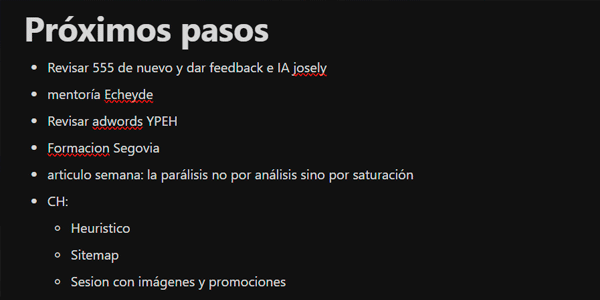
You can view it in your browser or download its mobile and PC application.
The free plan is more than enough.
Prioritize. Learn how
This may be very easy for you if, as I said earlier, you have a competent boss, but it may not be if that is not the case.
So the first thing you have to do is learn to do it yourself.
To do that, establish criteria such as:
- Deadline.
- Value provided by the task.
- Estimated duration.
- Estimated effort—which is not the same thing, as I explained earlier.
- How much headspace it occupies: think about how completing some tasks “frees” your brain and puts you in a relaxed zone, while after finishing others you start the next almost without stopping.
- The client's real needs.
And based on them:
- Decide what you will do each day.
- And write it down in a tool. Like the next one.
Calendar
While Notion's ordering is enough when there are not too many tasks, during periods of task overload I need one extra step.
That consists of setting specific hours for each task and putting them in the calendar, so that I “force myself” not to go over the allotted time and to keep making progress on all of them:
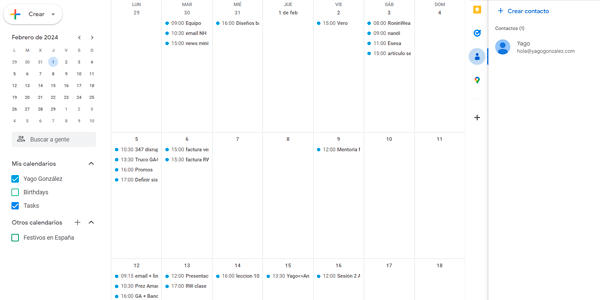
I use Google Calendar, but you can use whichever one you think meets your needs.
Avoid distractions
We said this is difficult when you have a team, but there are always things you can do. Such as:
- Turn off the visual and sound notifications on your phone.
- And those on your PC.
- Open your email only at specific times. For example, at the start of the day, at midday and just before you finish. Do not keep checking it constantly. Over time, you realize that nothing is that urgent.
- Use noise-cancelling headphones (the difference is genuinely surprising).
- Be assertive when necessary. And say, “I cannot right now; we will look at it later.”
Yes, you will not win the contest for the nicest colleague in the building, but what you are trying to gain is not that—it is time 😉
Create systems
Essential.
For every repetitive task. Spend time establishing the system and repeat it:
- Step 1.
- Step 2.
- Step 3.
- …
There will come a point when it is as automatic as driving. Or almost.
In addition, you do not have to stop at creating the system; you can go one—or two—steps further.
Automate. With AI and more
The first step is to automate—outside your brain—everything you can:
- Bank reconciliation.
- Daily or monthly reporting.
- Campaign management.
- Publishing on different social networks.
Whatever it may be.
Thanks to AI and tools such as Make and Zapier —as well as developers' code in large projects—you will save enormous amounts of time with this.
Document
And this is the second step.
Document the process or system. For yourself and for your colleagues.
As an essential part of systematizing, create Word documents, Excel files, Notion pages, mind maps or TXT files, but write down your processes.
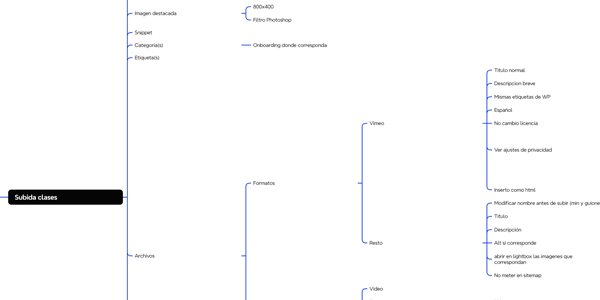
Do not entrust everything to your mind and memory; they are needed for more important things.
Track your working time
Right. We usually do not like this one much.
Perhaps because we think it is a waste of time.
Perhaps because you are a boss and see it as a weapon for your employees.
Perhaps because we do not like admitting how badly we estimate the dedication and effort a task requires.
But it is essential.
Knowing how long we spend completing a particular task.
And how many hours we spend weekly or monthly on a certain type of task.
Essential.
Otherwise, how do you expect to estimate correctly next time without knowing what it actually cost you to do something?
There are different methods, but for me the best in terms of “information obtained divided by implementation cost” is to use a backlog built in Excel.
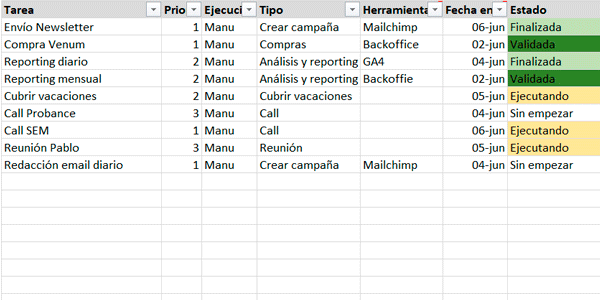
Do you like the fancy word? Want more information about it? Keep reading.
Agile marketing
Although it may look like one, a task backlog is not just a document. It is much more.
It is the first step in an agile methodology—or “agilism,” a term I really dislike—that goes much further.
I am not going to unpack it here because in this other article I go into detail on how to apply agile methodology to marketing and its many advantages.
And yes, I start by explaining what a backlog is and how it can be used.
If you want to live better while meeting your goals, take a look.
The 5-minute rule
We are nearly finished, but before closing I want to mention a few habits I have acquired that work for me.
The first is this: if a task takes me less than 5 minutes from the moment I see it until I finish it, I do it immediately.
The reason is twofold:
- My brain does not have to process all the information needed to carry it out more than once: the first time I review it. That is time gained.
- I get it out of my head: it no longer occupies space in that “I have to do this” group. Yes, I could write it in Notion, but I reserve that for tasks that take longer.
The eat-the-frog rule
Taken from Brian Tracy's productivity book, it says that we should tackle the task requiring the most effort first thing in the morning, when we are freshest after resting and have the most energy.
In my case, I can confirm that it works.
However, there is one exception: days when, for whatever reason, I do not feel strong enough to tackle the frog as soon as I start.
On those days, I begin with something gentler and easier that acts as lubricant, gets my brain moving, puts me in “ON mode,” and then I go for the frog. Like a Disney princess.
As Plato said:
Plato
“The beginning is the most important part of the work.”
PlatónBut remember, this is for very isolated days.
Background music
I can work without music, no problem. As long as there is relative silence, of course. Like in a library, where you hear a few footsteps—stiletto heels if you are in the Law School library.
However, after you have been working for a few hours and tiredness starts to take its toll, playing music that motivates me in the background helps me push a little further and keep “doing things.”
In my case, it has to be instrumental and must not distract me.
It is very different from what I play when I go running, for example, but the goal of lifting my mood is the same.
Switch off
This is a tough one if you are self-employed. But with time, it is possible.
At first, when you are starting out and need to win or retain your first clients, the truth is that unless you are brilliant and finish everything in far less time than you bill, it is hard not to think about work while training or watching a series on Netflix at night.
But as your client portfolio grows and becomes better defined, you will be able to do it.
You will already have demonstrated your value, you will have a steady workflow and you will be able to set your own deadlines.
And if you set reasonable ones, it will not be utopian to shut down your PC at the time you consider appropriate on 95% of days: 5, 6 or 7 p.m., 12 noon… Whatever you think is best.
For what it is worth, mine is 7 p.m. And except for the occasional mentoring session, I am managing it.
In addition, I am absolutely clear that one of next year's priorities is to bring this finishing time.
Bonus: a healthy lifestyle
This solution is not specific to this problem, but applies to everything in general.
There are certain things worth doing whatever your age:
- Eat well.
- Exercise.
- Get enough rest.
If you follow these three recommendations, you will wake up each day with much more energy to tackle your tasks, along with many other benefits for your body.
Habits, habits, habits.
Build good habits that help carry you through the times when you are feeling weaker.
And that brings this article to a close.
It is quite different from what I usually write, but I think it may help many people who are not trying to become productivity gods—for that, the systems and methods are different—but who do want to deal with a common problem: having too many tasks.
If you liked it, you know you can subscribe here and receive an article about digital business and everything surrounding it in your inbox every Thursday.
Like this one.

Leave a Reply