
In 1983, three years before The Dark Knight Returns and Watchmen shook the American comics market, Frank Miller published a work that showed just how far an author could go when given virtually complete creative freedom: Ronin..
After revolutionising Daredevil at Marvel, Miller moved to DC Comics to write and draw a six-issue miniseries that broke with many conventions of mainstream comics. There were no familiar superheroes and no existing continuity to follow. With longer, more lavishly produced issues than usual, he could experiment with what comics could do.
The result was a blend of many of his obsessions that would return in his later work: East Asian culture, samurai, demons, science fiction, psychic powers and a dystopia shaped by technology and military power. More than forty years on, the comic still surprises me with its ambition and extraordinary artwork.
Ronin isn’t a perfect work, as we’ll see. That’s why it didn’t make it onto my list of the ten greatest comics of all time, but it came very close.
A formidable graphic novel that falls just short of a masterpiece and is probably my favourite Frank Miller work alongside Elektra: Assassin and The Dark Knight Returns, even above classics such as Born Again or Batman: Year One..
Ronin's plot: samurai, demons and science fiction
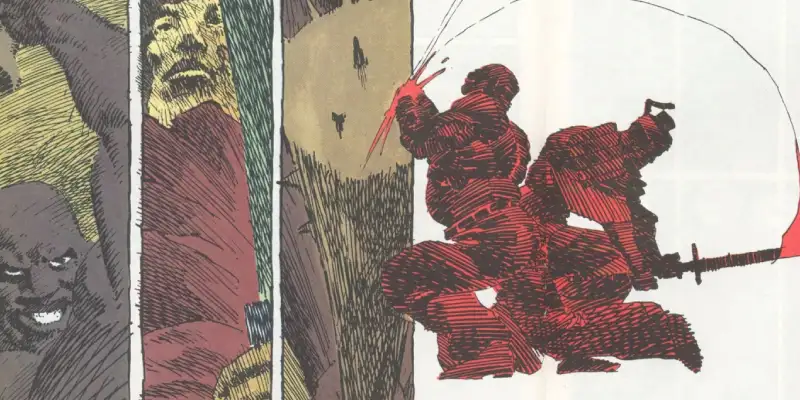
The story begins in feudal Japan, where a young samurai serves his master, Lord Ozaki. When Ozaki is killed by Agat, a powerful demon, the warrior becomes a ronin: a masterless samurai condemned to wander until he avenges his lord's death.
But what looks like a traditional tale of honour and revenge soon takes an unexpected turn.
The action shifts to a futuristic New York, now a decaying, violent city divided among rival factions. There stands Aquarius, a powerful corporation developing biocircuitry, technology that combines electronic components with organic structures.
Its facilities house Billy Challas, a young man without limbs who possesses extraordinary telekinetic abilities and has a close relationship with Virgo, the artificial intelligence that controls the complex.
When the samurai and the demon appear in this future, the stories of both worlds begin to intertwine.
From then on, Miller builds a tale in which nothing is quite what it seems, and reality, technology and fantasy prove harder to separate than you might think.
A story that never stops transforming
One of the great strengths of Ronin is the way it steers you through the story. Just when you think you know what’s going on, it turns out to be something else. Or does it? There’s a third possibility.
Miller knows exactly how to play with our expectations, choosing what to reveal, what to leave out, and when and through whom to reveal it..
The comic initially appears to be a story of samurai and demons, then turns into a science-fiction adventure set in a decaying future, before finally revealing that the real conflict is something else entirely.
What's remarkable is that these transformations don't feel like a string of improvised ideas. Miller places pieces that initially seem disconnected but ultimately make sense once we understand all the relationships between the characters.
The author knows how to play with information and our expectations. He makes us accept certain situations, steers us towards an apparently obvious explanation and, just when we think we understand what's happening, changes our perspective.
It's experimental in every respect, both in its plot and its artwork. More on that later.
It's also true that some of these twists rely on fantastical elements you have to accept without asking too many questions. The final revelations aren't always as convincing as the excellent journey leading up to them.
Frank Miller's obsessions: violence, samurai and corruption
Although Ronin looks quite different from Miller’s other work, it contains many of the themes that would define his career.
The first is the individual fighting a corrupt system. Miller is clearly drawn to lone figures who take on the most powerful institutions, even if it means resorting to questionable methods.
We had already seen this in Daredevil, with Matt Murdock taking on Kingpin's criminal empire, and we'd see it again in Elektra: Assassin, in Batman: Year One and, in fact, in most of his work.
In Ronin, corruption is not limited to crime or institutions as it is in Daredevil. It also affects a society that has turned technological progress into a new form of power.
The second great obsession is Japanese culture..
The Hand’s ninjas, Stick and Elektra had already shown how much inspiration Miller drew from martial arts and East Asian traditions. Here he takes that interest further, making the samurai code, honour and revenge essential elements of the story.
We also find eccentric supporting characters, grotesque creatures and moments of humour reminiscent of his Daredevil. The ronin's first companion, for example, resembles the minor crooks Miller used to create comic situations, such as Turk or Grotto.
Even certain monsters, such as a multi-armed, rat-like creature, seem to belong to that universe of bizarre beings the author mixes into his work and handles so well.
These aren't direct references, but they reveal an artistic personality that remains recognisable even when Miller changes setting.
Ronin's artwork: a genuine work of art
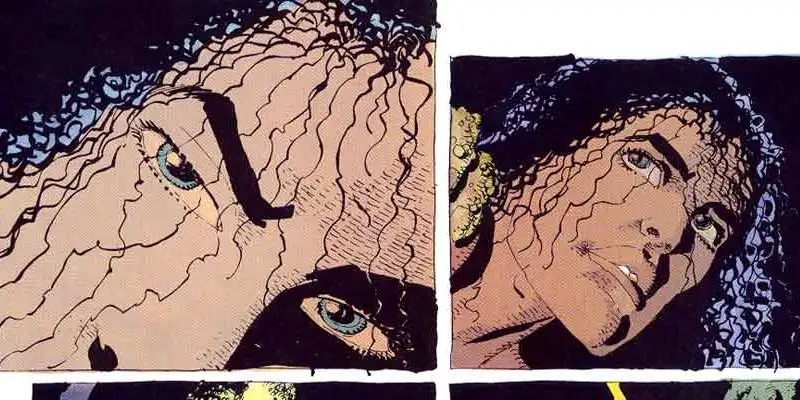
The script is good, but it’s the artwork that makes Ronin an extraordinary comic.
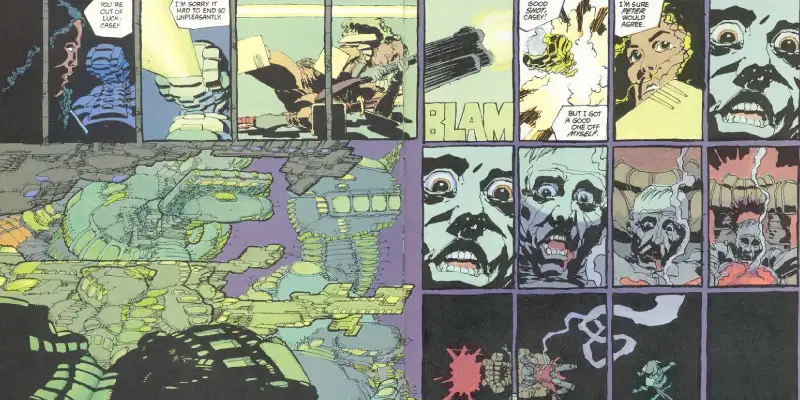
Frank Miller uses the pages with a freedom that still surprises today. We get compositions dominated by narrow vertical panels, sequences unfolding horizontally, full-page illustrations and scenes where movement seems to break through the traditional boundaries of the panels.
Some pages and panels are genuine works of art.
Most interestingly, Miller doesn't merely develop the style he had perfected on Daredevil. Here he brings in very different influences and builds something new out of them.
The influence of Japanese manga is obvious, especially Lone Wolf and Cub, by Kazuo Koike and Goseki Kojima. Miller adopts their way of depicting movement, violence and the passage of time during confrontations.
But there's also a huge European influence. The futuristic settings evoke Moebius, the hatching brings to mind Enki Bilal , and the large areas of black recall Hugo Pratt..
These are influences Miller himself has acknowledged, and they explain why Ronin has such a different identity from conventional early-eighties American comics.
Lynn Varley's colouring deserves special mention. Her work is relatively simple, with a palette that avoids overloading images and uses colour to reinforce the differences between settings. Rather than weakening the art, it makes Miller's compositions stand out even more.
Of course, all this experimentation comes at a cost. Some sequences are hard to follow, especially towards the end. At times it's difficult to work out exactly what's happening, and you have to stop at a panel or page for several seconds to decipher it.
Yes, the storytelling is weaker than in other works, but aesthetically and stylistically this is one of the artist's greatest achievements. Without a shadow of a doubt.
Aquarius and Virgo: surprisingly relevant today
One of the things that struck me most when rereading Ronin was how relevant some of its ideas still feel.
Aquarius is a technology corporation that has developed biocircuitry capable of reorganising, repairing and reshaping itself. Its operation depends heavily on Virgo, an artificial intelligence that controls the facilities and contributes to the technology's evolution.
In 1983, such a premise belonged firmly to science fiction. Today it's impossible to read it without thinking about the growing presence of artificial intelligence in our society.
The comparison that immediately came to mind was Palantir, a company that develops data-analysis and artificial-intelligence tools used, among others, by military and intelligence organisations.
The military use of AI makes this reflection even more relevant today, as systems now exist that can analyse sensor data, help identify targets and automate certain military functions . Weapons with varying degrees of autonomy also exist.
Ronin takes this idea to the extreme with Virgo, who brings to mind HAL 9000 from 2001: A Space Odyssey, GLaDOS from the video game Portal and even Skynet from Terminator..
Virgo speaks with HAL’s calm, seemingly rational tone, even as she manipulates the people who depend on her. Like GLaDOS, she gets some terrific lines, especially in the final third. And like Skynet, she embodies the threat of technology turning against its creators.
And speaking of dialogue, Miller shows a remarkable ability to build characters through it. Everyone, even the supporting cast, has a recognisable voice, a particular way of speaking that helps us understand their personality and relationships.
Characters, relationships and a few weaknesses in the script
The ambition of Ronin is also reflected in its characters.
Casey McKenna is one of the most interesting. A strong, determined female character. As Aquarius's security chief, she plays an active role in the story and offers a perspective different from the samurai's. She doesn't simply accompany him: she makes decisions, investigates and faces situations other characters aren't prepared for.
However, their romantic relationship feels somewhat forced and is one of the script's less convincing aspects, though I understand why it is that way.
Something similar happens with some explanations near the ending.
Miller manages to make the events fit together, but certain elements seem to work simply because the plot needs them to. Virgo's ultimate motivations, as explained by Dr McKenna, raise questions that don't always receive satisfactory answers.
The work asks us to accept a combination of psychic powers, technology and fantasy whose internal logic isn't defined consistently throughout. Even so, the climax is immensely powerful, especially thanks to extraordinary artwork, accompanied by several fold-out pages..
The final explosion of telekinetic energy and the destruction it causes inevitably recall Akira, by Katsuhiro Otomo, through the combination of psychic powers, transformation and urban catastrophe.
The similarities are visual and thematic, with no clear evidence of direct influence. The Akira manga began publication in 1982, while its famous film adaptation arrived in 1988, long after Ronin..
Speaking of the ending, it also retains some ambiguity about Billy / Ronin's identity and Virgo's disappearance, one final invitation to interpret what we've just read. Everyone can settle on the interpretation they prefer. I'm clear about mine.
Ultimately, not every piece of the work is perfect, but together they have an unforgettable force..
Conclusion: a formidable, if imperfect, graphic novel
Ronin is one of those comics that show why Frank Miller became one of the most important creators in the history of the medium.
It's ambitious, daring, deeply personal and visually extraordinary. It combines very different storytelling traditions, experiments with the possibilities of the page and builds a story that continually surprises the reader.
It has flaws too. Some compositions are confusing, and certain explanations at the end demand too many leaps of faith. Those problems stop it from being a masterpiece, although it comes very close.
What I find undeniable is its immense personality. . Ronin hasn't dated, and its reflections on artificial intelligence, technological power and the relationship between individuals and large organisations feel even more thought-provoking now than when it was published.
It's a comic that probably won't appeal to everyone. Its experimental nature, shifts in direction and the freedom with which Miller constructs the tale may unsettle anyone looking for a conventional narrative.
But that’s a big part of its appeal. It may not be Frank Miller’s most accomplished work, but it’s certainly one of the works that best represent his talent, ambition and desire to push the language of comics beyond its usual limits..
A formidable graphic novel and one of my favourites in Miller’s entire body of work.
The best of Ronin
- Its extraordinary artistic and narrative ambition.
- Frank Miller's artwork, full of stunning layouts and panels.
- The distinctively personal way Miller draws on manga and European comics.
- Lynn Varley's simple yet extraordinarily effective colouring.
- The plot twists and the way the story keeps reinventing itself.
- The continuing relevance of its ideas about artificial intelligence and technological power.
- The dialogue, especially Virgo's and Billy's.
The worst of Ronin
- Some visual sequences are confusing, especially near the ending.
- Certain motivations and plot explanations are unconvincing.
- Its experimental nature may make it harder for some audiences to read.
Technical details
| Feature | Information |
| Original title | Ronin |
| Writer | Frank Miller |
| Artist | Frank Miller |
| Colouring | Lynn Varley |
| Lettering | John Costanza |
| Publisher | DC Comics |
| Original publication | 1983–1984 |
| Original format | Six-issue miniseries |
| Genres | Science fiction, samurai, dystopia, action and fantasy |
| Country of origin | United States |
Rating
Who it is for
✅ Frank Miller admirers who want to discover one of his most personal works.✅ Readers interested in graphic experimentation and the storytelling possibilities of comics.
✅ Fans of Japanese manga and European science-fiction comics.
✅ Anyone who enjoys stories that mix genres, play with expectations and constantly surprise.
✅ Readers interested in technological dystopias and stories about artificial intelligence.
Who it is not for
❌ Anyone who prefers straightforward, conventional storytelling.❌ Readers who value visual clarity over graphic experimentation.
❌ Anyone who needs fully resolved, coherent explanations for every fantastical element.
❌ Fans looking for a traditional samurai adventure or superhero story.
Frequently asked questions
What is Frank Miller's Ronin about?
Ronin tells the story of a samurai from feudal Japan who mysteriously appears in a futuristic New York dominated by violence and technological development. There he encounters those running Aquarius, a powerful corporation controlled by an artificial intelligence called Virgo. The story blends action, fantasy, science fiction and mystery.
How many issues does Ronin have?
The original work consists of six issues published by DC Comics between 1983 and 1984. It has since been collected in various complete editions, with differences in format and length.
Is Ronin a standalone work?
Yes. Ronin is a self-contained story created by Frank Miller and doesn't belong to the Batman, Daredevil or other superhero universes. You can read it without knowing any of his earlier works.
What influenced Frank Miller when creating Ronin?
Miller has acknowledged the influence of the manga Lone Wolf and Cub, by Kazuo Koike and Goseki Kojima, as well as European artists such as Moebius, Enki Bilal and Hugo Pratt. These influences appear both in the depiction of movement and action and in the futuristic settings and page compositions.
Who is Virgo in the comic Ronin?
Virgo is the artificial intelligence controlling the Aquarius technology complex and has a close relationship with Billy Challas, a young man with extraordinary telekinetic powers. Her role is fundamental to understanding the story's events and major revelations.
What do Ronin and Akira have in common?
Both works combine science fiction, psychic powers and urban settings subjected to spectacular destruction. The manga Akira began publication in 1982, and Ronin appeared between 1983 and 1984. There are thematic and visual similarities, but it hasn't been established that the ending of Ronin is a tribute to Akira.
Is Ronin still worth reading today?
Yes, especially for anyone who enjoys ambitious, experimental comics. The artwork remains immensely powerful, and its ideas about artificial intelligence and corporate power feel surprisingly contemporary. That said, its visual storytelling and some liberties with the plot can be demanding.

Leave a Reply