
Yet another marketing buzzword.
One of those that had its moment of glory. That period when, for a while, everyone is talking about it.
Smoke and mirrors. Lots of smoke and mirrors.
Or is it?
Well, no.
Honestly, it isn't.
Not when your project reaches a certain level and you want to keep growing.
In this article, I'm going to talk to you a little –or a lot – about the subject.
We'll see what it consists of.
How it differs from multichannel, which looks similar, but isn't the same thing.
The advantages of the omni.
approach, real business cases I've been involved in, with specific examples and how we tackled them. So they can serve as a model and you can use them for your own.
And advice on how to develop this strategy depending on where you're starting from. Because moving from physical to digital isn't the same as doing it the other way around.
Like I said, a pretty comprehensive article.
Grab a coffee and let's get started.
What is omnichannel?
To define omnichannel, I'm going to turn the issue on its head. In other words, I'm going to explain what it isn't.
And what omnichannel isn't is multichannel. They sound similar because they have things in common, but they're not the same. The change in approach matters.
So the first thing is to see how they are alike and, above all, how they differ.
Difference between omnichannel and multichannel
I think that if I talk to you about multichannel in relation to a business, you'll have a pretty good idea of what it is: the use of multiple channels to communicate, promote or sell a product or service.
Generally, these three main channels are distinguished:
- The physical channel.
- The digital channel.
- The telephone channel.
So, when a business uses two or three of these channels, it is said to be multichannel.
And that's what most traditional businesses from the physical world have done when moving online: stopped at the point of opening a new channel.
And that's not bad. It's just that, at a certain point, this approach is sometimes not enough.
No, because it creates friction and pisses off the business's customers.
Or don't you remember calling Movistar and being told that, for the offer you'd seen advertised, you had to go to your nearest store.
You really loved that, didn't you?
Or when you bought a product on the El Corte Inglés website and had to pay shipping costs even though there was a store right across from your home. A store that didn't have the product and told you it was online-only and that you had to buy it on the website.
Great too, right?
I could go on, but I think these two examples get the point across.
These businesses were multichannel, but not omnichannel, because they followed separate strategies in each channel.
As you can see, it doesn't seem like the best option for the customer…
And it isn't.
So why open several channels?
Reasons for multi- and omnichannel
I'm going to explain them based on each channel.
Importance of the digital channel
I think that if you're reading something on my website, you probably have few doubts about the importance of the digital channel. But just in case your physical business is doing so well that you're still skeptical about digital, here are some figures:
- 90% of Spanish customers buy online.
- Which means that ecommerce in Spain is growing at a rate above 22% per year (let's see how many sectors can say the same).
- And it generates more than 20 billion euros in revenue in our country in the second quarter of 2023. We have almost certainly exceeded 100 billion euros for the whole of 2023.
- In turn, all this activity means that one third of air-freight goods are related to online sales. In other words, it moves the needle considerably for other sectors.
Okay, fine, but that's about ecommerce. And you might tell me that your business is a law firm or a psychology practice…
Well, I've got info for you too:
- 46% of all Google searches are local searches.
- 72% of consumers who perform a local search visit a store within an 8km radius.
- 82% of people who perform a local mobile search visit a business within the next 24h.
- More than 58% of local businesses have not claimed their Google profile.
- 56% of actions on business profiles are website visits, while 24% are phone calls.
And wait, there's more. Let's talk about the reviews of your business that people are leaving –whether you like it or not– on the Internet:
- 92% of consumers read online reviews before visiting a local business.
- 88% of consumers trust online reviews as much as personal recommendations.
- 93% say online reviews influenced their purchasing decisions.
- Less than half of consumers would consider using a business with fewer than 4 stars.
I think that whatever type of business you have, having a decent digital presence and looking after your online reputation (ORM) is essential. Unless, of course, you want fewer people walking through the door every day without knowing why.
Importance of the traditional channel
It doesn't seem like a coincidence that all the major online stores and brands have opened a physical channel.
I'm talking about the biggest ecommerce businesses, such as PcComponentes or TiendAnimal, and also Digital Native Vertical Brands (DNVB) such as Blue Banana, FootDistrict, Freshly Cosmetics, Tropicfeel, PDPAOLA, HOFF, Alohas…
All of them hugely successful online and all of them opening a physical channel to grow further.
Because after internationalization, if you want your digital business to generate more revenue, you have to move into the physical channel.
Looking at all these examples, it couldn't be clearer.
Importance of the telephone channel
You may not have expected this one.
But look at what the Infoadex annual report on advertising investment:
tells us. Within what they call “estimated media” (the old-school BTL ) telephone marketing, with investment of almost 2 billion euros, is the channel that takes the biggest slice of the pie.
We're talking about the fact that exceeds total investment in television, just think about that.
And if it's growing by 10% compared with 2022, it's because it works. No more, no less. Even if it ruins your nap.
Later I'll tell you about a real case of my own that fits perfectly, so you can see how effective this channel is for selling certain services.
First, I'm going to show you a couple of images:
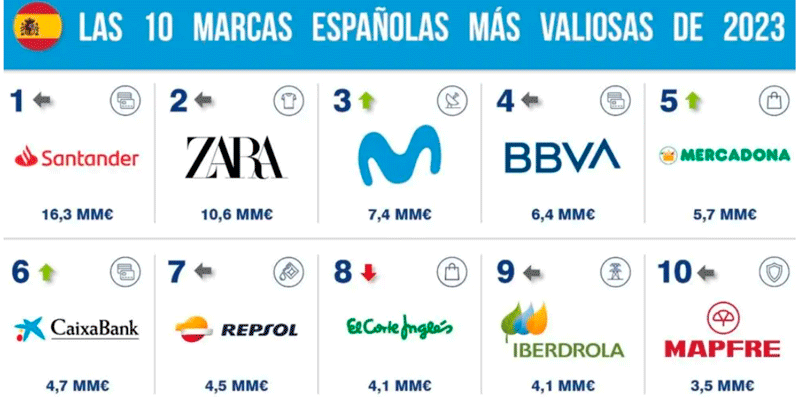
This one shows the 10 most valuable Spanish brands in 2023 according to the Brand Finance report.
It won't come as a surprise that all of them, perhaps with the exception of Repsol because of its product, are genuine multichannel powerhouses.
But even if we narrow it down further and focus on a single channel –looking for the leading ecommerce businesses in Spain – we can see that the vast majority have a very significant physical presence:
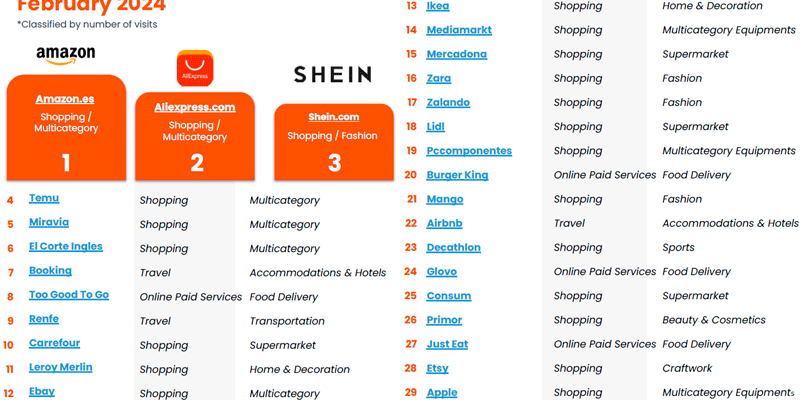
In my view, this makes it crystal clear that, in Spain, the vast majority of successful projects are, at the very least, multichannel.
Omnichannel, however, is something we'll now see doesn't apply to all of them.
Omnichannel strategy
So far I've explained the importance of each channel and why, for a company born in one of them, it can be interesting to make the leap to another one or more.
But as I also said, this approach –simply opening a new channel and managing each one completely independently– is more typical of 10 years ago, when customers weren't as digitally advanced.
It still happens today, but mainly in small and medium-sized projects. In large ones it's getting harder to find every day. Because creating friction for your customer is usually not a good idea, which is often exactly what happens if we stop at this point.
That's why, for several years now, companies have been considering a change of focus, which consists not of reaching a customer through multiple channels, but of putting the customer at the center and understanding what they can expect from each one.
In other words, something like this:
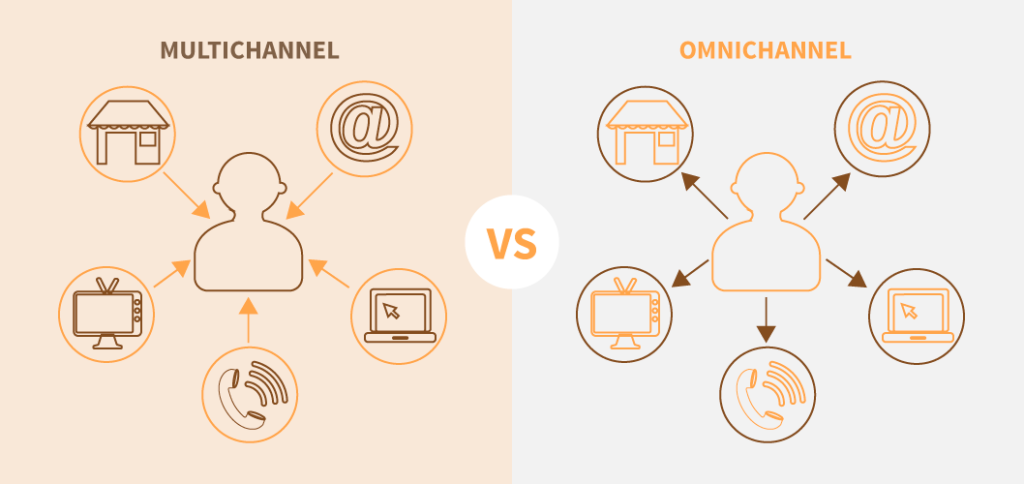
That's the difference between multichannel and omnichannel. And moving from one to the other requires certain general changes in approach. Mainly thinking about how to provide a global, unified experience at every touchpoint:
- Same purchase price for the product or service across all channels. No “web promo” or “go to the store”.
- Same sales pitch and same response to complaints. You can't have the same question or issue answered one way in a store, another way on social media and yet another way by phone.
- Same technological systems. Or, if major constraints mean the database can't be the same, at least make sure it is synchronized across each channel's systems.
- Properly record every customer contact with the company, so that their CRM record reflects absolutely everything.
- Look for synergies between channels. Examples: I order a coffee from Starbucks in the App and pick it up 10 minutes later on my way to work. Or I buy online at Zara and, if it doesn't fit, return it in the store.
- Adapt the message to the channel, not the other way around. In other words, your brand proposition is always the same, across every channel, and if your tone is friendly, you'll be friendly when customers call you or when you speak on social media. You won't start making memes on TikTok just because that's what works on the platform.
In an omnichannel strategy, the business is a single entity, however many legs it may have, but always consistent. And you should try to make the customer feel that consistency at every touchpoint (advertising, ATC, brand image), because it's extremely positive, since brand consistency builds trust and increases brand recognition and differentiation.
Advantages of omnichannel
Continuing with the advantages of this approach, beyond the consistency we just mentioned, the main advantage of omnichannel over multichannel is an improved customer experience.
Our users know what to expect from us, we're predictable. And that, contrary to what you might think, is fantastic. Or do you like surprises on your phone bill?
Exactly.
Generally, omnichannel brands achieve higher NPS (Net Promoter Score) values and find it easier for their customers to become brand advocates and ambassadors.
It makes sense: if the customer connects with the brand's message and that message remains consistent, never getting diluted anywhere, affinity becomes stronger.
But even when the touchpoint with our customer is about something negative, an omnichannel strategy is clearly better than a multichannel one.
Think about a time when you've had to make some kind of complaint.
You've probably had a bad experience like “we can't find what you're telling us in our systems” or “there's no purchase linked to your ID here”. How does that make you feel?
By contrast, when you complain and the agent says “yes, your complaint appears here, but it's still being processed”, the outcome of the call is the same (they haven't solved your problem), but the feeling is different.
And that's what you get from having unified systems.
I still remember the difference between Lowi's systems (designed from day one to be omnichannel) and Vodafone / Ono's, which multiplied everywhere: two CRMs, different systems for phone agents and physical stores, integration problems on the website…
I honestly think the work of many people –especially in ATC– trying to keep customers satisfied deserved a lot of credit given those difficulties.
Or, well, ask Alsa, the bus company, whose systems integration strategy earned it the Ecommerce Award 2023.
Also, interestingly, unified systems are cheaper to develop and maintain. Assuming they've been considered from the start, of course.
And this, cost savings, is the third advantage of an omnichannel strategy. And it's hardly a minor one.
Unified management of purchasing, logistics and ATC avoids duplicated operational and management roles, as well as delivering economies of scale.
Of course, this goes hand in hand with inventory and logistics optimization. Having a single stock pool and being able to manage it according to demand from each channel makes us more agile and means we need less total stock than if we managed each channel independently.
So far, those are the clearest advantages of one multi-channel approach over the other, but I want to mention a couple of advantages shared by both omnichannel and multichannel:
- Expand customer reach: if I use just one channel, I'm sure some customer group slips through the cracks. If I use two, fewer do. And if I use all three, I may be close to reaching 100% of my potential customers.
- Diversification: the pandemic is too recent to forget. At that time, when (almost) every physical business had to close, more than one owner was tearing their hair out for not having launched a digital channel earlier. It's never a good idea to put all your eggs in one basket.
Examples of omnichannel companies
Here I'm not going to talk about the classic examples (Disney, Starbucks, Apple…) you can find in the first Google results, but about real businesses and cases I've directly worked on or built, so you can see things that might apply to your own.
TiendAnimal: digital pure player that moves into physical retail
When I joined, the business was an ecommerce company. One that was battling several others in what was then the less competitive pet-products sector.
Although it was an online store –or perhaps precisely because it was– the telephone customer service channel used the same systems as the end customer. In other words, when a customer called to create an account or place an order, the agent did exactly what the customer would do from their PC.
Exactly the same.
This exposed any possible errors a customer might run into.
On top of that, because we did things very well, we grew enormously. And at a certain point, we considered opening a physical store.
And we opened one.
A store we put a lot of care into. And since things you put a lot of care into generally work, that pilot store was a success. That led to another 10 opening before the company was sold, which helped increase the sale price.
The physical channel worked really well, so the new owners continued expanding until reaching the more than 100 stores that currently exist in Spain.
But besides the huge increase in revenue, opening stores brought us something else.
You see, a few years earlier, in 2013 or 2014, we took part in different pet-related events and trade fairs.
On those tours, we were at Ifema in Madrid, at a huge event where we had an equally huge stand, where former Queen Sofía even took a photo with us.
Well, despite TiendAnimal being the online leader in Spain at the time and billing several tens of millions of euros a year, most people attending the fair didn't know us. And we're talking about an audience of pet lovers, so you couldn't ask for a better fit.
However, a couple of years later, with quite a few stores already open across the country –several of them in the capital– I started working at Vodafone. And by then (almost) everyone knew the company.
Because all my new colleagues had pets?
Could be, but no. It was the power of the physical channel.
Lowi: omnichannel service sales from day one
The brand was born under Vodafone's umbrella, as an MVNO (mobile virtual network operator) that allowed the reds to compete in the low-cost segment.
That's how it started, offering only mobile plans and selling services through all three channels: web –the main one–, telephone –only inbound (incoming calls), not outbound (outgoing)– and physical, in MediaMarkt stores –not Vodafone stores–.
As with TiendAnimal, the management system was designed to be a single system that could adapt to and support every channel, so there was no problem there.
The problem came when Lowi grew and started selling fiber.
At that time –mid-2017, if memory serves– it still wasn't common to sign up for fiber online.
For those services, people called (it's amazing how much things have changed in just 7 years). Back then, it seems that having a flesh-and-blood person on the other end of the line gave us more confidence for certain things.
And, of course, the online channel suffered.
For a while, it stopped being the favorite child.
The in-person channel and, above all, the phone took over. We even started making outbound calls in an effort to hit the ambitious targets.
And thanks to that omnichannel setup, we got close, even though we didn't quite make it. If we'd relied on digital, we'd have got absolutely nowhere with fiber. That's how clear it is.
Yo pongo el hielo: from digital to multichannel. And from there to “semi-omnichannel”
It's curious how every business adapts differently to its circumstances.
We created Yo pongo el hielo following TiendAnimal's example: online plus phone-assisted sales.
Up to that point, everything was the same. The difference was that, unlike what we did with the pet business, Yo pongo el hielo hadn't yet reached the stage where it needed to grow by opening a physical channel.
And yet we partnered with a company specializing in physical distribution to the Horeca and wholesale channels. With them, we also opened physical stores under another brand (ComenXall).
The point is that, without really planning it, circumstances made us multichannel. And as a group, that helped us get through the pandemic well.
Today, you can't say we're fully omnichannel, because each side operates under a different brand, but we do enjoy some of the benefits of this strategy: unified purchasing and stock, the same sales prices and systems that, while not identical, are unified and synchronized.
García Méndez Abogados: a local physical business that acquires customers digitally
The final example I want to show you is a law firm. About as physical a business as you can get.
This firm was attracting some clients, but far fewer than they'd like. So they decided to open the online channel and hired me to do it.
Result: with a MINIMAL investment in advertising, two and a half months after launching the website, they're already looking for an assistant to help with all the new clients.
Not much more to add.
Challenges for omnichannel companies
However, while the advantages of using several channels are obvious, doing so with a coordinated omnichannel strategy has certain challenges.
The first is perhaps the one we've already mentioned: maintaining consistency across channels: giving the same answer in the same way on social media, by phone, in a store or via email isn't easy.
To do that you need a good CRM that records every contact with the customer. And good training for company staff, explaining how and why each interaction should be categorized.
Likewise, it can sometimes be difficult to keep prices consistent across all channels, especially if competitors in each channel offer customers better commercial terms than we do.
There's another problem that happens both ways, but perhaps more often with traditional companies moving online: they believe they can succeed with the current in-house team, without specialists in the channel they're trying to open.
I audit plenty of businesses whose internal teams have a serious lack of digital knowledge.
Instead of filling that gap with new hires, they try to solve it by outsourcing to agencies and external consultants, and the result is, at best, a short-term fix that creates long-term problems.
At worst, it's a Frankenstein digital strategy, mixing the different objectives of different agencies and resulting, in the medium term, in a hole in the channel budget.
Finally, and related to the previous point, lack of knowledge about the new channel means that the importance of synchronizing systems isn't taken into account.
What usually happens is that when the new channel is opened, different systems are set up for it, and they don't communicate properly with the existing ones.
In the short term, that's the fastest option, but in the medium term things get complicated. So if opening this new route is important, it's better to take this aspect into account and delay the launch a little in exchange for being absolutely clear about how the channels will communicate with each other. Or migrate to a single system, if that's the most appropriate option.
Process for developing an omnichannel strategy
Now that I've explained the (considerable) advantages of an omnichannel strategy and the challenges it faces, it's time to ask yourself whether a strategy like this fits your business.
If the answer is yes, this is what you're going to face.
If you started offline
I'm going to explain what I would do, step by step.
#1. Review ORM
In other words, look at what people are already saying about us online.
Start with reviews on Google, TrustPilot and Facebook. Create and claim the necessary accounts.
Encourage positive reviews.
Then, depending on how popular our business is, we should review the first Google results that talk about our business, including press releases, forums and news. And see whether everything is positive or how we can make negative results lose strength or ranking. If you don't know how, let's talk.
#2. Think about how the online channel can help us achieve the business's objectives
If I sell services, perhaps the answer is to create a proper corporate website and do some local SEO and SEM to generate leads or get customers to contact us.
If I sell products, it's probably worth setting up an online store or opening an account on a Marketplace such as Amazon or Ebay.
Help from AI
Just so you know, AI is here to help you in many different ways:
- SEO optimization.
- Help with product descriptions.
- And with translations.
- Social media content.
- …
Now you don't need an expert in every area, just time to research or someone on your internal team who's sharp enough and keen enough to learn and start doing it.
#3. Social media
I put them in third place and only as an optional step because I don't consider them essential at all.
It's only worth opening them if I'm very good at them.
If not, it's better to focus on the two previous steps, because otherwise they'll become a workload that brings us hardly any benefit.
If you started digital
And you want to open a physical channel, in my experience the challenge is understanding the channel's particularities. Specifically, those of your sector, which can vary enormously from one to another.
If all your experience is digital, don't underestimate how hard it is to succeed in the physical channel, because the rules are VERY different. Get advice and surround yourself with people who know it well (I'm telling you because I know: I've experienced it firsthand with Yo pongo el hielo).
On the other hand, the unified-systems part will come naturally to you. You'll know its advantages and you won't consider adding anything independent that can't communicate with your digital systems.
In both cases
Whether you're moving from physical to digital or the other way around, you're going to need a CRM that lets you synchronize communications across the different channels.
If you don't have a big budget, I'd recommend trying HubSpot.
Reasons? Several:
- The free version allows up to one million contacts. Believe me, that's a looooot of customers.
- It lets you synchronize all channels: the web CMS database, your website form, calls (optional, with several possibilities), WhatsApp, social media…
- You can add a free ChatBot if you're interested.
Once implemented –and used properly– it means we can have, in the customer record, every contact they've had with our business. That way we'll know what our colleagues in other channels have told them and we'll be able to maintain the consistency we've been talking about.
Another recommendation: make the business objectives global. Even if they're distributed by channel, try to get the people in each one to collaborate and work together, looking for synergies rather than conflict, which is what usually happens in multichannel.
Finally, put yourself in your customer's shoes and think about what you'd expect to be able to do in each channel. Work on anything you can think of that you're not doing yet.
Conclusions
After this extensive overview, I hope I've convinced you of the path your business should follow. It's hard to imagine omnichannel not fitting any successful project.
That doesn't mean you have to focus on this from the start. There are more important and simpler things, such as growing your main channel.
That said, with the data and examples in hand, consider its importance and don't lose sight of the advice I've mentioned here (systems, customer at the center, synergies…), because when the time comes –and let's hope it does– the transition will be much easier.
And if you think a bit of help would come in handy, you can contact me here to see how to approach your project. As you can see, it wouldn't be the first one I've worked on.

Leave a Reply