
For quite a few years now, digital businesses have been on everyone's lips.
The reason is simple: they make entrepreneurship -enormously- easier.
And they have no shortage of advantages, as you'll see throughout this article.
If you're interested in starting something but aren't exactly sure what, I think you'll find a bit of guidance here.
But before we start, if you already have a digital business, take a look at this because it might interest you:
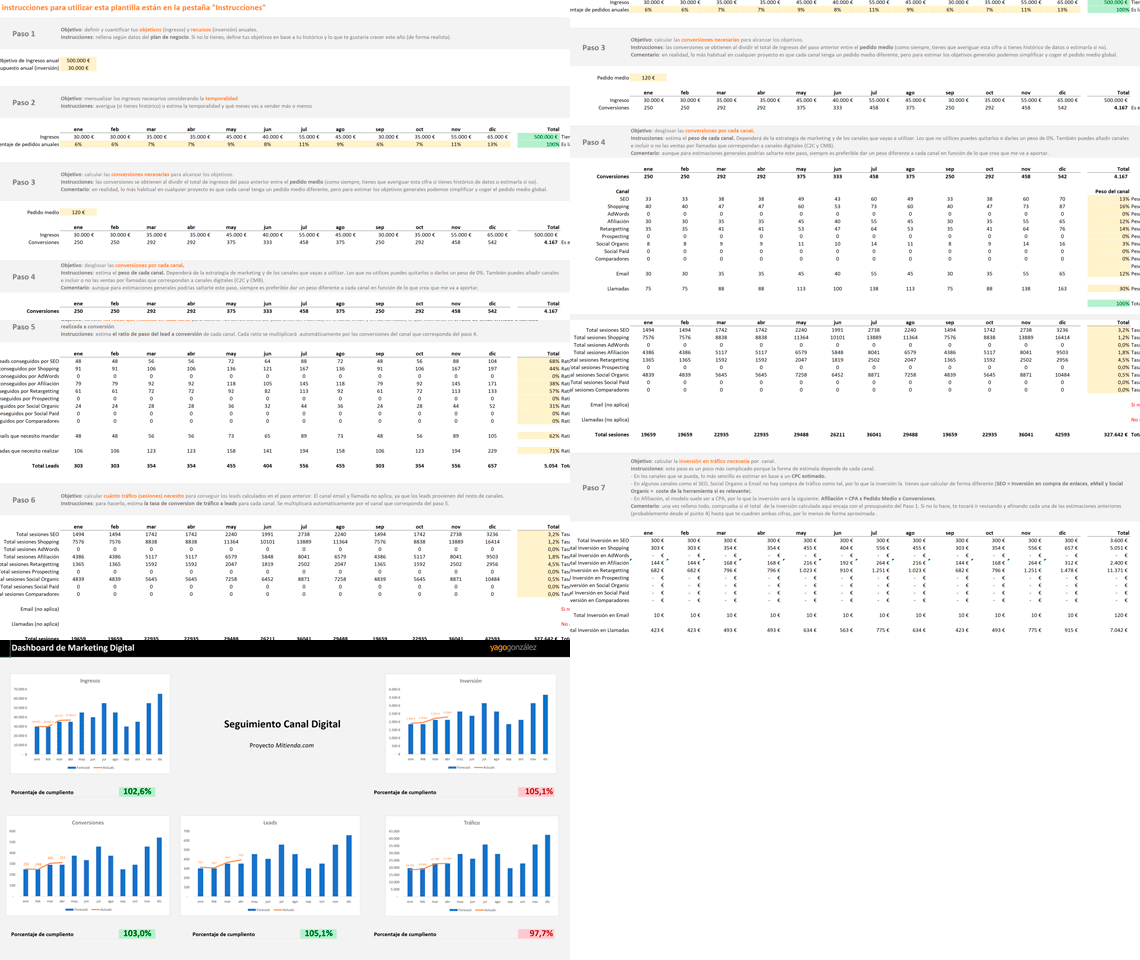
Allocate the budget and create different scenarios very quickly
Putting together the annual Marketing plan for an online store is a pain. Whether it’s a new store or one with history.
And if you also have to make the budget fit the required investment, even more so.
That’s why I use this template: I enter a project’s data and it returns the required investment with the figures updated. Without having to change formulas and calculations.
It’s not a bad way to get started with your ecommerce analytics.
Plus, besides the calculator, every day you’ll get a tip or piece of advice (a good one) in your inbox to improve your business or digital project.
Now, let's get to the different possibilities…
#1. Selling products online
Selling products will be one of the first types of online business that comes to mind.
After all, Amazon has been around for a long time now.
Business model
It's very simple: I buy goods and sell them at a margin, which will be my profit.
But within this same model, there are different possibilities.
Variants
You probably already know the three most common formulas.
Online store

It's perhaps the most common formula. The 2.0 version of the brick-and-mortar store we've always known.
We also usually refer to it as setting up "an ecommerce", although, technically speaking, the two concepts aren't exactly the same.
If you want to go deeper into the subject, here's another article where I explain the differences based on the types of ecommerce that can exist.
Characteristics
- It is an online store of your own, not a store on a marketplace (we'll talk about those next).
- They can sell a single brand (usually their own) or multiple brands (multi-brand distributor).
- Online stores use a CMS Open Source or a SaaS (Software as a Service) to manage everything: what the user sees and the operations behind it.
- Logistics can be handled in-house or through a dropshipping system.
- What will be 100% ours is the invoicing to customers and the management of customer service.
- We'll use different marketing channels to attract users to our website or app and get them to buy.
- Likewise, we'll apply concepts from UX or CRO to increase conversion.
- An online store can be of any size: from something tiny with only 10 products to monsters with tens of thousands of products.
- Likewise, you can run it as a self-employed professional (ideal for certain models) or directly as a company.
Examples
- Yo pongo el hielo (mine).
- Ikea
- Lidl
- Primor
If you're thinking of launching your own, I have a course on how to build an ecommerce business from scratch that might interest you.
Marketplace

If the online store was the digital version of the physical store, a marketplace is the shopping mall of the internet.
Here you'll find different stores selling their products on the platform.
Some products will be exclusive to one store, while others will be sold by different stores on the marketplace, each with a different price and shipping conditions, since each store sets its own.
This model has two parties that do business:
1. The marketplace operator
They are responsible for the overall management of the platform -like the manager or owner of the shopping mall- and will charge sellers:
- A monthly fee.
- A commission on each sale depending on the product category.
- Optionally, advertising within the platform that the seller buys. This is what is known as Retail Media.
- Also optionally, it may offer its own logistics systems to sellers.
In addition, it may or may not sell its own products there.
2. The sellers
They will publish their products on their marketplace profile (or store) and sell them at a margin.
It's similar to the online store model, except the platform isn't yours and you have to pay commissions.
In return, you don't have to manage any technology (you don't need a website, just a warehouse) and the reach and exposure are usually greater.
Characteristics
- In the case of the marketplace owner, if they don't sell their own products, we could call it a model of selling services and advertising.
- Sellers, on the other hand, make money based on the margin on sales.
- They can use their own logistics or the marketplace's (paying for it in either case).
- This model is great for brands, which upload their products to the platform, controlling -more or less- the prices.
- For companies that distribute several brands, joining may not be worthwhile because of the commissions.
- Improving the platform is up to the owner. Sellers can do little beyond designing their stores and setting prices.
- The invoicing to customers may be handled either by the marketplace or by the sellers.
- The customer service will be handled by the marketplace.
- If you're a seller, you can manage both as a self-employed professional or as a company.
Examples
- Amazon.
- Ebay.
- AliExpress.
- PcComponentes (it started as an online store).
As you can see, there are generalist marketplaces alongside others that are specialized in a specific sector.
If you have a physical business, it's an easier way to sell online than setting up an online store.
Digital second-hand platforms

Once again, we have a system that existed before the arrival of the internet -that of the classified ads– updated for the new digital age.
And again, as with marketplaces, there are two ways to do business:
1. Platform owner
They are responsible for managing it and getting users to use it.
They charge in three ways:
- Commission on sales involving shipping, as "insurance".
- Advertising: bought by advertisers on the platform to give their products visibility, plus spaces reserved for other advertisers, usually purchased by retargeting networks.
- Probably a small margin on the shipping fee paid by the seller who ships.
Important: if the sale between users takes place in person and in cash, the platform doesn't take a commission.
In return, it won't offer any insurance or guarantee either.
2. Sellers
They can be private individuals or professionals.
In fact, although products make up most of what is sold, you can also find some services (plumbers, IT technicians…)
Characteristics:
- When there are shipments, the logistics provider is chosen by the platform. Unless you want to close the deal outside it, which isn't very advisable.
- Depending on the platform, the commission on shipped purchases, charged as insurance (not to be confused with shipping costs), may seem high, around 10%, but the buyer pays it.
- Although the conversation takes place between buyer and seller, if there is any problem, the customer service will be handled by the marketplace.
- If you're a professional seller, you can manage billing as a self-employed professional or as a company.
- These platforms can give rise to businesses in a legal grey area. Or outright illegal ones. And I don't mean selling products or services prohibited by law (such as drugs and the like), but people who are effectively professionals making money here without declaring taxes, registering as self-employed, issuing invoices or offering the legal guarantee…
Examples
Here, although most platforms are generalist, you may also come across one that is sector-specific, such as Vinted, which specializes in clothing.
#2. Selling services online
After products, this is probably the second type of business that will come to mind. After all, it's also about doing online something -selling services- that has always been done through other channels.
Business model
Although in general the model will be exchanging time for money, there are some specific cases, such as SaaS or other particular services, where that's not exactly how it works.
Let's look at all the possibilities.
Variants
Bear in mind that these models apply both to self-employed professionals / freelancers and to companies or agencies.
Digital professions

This group includes professions that were created (or expanded) with the arrival of the digital sector and that, moreover, only require a PC to perform them.
- SEO.
- Traffic manager.
- Copywriter.
- Community Manager.
- Designer / Video editor.
- Analyst.
- …
Traditional professions adapted to the digital channel

For example:
- Locksmiths.
- Plumbers.
- Doctors.
- Psychologists.
- Real estate agencies.
- Restaurants.
- Car dealerships.
- …
And anything else you can think of. The list would be endless.
Very, very few service-based professions today can get by without a digital side.
On the other hand, the marketing activity and its channels can change quite a lot compared with what we saw for product sales. Directories are very common here.
SaaS and other services

We can also buy other types of services online that don't require a person's working time for us to enjoy them.
I mean paying for plans for:
- SaaS tools: such as Canva, Dropbox or ChatGPT (SaaS).
- Other services: such as streaming (Netflix), financial services (Wise) or internet services (Lowi), among many others.
The company offering them charges us a monthly or annual fee that lets us use them, but it isn't an exchange of time for money as in the previous service-sales models.
These types of businesses usually have high barriers to entry, so this model is limited de facto to companies.
#3. Selling digital content
Now we're getting into less familiar types of online businesses.
Or ones we consider less plausible. Especially if we're already a certain age.
In reality, they don't have to be that complicated if you think about it. Just ask the thousands of teenagers trying to become YouTubers.
Business model
In this case, we'll try to create content for our audience and receive money in return.
The type of content and the way you get paid can vary considerably.
Variants
Although once you're successful you'll have to become self-employed or create a limited company one way or another, if content creation is just a small extra or something occasional, you can do it as an individual.
Influencers

Perhaps the trendiest variant. Again, the concept is similar to celebrities in traditional media.
These people create public content on their social networks for their followers to see and share.
When they start to have a significant number of followers and interactions, brands propose collaborations, with influencers charging for advertising for the brand or sales commissions on the advertised products.
It's not unusual for an influencer to launch their own clothing, eyewear, skincare brand… adding a product-sales model to their business.
YouTubers, podcasters

The business model is similar to the previous case: they offer free content on their YouTube, Twitch or podcast channels and can charge brands to advertise their products, through sponsorships or sales commissions.
However, their main source of income is advertising managed by the platform itself on their channels, of which they receive a small percentage.
Paid podcasts and newsletters

In this case, although you can see that I've included podcasts again, it's not a mistake but a different model:
Here the content isn't public; it's private. And revenue isn't generated by brand advertising, but by subscribers who pay for that content.
And yes, people pay, and a lot, for this content.
Although it's a model more typical of the US market, it's on an upward trend in Spain.
Examples
- Podimo (paid podcast).
- Gente invencible (paid newsletter).
Onlyfans and similar platforms

These are platforms where content creators share exclusive content with their followers / sponsors, often of an erotic or directly sexual nature.
Creators earn income from subscriptions, sponsorships and tips from their followers.
Patreon, LiberaPay, PayPal and other sponsorships

It's similar to the Onlyfans model, except here the content doesn't go down the same path; it's more about personal opinion or information.
Although it's probably the sponsorship system most closely linked to personal blogs, it also appears in newsletters.
Sponsorships can be one-off or recurring, with tips added as another form of income.
Naturally, the payment platform keeps a percentage of each transaction and although PayPal was the first to provide this system, Patreon is the most popular today.
Besides these platforms, on these opinion blogs and newsletters advertisers can buy an appearance or sponsorship.
This way, the author exposes their audience to the specific brand and, although it's usually a fixed cost, sometimes it can be priced on a CPL or CPA basis.
#4. Selling online traffic
Let's go one step further.
Some variants of this system will sound familiar, but they'll seem remote.
Others we simply won't know at all if we don't work in digital marketing.
Business model
What we'll do here is exchange visibility and traffic -whether it converts or not, depending on the case- for money.
There are different ways to do this.
Variants
For two of the variants, the usual thing will be to operate as self-employed or as a company.
However, for affiliate commissions, depending on the volume, that may not be necessary.
Digital advertising
This one definitely sounds familiar.
It's identical to what happens in traditional channels, where advertisers are charged to appear in established advertising formats and have our audience see them.
Online advertising has two different varieties depending on the platform where it is hosted, although both are basically similar.
Advertising in media outlets

Without a doubt, this is the best-known type.
It includes advertising that appears in media such as digital newspapers, magazines or blogs (large ones). Whether they are generalist or sector-specific.
This channel is called display and here banners like the one in the image at the top of this section are king.
They're usually used for branding campaigns or, in performance marketing, for prospecting.
There are many banner formats depending on their size, and they strongly resemble advertising in print media. You know, the footer ads, , half-page ads and full-page ads.
We can also find other formats such as:
- Online video: spots that appear before we watch a video on the platform.
- Interstitials or popups: pop-up windows that appear when the page loads and, although they mostly disappeared when Google announced it would penalize their use on mobile versions of sites, they can still be seen.
- Brand-days: banners that appear on the sides of the media outlet, acting as a background and framing the publication.
- Display retargeting: these are dynamic creatives that show users products or services they viewed or added to the cart on the advertiser's website. They're a purchase reminder and work really well.
When it comes to payment, the advertiser will pay on a CPM (cost per thousand impressions) basis or by booked days on smaller platforms.
Retail media

Well, it's the same thing—advertising our products—but instead of doing it in media outlets, we do it on large ecommerce platforms (mainly marketplaces, but also major sector-specific players).
This way, we make sure our products are visible to interested users, increasing the chances of purchase.
The formats available will depend on each platform, but we can safely say there are more possibilities than in media outlets.
Again, it's an idea from the traditional channel –point-of-sale advertising– transferred online.
Affiliate commission

I mentioned this second variant at the beginning. Now it's time to explain it, since it's one that only marketers will know.
And it's a great way to get started in digital businesses, so it's worth knowing about.
If in the advertising model we simply advertised products or services and didn't much care whether customers clicked the banner -let alone whether they bought the product on the advertiser's website-, here we turn the tables.
Here the number of users we send the advertiser doesn't matter; what matters is that the users we send register, buy or sign up.
It's a model based on commissions identical to those of salespeople in traditional businesses: when you're paid only on commission, if you get results you get paid; if you don't, you don't.
That's why the models are based on CPL (cost per lead or registration) or CPA (cost per acquisition / purchase).
The way you send the traffic is up to you. It can be through:
- A blog with strong organic rankings on a particular topic. These are known as niche websites. Example: The Placas Chinas blog.
- Comparison platforms, such as Rastreator.
- Social profiles of micro-influencers.
- Links in YouTube video descriptions.
- Newsletters with links to products.
- Deal websites, such as Chollómetro.
- Coupon websites. Or sections of media outlets: Cupones de El País.
- Remarketing platforms, such as Blue Performance.
- Email marketing tools, such as Probance.
- …
Almost all major ecommerce players have their own affiliate programs:
As I said, if you already have an audience because you've built up a social profile or you're good at SEO and copywriting, it's an extremely easy way to earn a few extra euros a month.
CPC platforms

These are online comparison sites like the ones we just saw, except their revenue system isn't CPL or CPA but CPC (cost per click).
In other words, they send traffic to the advertiser and charge for it, regardless of what the users they send do on the brand's site.
The way they get the traffic that they later redirect is by:
- Achieving strong organic rankings.
- Building a strong brand image.
- Using an arbitrage system in a specific channel. I'll explain it next.
Examples
Arbitrage systems
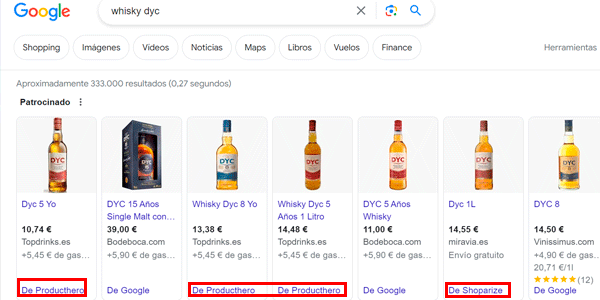
Arbitrage comes from the financial world, where it involves exchanging currencies between two platforms when there's a price difference.
Example:
- One platform has the Euro / Dollar exchange rate at 1,15.
- Another platform has it at 1,11.
- The trader buys dollars with euros where they're cheaper and quickly sells them where they're more expensive, pocketing the difference.
In online marketing, this means companies that are experts in a specific channel, such as AdWords or Shopping.
They buy traffic on these channels at a low price and then resell it to the advertiser at a higher CPC.
The process is this:
- The advertiser buys traffic from these platforms at, for example, 0,18€.
- These platforms launch Shopping campaigns that cost them 0,15€ per click, pointing to the advertiser's website.
- They make a margin of 0,03€ on each click.
Even if the margin is only cents, at scale that's a lot of cents earned.
You need to be very good at optimizing a channel to achieve that spread, because the advertiser isn't stupid and, if they could do it themselves and save the extra cost, they would.
#5. Selling online training
The last possibility is, in my view, the crème de la crème of digital business models. For several reasons:
- Maximum scalability: you create the content once and sell it -theoretically- infinitely many times.
- Simpler distribution: no logistics understood as transport. It could be considered free -or almost- and immediate.
- It's compatible with any type of job: whether you're self-employed, a civil servant or an employee.
- Although it isn't passive income -selling never is- it does let you keep billing automatically while you do other things (like sleep).
- If you like your job and have several years of experience, it's almost a logical step, to make the leap into training other people.
- The flexibility of formats allows each trainer to choose the ones they find easiest, without needing to acquire technical expertise if they don't have it.
That said, you have to enjoy it.
And not everyone likes training. Nor is everyone suited to creating it.
That's just how it is.
But as I said, I think it's well worth considering.
One more thing before getting into the different possibilities: I want to make clear that I don't include in this model the selling of training online, which isn't the same as selling online training.
In the first case, it would mean selling in-person training (vocational training, degrees, Master's programs) through digital channels and, in my view, that would be a sale of services.
Here I'm talking about training consumed in any of the digital formats.
Business model
The model is clear: selling training content in any digital format (video, audio, newsletter or ebook).
Variants
There are two, depending on whether it is a one-off sale or a subscription.
We could also divide them according to whether the training is live or pre-recorded but I think it's more appropriate to separate them using the previous criterion.
One-off sale of online training

Typical examples include:
- Courses.
- Masterclass.
- Ebook.
The system is simple: you buy a course and receive the material in one of the possible ways, depending on the sales platform chosen.
Platforms for selling online training
There are three:
Own platform
The usual approach here is to use WordPress with Stripe as the payment gateway.
This system gives the creator the greatest control over everything and a larger margin too, but in return it requires more management and full responsibility for promoting the training.
This is how I have my own system set up.
Hybrid platform
The most typical one currently is Gumroad.
The platform makes your life easier when it comes to managing the technology -including distribution of the materials- and billing.
And it takes a commission (which can change at any time) for doing so.
External platform
Platforms such as Domestika, , Udemy and similar platforms.
Here the tables are turned: in many cases, the creator only gets a commission while the platform pockets most of what the user pays.
That means you have to sell a lot for it to be worthwhile.
But on the other hand, you can forget about management, technology, content distribution and billing, while your course's reach multiplies.
It's genuinely difficult to choose one of the three systems, because each has strengths and weaknesses.
The particular situation of each business is what will tip the balance toward one of the three routes.
Selling online training by subscription

This is fundamentally about memberships.
In this case, we charge the customer a monthly fee in exchange for being inside (like at a gym), and we keep adding new content constantly.
The advantages of this model are mainly two:
- You sell once, but get paid many times (every month).
- In addition, revenue is more predictable.
The main disadvantage is that you have to keep creating new content.
Rain, storm or sunshine.
On top of that, you may also have to provide support to members, in which case, if things grow too much, the time invested can get out of hand.
Membership models
There are many different models:
- Independent courses or lessons, so you can do them at your own pace.
- Weekly or monthly frequency.
- Video, audio or text format.
- Permanent or temporary content, so if you're not inside at the time, you miss it.
- Premium or low-cost rates.
Technology
Except for very large projects, the membership CMS will usually be WordPress or Kajabi.
Examples
There are loads of them, but some of the most popular are:
And that's everything I wanted to tell you about online businesses, but before wrapping up I want to leave you with a couple more points.
Final conclusions
First, I don't know whether you knew all these models.
If you've made it this far, probably not.
I'll tell you there are even more, but these are the main ones and they'll give you an idea of what you can expect.
I will say that I think digital businesses have many advantages over physical ones, such as lower costs or the real possibility of working wherever and whenever you want.
Obviously, some models lend themselves to this more than others.
What's more, they're very flexible, so you can devote a full or part-time working day to them.
That said, they aren’t free, as many people think before starting.
And they aren't free in time or money either, although, as I say, the investment required is (much) lower.
Administrative procedures are also streamlined. In fact, in some cases you don't have to carry out any at all.
There are no opening licences, rents, employees under your responsibility, etc. here if you don't want them.
So, if you're thinking of starting some kind of business, I'll leave you a couple of links that might help:
- Types of ecommerce: an article with useful information about this type of digital business.
- Training to build an ecommerce business: where I explain the process step by step from scratch until you have a fully operational online-store business at every level.
- Ecommerce Analytics Course: if you already have yours but feel you don't have control and want it, this might help.
If after reading this article and the ones I link to you still want more, you can receive a tip about digital businesses every day.
Right below you'll find the form to subscribe to my newsletter.

Leave a Reply