
It's clear that Paul Greengrass is a director who likes to put us right in the middle of the action. He did it with the Jason Bourne films, and also with United 93 , Bloody Sunday or Captain Phillips, where his handheld camerawork and almost documentary-style filmmaking conveyed a very particular sense of realism.
Now he's decided to bring that style to medieval England, specifically to the Peasants' Revolt of 1381..
The result is the film known in Spain as El hombre que desafió al rey (The Uprising), a film that inevitably brings to mind Braveheart, though there are obvious differences, as I'll explain later.
The historical recreation is excellent, as are the atmosphere and the entire production. What I'm less sure of is whether this is a film you'll remember in a couple of years. Here's why.
What The Uprising is about
The film takes us to England in 1381, a country still dealing with the aftermath of the Black Death, where peasants live under appalling conditions. The war against France needs funding, taxes keep rising, and most people barely have enough to survive.
Andrew Garfield plays a peasant who has lost his family, whose desperation eventually sparks a rebellion against abuses of power. What begins as a local conflict becomes part of a much larger uprising led by historical figures such as Wat Tyler and John Ball, aiming to reach London and win concessions from the young King Richard II.
The film is based on real events, although its protagonist is fictional and it takes certain liberties. It's worth remembering that, but it doesn't stop the film from offering an interesting look at an episode of medieval English history.
A very capable cast
Andrew Garfield plays a peasant consumed by grief and resentment, who eventually finds a reason to carry on in the rebellion. He's a fairly restrained character, very different from the typical hero who spends the film delivering speeches to his followers—think William Wallace or Maximus Decimus Meridius—and I think Garfield suits the role.
Also convincing are Cosmo Jarvis as Wat Tyler—after Shogun, he seems to have developed a taste for historical epics—and Jamie Bell as John Ball, two characters who help us understand the rebels' different motivations. They don't all have the same goals or want the same things from the revolt, which gives credibility and interest to a story that's about more than good peasants fighting evil nobles.
On the other side is the young Richard II, played by Woody Norman, and his advisers, notably Tom Hollander. Overall the cast does a very good job, and I have no major complaints about any of the performances.
A grey, dirty and convincing medieval world
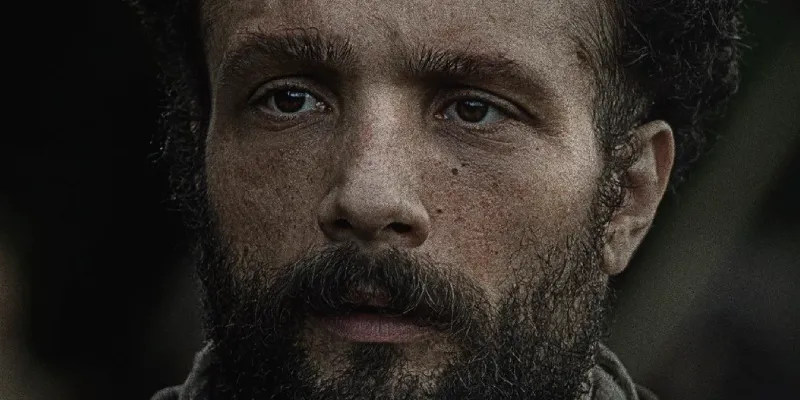
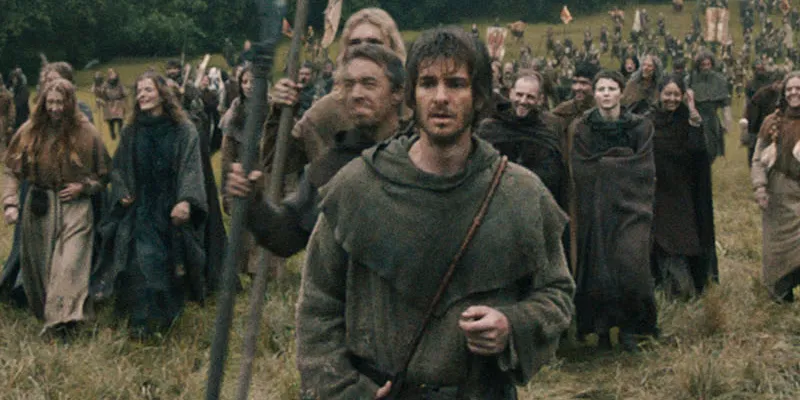
What I liked most about The Uprising is its setting. Greengrass manages to recreate a remarkably believable medieval England, dominated by greys and browns, muddy roads, miserable houses and a starving population sick of enduring hardship.
Visually, the film has a very distinct personality. Everything looks harsh and unpleasant, from the clothes to the interiors of the homes. While watching it, I remarked to my partner how hard it is to imagine an era when being alive looked so thoroughly unappealing.
There's certainly no room here for that Middle Ages full of knights in shining armour, grand passions and heroic exploits.
But there is action. And the violence fits that approach perfectly. Whether restrained or erupting outright, it's filmed in a very physical and convincing way. The clashes are brutal, confusing and hardly elegant, which I think suits the period being portrayed..
It's clear that Greengrass's style, with its handheld camera and jittery movements, can annoy some viewers. I think it works brilliantly here. I'm fairly convinced that a medieval battle must have been a chaotic experience, with people shoving, shouting and striking without the slightest idea what was happening a few metres away. That's exactly the feeling the filmmaker creates.
The realism of the battles and setting, together with the fact that it's based on historical events—with liberties, remember—makes me think the film could easily be used in secondary-school history lessons. Of course, you'd need to explain which events were real and which were changed for the screen, but it gives a very good idea of social inequality, the living conditions of peasants and how power operated in that feudal society.
A Braveheart missing some of the epic spirit
My main problem with The Uprising is that, despite how well it recreates the period and how interesting the historical conflict is, I found the film a little cold.
A peasant revolt against a deeply unjust system of power should have everything needed for powerful emotional engagement. There are characters who've lost their families, people who can barely eat, constant abuses and a population deciding to risk everything because they have very little left to lose.
And yet, apart from the beginning, I never connected with the story as much as I'd expected..
This is where I think of Braveheart. Both films depict popular uprisings against the established authorities, although Greengrass takes a far more realistic and less idealised approach than Mel Gibson. The problem is that Braveheart, for all its exaggerations and historical liberties, got you much more invested in its characters' struggle.
The Uprising opts for a more sober and believable recreation, but loses much of that emotion in exchange. Greengrass doesn't need to copy William Wallace's speeches or turn every battle into an epic set piece, but I would have appreciated a stronger emotional connection to the protagonists.
I also found it a little long. It's not a boring film, and some tense moments are well handled, but there are stretches where the storytelling loses momentum. Its running time of a little over two hours could have been tightened without harming the result.
Finally, there are a couple of details worth mentioning. The film's promotion has made quite a big deal of its connection with Robin Hood. To me, it is a minor detail. It is a curious twist that might work if you did not know it was not real, and it does not deserve too much thought.
That said, it's interesting to compare this take with the recent The Death of Robin Hood, starring Hugh Jackman. The characters are so different that it's hard to imagine how one could have evolved into the other, although these are obviously independent films using the same legend in their own ways.
The best things about The Uprising
For me, the setting is its greatest strength. Greengrass creates a very convincing picture of medieval England, with cinematography dominated by muted tones and grime that seems to be part of every location.
I'd also highlight how the violence is filmed. The fighting is suitably confusing, I think, and the handheld camera helps convey the sensation of being right in the middle of events.
The cast works well, and the story of the 1381 Peasants' Revolt is interesting enough in itself to justify the film, especially as it isn't a historical episode you often see in mainstream cinema.
The worst things about The Uprising
What hurts it most is its lack of emotion. The film depicts the suffering and violence of the period well, but it doesn't get me as invested as I ought to be in a rebellion of this kind.
It's also a little too long, and comparisons with other historical epics show that, however realistic the approach, sometimes you do appreciate a little more dramatic punch.
I consider the historical liberties a minor issue. They're debatable, but they don't change my overall assessment.
Conclusions and verdict
The Uprising strikes me as a good historical film, particularly because of how well it recreates feudal England and depicts the violence and social inequalities of that era without trying to make them look pretty.
Greengrass applies his familiar style to a setting quite different from what we're used to, and I think the experiment works visually. The battles are chaotic, the characters believable and the cast does a good job.
But I also think it's a film that's more interesting for what it shows than for what it makes you feel. I found it a little long, and although I understand its search for realism, I ended up missing some of the emotion of Braveheart..
If you like historical cinema, it's worth watching. And if you're a history teacher, it might even be a useful tool for showing students what life in a feudal society could have been like, provided you include the necessary historical explanations.
The Uprising: film details
| Detail | Information |
| Title in Spain | El hombre que desafió al rey |
| Original title | The Uprising |
| Year | 2026 |
| Director and writer | Paul Greengrass |
| Running time | 128 minutes |
| Cast | Andrew Garfield, Cosmo Jarvis, Jamie Bell, Woody Norman, Tom Hollander, Katherine Waterston and Thomasin McKenzie |
| Genre | Historical drama, action and war |
| Setting | England, 1381 |
| Distributor in Spain | DeAPlaneta |
Rating
Who it is for
✔️ For anyone who enjoys historical films.✔️ For those who prefer a raw, realistic recreation to an idealised one.
✔️ For viewers who appreciate Paul Greengrass's directing style.
✔️ For history teachers and students interested in the social context of 14th-century England.
Who it is not for
❌ For anyone expecting another Braveheart.❌ For those who can't stand handheld camerawork and deliberately chaotic action scenes.
❌ For viewers looking for an entirely faithful reconstruction of historical events.
❌ For those who prefer lighter medieval films or a constant adventure pace.
Frequently asked questions
Is The Uprising based on a true story?
Yes. It's inspired by England's Peasants' Revolt of 1381, although it includes fictional characters and changes some events.
Who directed The Uprising?
Paul Greengrass, known for several Jason Bourne films, United 93 and Captain Phillips.
Who was Wat Tyler?
He was one of the main leaders of the 1381 Peasants' Revolt. Cosmo Jarvis plays him in the film.
Does The Uprising tell Robin Hood's origin story?
The film draws a fictional connection to the Robin Hood legend, but it doesn't portray a historically documented origin of the character.
Is The Uprising like Braveheart?
Both depict rebellions against established authority, but The Uprising has a rougher, more realistic style and far less epic grandeur.
Is The Uprising worth watching?
Yes, especially if you're interested in historical cinema and appreciate a convincing setting. Its main weakness is that it feels somewhat emotionally cold and has a few pacing problems.

Leave a Reply