
I’ll say it again in case the title didn’t make it clear: The Expanse is one of the best science fiction series of all time. Top 3, no question and, for me, the best.
It has everything: good characters, an interesting plot, a rich and believable universe, enemies you want to see die horribly and a more realistic way of understanding science fiction.
Hard, serious, no frills, and without that Star Wars-like tendency to turn space into an excuse to cram in special effects everywhere.
That said, it is not an easy series. There are many characters, many factions, many betrayals and Belter jargon that requires you to pay quite a lot of attention and even pause the show, especially if you watch it in the original version.
The good thing is that, even though the plots simmer over several episodes (and seasons) it is not a slow series. Something happens in almost every episode, the story moves forward and you start to realise that everything is part of a much larger universe.
That is why, despite not being light, the series pushes you to binge it. It is hard to step away from it once you enter its universe.
The point where you really enter it comes next.
The end of the first season: when everything clicks
The series starts well, but I think by the end of the first season it is already clear that we are dealing with something else.
Up to that point the series seems to be mixing several ideas: Miller’s noir storyline, the science fiction of ships and pseudo-realistic technology, political intrigue à la Game of Thrones in space, and a more-than-plausible future where Earth, Mars and the Belt are — states? — with interests, cultures, hatreds and different ways of understanding life.
But suddenly, at that moment, everything clicks.
And that is when that universe much darker than Star Trek’s, to name an example of excellent science fiction with a very different spirit, grabs you.
Here there is no idealistic look toward the future and no clean exploration of the universe. The Expanse is dirtier, much more political, more realistic and less optimistic. Its future does not look like a technological fantasy, but an extrapolation of our current world.
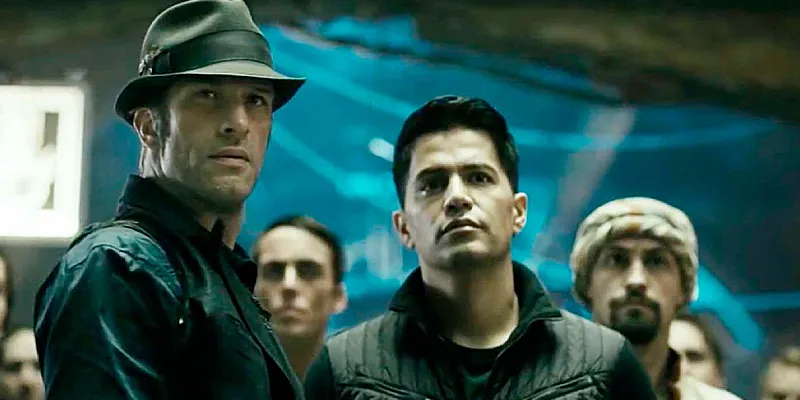
Hard science fiction
One of the things I like most about the series is that it takes what it is telling seriously, probably because of its literary origin. It does not need to keep reminding you that it is adult, dark or complex. It simply is.
And that applies to physics. The part of science in its genre, science fiction, applies just as much as the part of fiction.
Gravity matters. Acceleration matters. Manoeuvres matter. Vacuum matters.
A ship does not move like an X-Wing and, of course, a battle is not an exchange of red and green beams until the good guys win.
Here there is distance, limited arsenal, calculation, speed, damage, fear and blood. Quite a lot of blood.
And consequences.
A future that could be
One of the great successes of the series is that it builds a universe that exists with and beyond the protagonists. A thousand different stories could be told in that setting, such as Erich’s, for example (a supporting character from the later stretch).
And the thing is that Earth, Mars and the Belt are not the backdrop, but protagonists too. They are political, social and cultural blocs. You can feel them.
Earth is the old centre of power. Mars is the technological and military ambition of a civilisation built around a common project. The Belt is exploitation, survival, resentment and adaptation.
The Belters , for example, are very different from the Inners (Earthers and Martians). Their style — bizarre hairstyles covered in tattoos — their way of speaking — their accent, their language — and their way of moving through the world sometimes make the series harder to follow, especially in the original version, but they are also one of its greatest strengths.
They do not speak that way because of an arbitrary script decision, but because they have evolved away from the Inners, because they live in another environment and because their identity is born from that physical and social distance.
And you believe it, Beltalowda.
Space battles: a lesson in applied physics
The battles in The Expanse are among the best things ever done on television within science fiction.
They are not the biggest or the most visually spectacular, but they do reflect better than almost any others what you would expect.
Those turns and the g-accelerations they cause in the crew, mass propulsion, the impacts from the railguns, electrical circuits breaking at the worst possible moment… Everything feels believable.
And every manoeuvre is thought out and decided for a reason. Every weapon, all of them very credible, works as you would expect it to. Every decision can kill someone, or let someone live.
In a way they recall naval battles, but in space, which I find far more believable than what we see in other similar series.
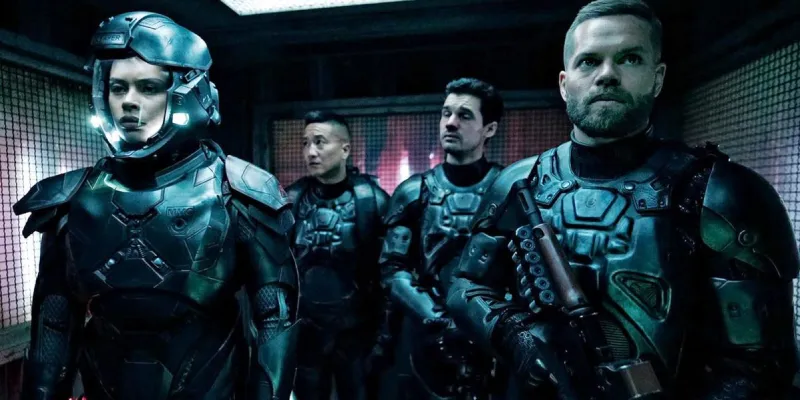
A scene that sums up why The Expanse is so good
There is a scene in which Drummer and Ashford are physically trapped by machines weighing several tonnes.
There is a communicator floating in the vacuum with which they could alert their crewmates. And they control a mechanical hook to reach it.
They try and fail.
They try again and fail.
And on the third attempt, what in any other series would have been resolved with the hook finally grabbing the communicator and problem solved, does not work like that here. Here it seems they have made it… and then it breaks.
That is The Expanse.
Things fail, solutions are never easy and space is cruel to human beings.
But there is more: while the whole scene unfolds, the series uses that tension and extreme situation to build a brilliant conversation between two characters who could have been the typical supporting players who appear at a specific moment to move the plot forward and who, however, end up carrying much more weight.
The scene works on this double track: both through the physical tension and through its dialogue. Drummer and Ashford are not there just so you can see the serious consequences of a problem; the series uses it to show us more clearly who they really are.
A cast of interesting characters
The Expanse has many characters. Several very good ones and, although not all of them reach the same level, main protagonists, supporting characters and enemies have a certain “something” that makes them work very well on screen.
Whether because of the characters themselves, their characterisation, their actions, the performances or the dialogue, the fact is that every scene shows you something interesting.
Drummer
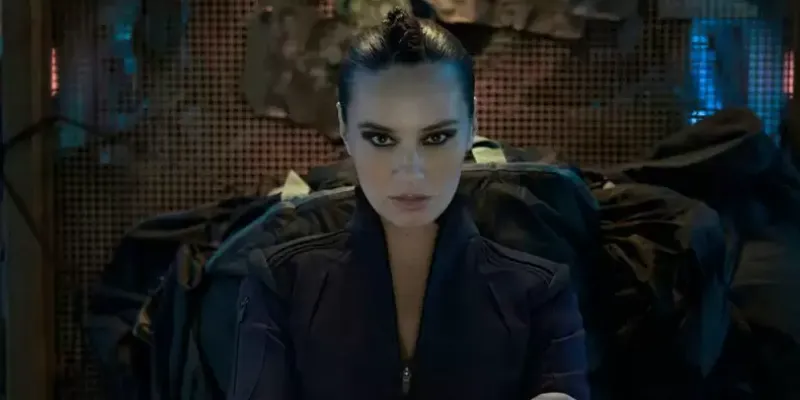
I could not start with anyone else, because she is my favourite character.
She has everything. She can be a great leader or a great help to others. She knows how to take charge when she must and step aside when it is time. She is intelligent, tough, charismatic and an action heroine, without losing political or emotional complexity.
Besides, you can tell that the series has merged elements from several novel characters into her. That could have gone wrong (we have seen it in other series), but here the exact opposite happens: Drummer gains intensity, weight and relevance.
It is impossible to look away whenever she appears on screen.
Amos
It is not because he is one of my favourites, which he is, but because I highlight him as one of the most believable evolutions in the series.
The easy thing would have been to leave him as the typical brute with a good heart who learns to be a better person.
But The Expanse does not do exactly that. Amos goes from being a guy who needs to use others as a moral compass to someone capable of making his own decisions.
He remains dangerous, he remains terse, and he still has that very particular way of understanding the world, but he is no longer just muscle.
Amos does not stop being Amos, but he is (much) more than he was in the first season.
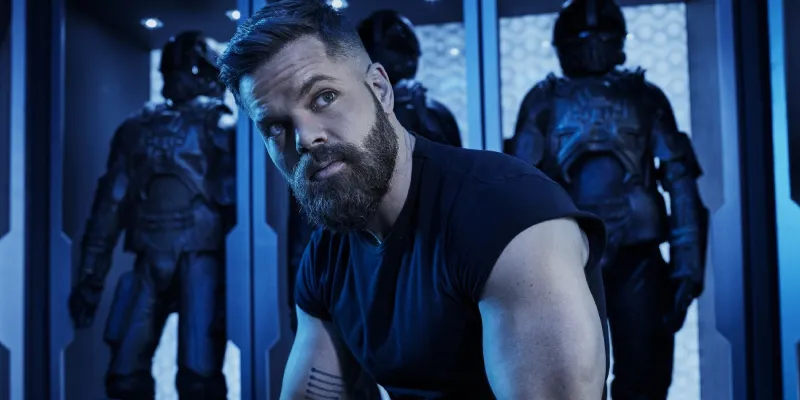
Holden
I like the character precisely because he is quite an unusual protagonist.
He is not especially good at anything: Amos and Bobbie are better fighters, Naomi is a much better engineer, Alex outclasses him as a pilot, Avasarala runs rings around him when it comes to politics…
Holden, in reality, is “only” the group’s moral compass and glue.
He is the least protagonist-like protagonist I can remember in a series of this kind. An almost accidental hero.
Even if the series does not make it entirely clear, he is no “chosen one”. The protomolecule chooses him, not because he is special in some messianic Neo-in- Matrix sense, but because he is in the right place, with the right ship, the right bond with Miller and that tendency of his to stick his nose where it does not belong.
Besides, Holden has weaknesses. Sometimes he is annoying, naive, he gets used and makes decisions that are, at the very least, questionable. But without him the Rocinante would not be the same.
Avasarala, Naomi and Bobbie
Avasarala works very well as a politician. She is manipulative, tough and clearly favours Earth whenever she can.
But she also has a broader idea of humanity. She plays dirty, but she is not a blind bureaucrat. She understands that, above Earth, Mars or the Belt, there is something greater: the survival of the human species.
Naomi, on the other hand, works for me only in patches. She is intelligent, brave and extremely capable, as she proves several times throughout the story, but she can also be too idealistic and selfish.
Her plot with Filip and Inaros is relevant, although, honestly, it is among the least interesting parts of the series.
Bobbie, by contrast, has a curious and fairly broad evolution: from elite Martian marine to manual worker after being cast out. And from there, down further: becoming part of a group that carries out illegal activities. Later she moves closer to politics through Avasarala until, finally, she finds her place as a member of the Rocinante.
No one’s situation changes as much in the series. For that alone, I like her.
The antagonists: very good, but one (far) above all the others
Marco Inaros is the great antagonist of The Expanse.
Mao plays his part, Errinwright is hateful, Murtry is extremely fun and, well, I do not consider the protomolecule an enemy, despite being a fascinating threat.
But Inaros is the top antagonist because he is unbearable in the best possible sense.
He is charismatic, manipulative, prophetic and tremendously detestable. He perfectly understands human psychology and takes the resentment of the Belters and turns it into a weapon.
And he eats up the screen every time he appears, with that very particular look.
You want him to lose. He comes close twice, but he does not fall and your blood boils. You want someone to take him out once and for all. But you cannot stop watching until it happens.

Why The Expanse is worth watching today
Compared with other series in the genre, The Expanse is far above almost all recent science fiction, mainly because it understands that the most interesting thing in the genre is to build an attractive world with its rules, conflicts and consequences.
That is why it seems much more solid to me than Foundation as an adaptation of classic science fiction. The “adaptation?” of Asimov’s work has more visual polish, budget and ambition to look enormous, but every seam shows.
However, The Expanse goes to the root, knows what it is telling and why it matters.
With Battlestar Galactica the comparison is fairer. Battlestar has huge peaks and memorable moments, but The Expanse seems to me more consistent as a universe, more precise in its political construction and more rounded overall.
Star Trek has very good series that can resemble it somewhat in concept (hello Picard) but its universe is much more ideal. And well, Star Wars is something else: pure, straightforward entertainment with no real reflection.
The Expanse has six seasons, the main arc is closed and the series is surprisingly easy to watch. It also has that quality of great genre works: when it ends, you do not want to leave its world.
Believe me, you will want to read the novels. Know what happens with Laconia. Understand more about the protomolecule. Learn more about the future of characters like Erich or Filip Nagata. You want to squeeze out every last drop.
And very, very few works manage that.
The worst thing about The Expanse
The Expanse is not perfect, although it comes close.
The fifth season seems to me the weakest because it separates the protagonists and loses part of the group chemistry. In exchange, yes, it gains individual depth, but you spend the whole season waiting for them to reunite.
Also, and this is a problem of its literary origin and the difficulty of showing certain concepts on screen, there are moments when it feels as if you are missing a piece of the puzzle. In the adaptation, some explanations get left by the wayside.
Ilus is the best example: everything that happens with the protomolecule, Miller, the activation of alien technology and the changes on the planet makes sense separately, but it is not clear what is cause and what is consequence.
On the other hand, the sixth season has a problem: due to Covid, it has only six episodes, which is clearly shaped by the production context. It is very good, but it is short and everything feels a little bit rushed.
It closes the main conflict, yes, but leaves Laconia completely unresolved and the feeling that this universe could have continued much further, which, by the way, was its producers’ intention in case it was ever continued.
There are minor details, such as the rather unheroic exit of a beloved character for reasons outside the story itself. You understand the context, but dramatically it feels very unheroic and jars.
Finally, and probably linked to the adaptation stopping at the sixth of the nine main books currently available, there are the futures of Erich, Filip Nagata and other characters left hanging.
It is not a bad thing in the strict sense, but you would like to know more about it. It is part of that hunger the series leaves behind.
Conclusion: the worst thing is that you will want more
I think I have made it very clear that I consider The Expanse the best science fiction series of all time.
Not because of one single thing, but because of the sum of everything: universe, characters, politics, realistic physics, pace, antagonists, battles and a way of understanding the genre that respects the viewer.
It does not spoon-feed you everything and it does not confuse spectacle with noise.
It is demanding, yes. Sometimes too much. There are moments when you wish it explained some piece better, stretched its final season further or even continued beyond the point where it decides to stop.
But that is also why it stays in your head.
The Expanse ends and you keep thinking about its world. About Laconia. About Filip. About Erich. About Drummer. About Amos. About everything that could come next.
That is why the worst thing about The Expanse is not that it ends. No.
The worst thing is that it ends and leaves you desperate to know what lies beyond the ring.
Fact sheet for The Expanse
| Field | Detail |
| Title | The Expanse |
| Year | 2015-2022 |
| Seasons | 6 |
| Episodes | 62 |
| Runtime | 42-63 minutes per episode |
| Creators | Mark Fergus, Hawk Ostby, Daniel Abraham and Ty Franck |
| Main cast | Steven Strait, Dominique Tipper, Wes Chatham, Shohreh Aghdashloo, Cas Anvar, Thomas Jane, Frankie Adams, Cara Gee |
| Genre | Science fiction |
| Country | United States |
| Available on | Prime Video |
Rating
Who it is for
✔️ For anyone who wants serious, adult science fiction.✔️ For anyone who enjoys complex, compelling and believable universes.
✔️ For anyone who wants well-built characters who evolve.
✔️ For anyone who values space battles with physics, tension and consequences.
Who it is not for
❌ For anyone who wants light science fiction, special effects and epic lines without much substance underneath.❌ For anyone expecting something more like Star Wars, Star Trek or a clean space adventure.
❌ For anyone who needs everything spoon-fed.
Frequently asked questions
Is The Expanse worth watching?
Yes. Very much so. If you like serious, political science fiction with a coherent universe, The Expanse is one of the best series you can watch.
Does The Expanse have a complete ending?
Yes and no. It closes the main arc of the series, but leaves important parts of the universe open, especially everything related to Laconia and some supporting characters.
Do you need to read the books to understand The Expanse?
No. The series stands on its own. But sometimes you can tell it comes from a broader work and that some explanations or transitions have been compressed.
Is The Expanse hard science fiction?
Yes, at least within what a television series can be. Physics, gravity, manoeuvres, acceleration and space battles matter much more than in most productions in the genre.
Is The Expanse better than Battlestar Galactica?
For me, yes. Battlestar Galactica has huge moments, but The Expanse seems to me more consistent as a universe, more politically coherent and stronger in its evolution.
Is The Expanse like Star Trek?
Not too much. Star Trek has a more idealistic and exploratory outlook. The Expanse is dirtier, more political, more physical and closer to home.
Where can you watch The Expanse?
The Expanse is available on Prime Video, although it is worth checking the platform before watching because catalogues change.
How many seasons does The Expanse have?
The Expanse has 6 seasons and 62 episodes.

Leave a Reply