
I saw this film when it came out in 2000, back when I was in high school. I have just revisited it more than twenty-five years later expecting disappointment, as happens with almost everything you remember fondly from that era.
But it didn’t happen.
The feeling it left me with was almost identical, which shows that it hasn’t aged that badly compared with other films from that period.
However, that does not mean The Crimson Rivers is a great film, because it is not. The script cheats throughout the whole film, especially in an ending that is totally implausible and, in general, we can say the resolution is nowhere near what the opening promises.
But it has something that is hard to find in many current thrillers: personality and ambition.
That is why, a quarter of a century later, I still remember it. And why certain images, like the aerial shots of the snow-covered mountains, hit as hard as they did back then.
By the way, I am talking about the first film, not its inferior sequel nor the video series that I have not seen.
What The Crimson Rivers is about
We start with a classic that is always welcome: two separate investigations that, obviously, are not quite so separate.
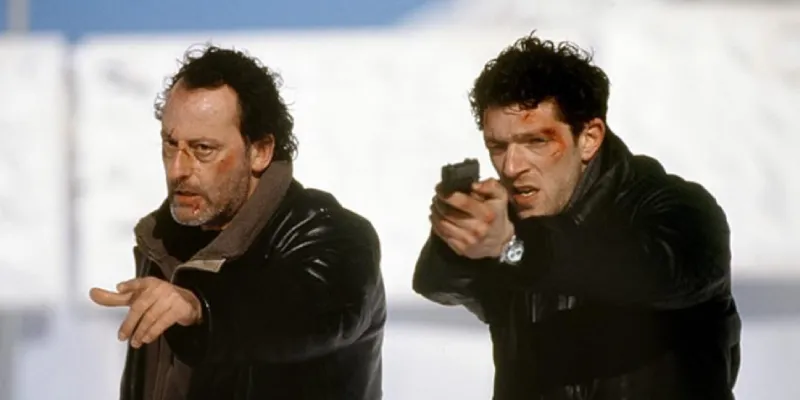
Pierre Niemans, played by Jean Reno, arrives in a mountain university town to investigate a fairly brutal murder. Max Kerkerian, played by Vincent Cassel, is separately investigating the desecration of a grave at another nearby location.
Mathieu Kassovitz’s film, based on the novel by Jean-Christophe Grangé, gradually brings those two lines together until they become a single investigation.
And the fun is in the journey more than the destination, since it is better not to think too hard about how the pieces fit together.
The best of The Crimson Rivers
If the film has aged relatively well, it is mainly because of two things.
The atmosphere
What I remembered about this film was not the plot. It was the feeling on the one hand (and certain scenes on the other).
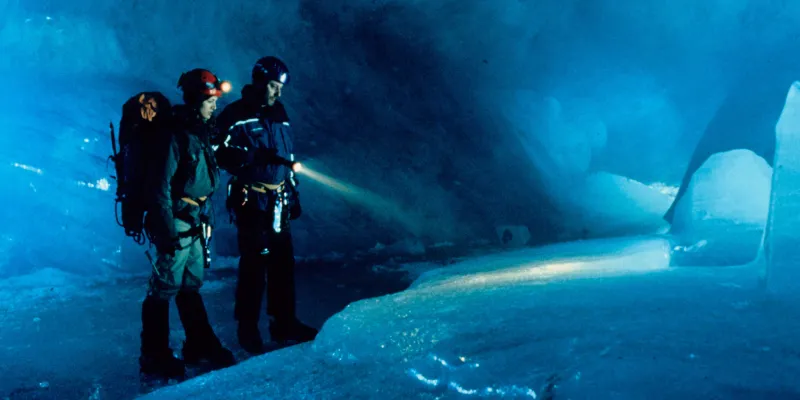
The cold. The snow. The mountain. That university and its motley population.
Watching it again, everything is there, exactly where I left it.
The snow is not (just) a pretty backdrop; it is setting and atmosphere. It isolates the story, cools it down and fences it in. It makes you wonder whether what happens in that place really matters to anyone else.
This white, pure setting mixes with something very late-nineties and early-2000s: dark imagery, stylised violence, macabre investigation and tension-building sound, creating a blend that, curiously, gives the film the personality I was talking about.
In fact, the film holds up better because of its atmosphere than because of its script. What stayed with me was not the explanation of the case but its tone. That feeling of entering a closed, cold and unpleasant universe, where every clue points to something bigger than what it finally turns out to be.
Jean Reno and Vincent Cassel
Jean Reno does Jean Reno. We have seen him a thousand times in that role, so grey, good-bad as he is here, or bad-good as in so many others (Mission: Impossible, Ronin…)
A grave, imposing presence, a guy who has seen too much and no longer needs to raise his voice, just look, for people to step aside. He is not an especially complex character -none of them are here-, but Reno carries him well with just his physical presence and by simply being there.
Cassel goes in another direction.
More nervous, more ironic, more electric, with that energy of a guy who always seems about to do something he shouldn’t. And he does it throughout the film, several times too.
The pairing works very well, with that inevitable contrast in any buddy-cop movie. Do not expect nuanced characters, but they are effective and their dialogue does not make you cringe.
Let’s raise the bar and talk about Seven
The comparison comes up by itself and is perfect for placing the tone: macabre crime, sickly atmosphere, police investigation, bodies turned into messages and the feeling that there is something more than a simple serial killer.
But that is as far as the comparison goes. Let’s not get carried away.
Seven is a much better film in almost every respect. More precise, better woven, more surprising, morally denser and, above all, more rounded. It does not have the cracks that The Crimson Rivers.
In Seven, the city, the characters, the killer, the moral idea and the ending are all part of a perfectly oiled machine. Not here.
The Crimson Rivers plays in another league. The comparison is useful to orient the tone, not to put them on the same level.
What we have here is perhaps a more physical thriller and, above all, a more European one. With snow instead of rain and mountains instead of city. Less deep and more obvious, but not a cheap copy trying to ride the wave. It is something more.
What I liked least
The main problem is obvious: the resolution.
The film sets up a relatively interesting mystery and builds it more or less well for a good part of its running time. There is pace, there are strong images, there is a sense of threat and there is an investigation that, even if it is not especially realistic, is entertaining.
But the closer it gets to the explanation, the less interesting it becomes.
Some pieces fit, others creak, and the ending directly asks for a lot of goodwill to keep disbelief suspended. It is totally implausible and it is there because the film needs to be closed somehow. Do not ask more of it.
That said, it does not destroy what came before either.
The setup is better than the development, and the development is better than the conclusion. But the path is still entertaining enough for the final blow not to bring the whole film crashing down.
Verdict
The Crimson Rivers is tricky and not a rounded film. But it has a worthwhile atmosphere, the right tone and shots you could frame.
That is why it has not aged that badly, despite being very much of its time. It is a shame the ending does not help, because it weighs down a more than acceptable whole.
Anyway, it is an entertaining thriller and it will not disappoint you if you open Prime Video with low expectations on a Sunday afternoon now that there is no football before the World Cup.
It is what it is and it does its job. Sometimes, that is enough.
| Field | Data |
|---|---|
| Title | The Crimson Rivers |
| Original title | Les Rivières pourpres |
| Year | 2000 |
| Runtime | approx. 105 minutes |
| Director | Mathieu Kassovitz |
| Main cast | Jean Reno, Vincent Cassel, Nadia Farès, Dominique Sanda, Karim Belkhadra |
| Genre | Thriller / police procedural |
| Country | France |
| Available on | Prime Video, fuboTV, Atresplayer, Tivify and Prime Video with ads, according to JustWatch Spain on 7 June 2026. |
Rating
Who it is for
✔️ For anyone looking for a dark, atmospheric crime thriller.✔️ For anyone who enjoys macabre police investigations.
✔️ For fans of Jean Reno and Vincent Cassel.
✔️ For anyone expecting a film in the style of Seven.
Who it is not for
❌ For anyone expecting a film on the level of Seven.❌ For anyone looking for a realistic police investigation.
❌ For anyone who needs a perfectly woven and believable mystery.
Frequently asked questions
Is The Crimson Rivers worth watching today?
Yes, if you like dark thrillers with atmosphere and strong staging. It is not perfect, but it is still very entertaining.
Is The Crimson Rivers similar to Seven?
It has points in common: macabre crime, police investigation, sickly atmosphere and a very strong visual style. ButSevenis a much better film. The comparison is useful to orient the tone, not to put them on the same level.
Does this review contain spoilers?
No. The review discusses the tone, strengths and problems with the ending, but without revealing the mystery’s resolution.
Who stars in The Crimson Rivers?
It stars Jean Reno and Vincent Cassel, alongside Nadia Farès, Dominique Sanda and Karim Belkhadra.
Where can you watch The Crimson Rivers?
According to JustWatch Spain, as of 7 June 2026 it is available on Prime Video, fuboTV, Atresplayer, Tivify and Prime Video with ads. As always with streaming, it is worth checking before watching because catalogues change.
Does the ending of The Crimson Rivers work?
It works as an entertainment wrap-up, but not as an especially believable resolution. It is totally implausible, although it does not invalidate the film because the journey up to that point makes up for it.

Leave a Reply