
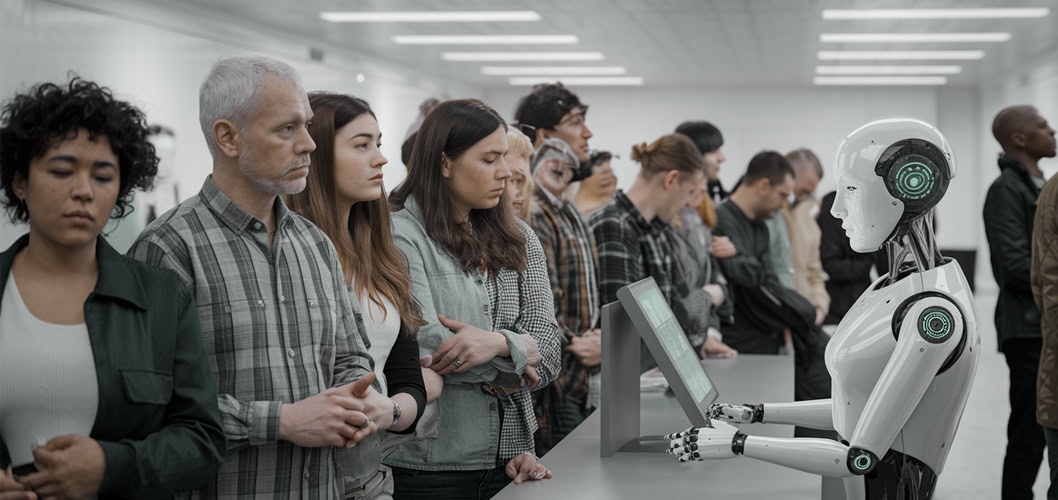
Unlike most of the posts I write, this one is not intended to teach you anything.
But it is meant to make you think a little. And it goes somewhat against the current mood, which keeps proclaiming that “AI is not going to take your job”.
I have been hearing and reading this lately, and I am not entirely sure why.
I do not know whether it is due to a lack of understanding of what AI can do. And what people can do.
Or because people want to give AI a makeover—“it is not that bad”—to prevent conflicts like the screenwriters’ strike that took place in Hollywood not so long ago.
The point is that the claim that AI is not going to take your job is, at the very least, debatable.
And I say that from experience, as you are about to see.
Who it is affecting most
From my conversations with business owners and freelancers, I see these groups.
Communication and advertising agencies or freelancers
The larger ones tell me how they use AI and about the time savings they are achieving. They do not say it outright, but I suspect new hiring is being frozen. Or at least postponed.
Smaller freelancers are losing clients. Small clients, who watch closely where they spend their money, are usually the first to leave. But I think this will scale up.
These sectors have been producing the largest number of pieces that AI can create. For example:
- Photography.
- Illustrations.
- Graphic and web design.
- Copywriting.
- Translations.
And as of October 2024, video has not fully arrived yet, but it is just around the corner…
As I said, clients’ need for this kind of work will shrink dramatically, because what AI generates will be good enough for them.
Companies and businesses
Let us talk about what companies are doing.
I see two paths here, moving at very different speeds:
Technology companies
They embraced AI from the start.
They saw what it could do and took it very seriously, using it to automate their most manual processes.
For software development companies, hiring is also changing: thanks to AI, onboarding a new junior developer is much faster and the quality of their output improves rapidly. This is nowhere near true for every profile, but it is a trend.
Lastly, the largest companies with strong IT departments go even further: they do not just use public models such as ChatGPT, Copilot or Midjourney; they are training their own models for… well, anything they can think of:
- Increase sales.
- Reduce churn.
- Cut spending on operations.
- Or on customer service.
I will return to those last two uses shortly, but first you should know that, today, these companies are running the show and are best positioned to grow alongside future advances in AI.
Non-technology companies
This is where I place companies that are using AI in end-user mode:
- They are starting to experiment with ChatGPT.
- They record video calls and generate summaries with Google’s AI.
- They use DALL·E to create images for presentations.
Companies that may previously have paid for a Shutterstock licence and no longer do.
Or that used to spend a good while designing product catalogues and have now cut that time in half.
Or that used to call an agency to create a logo for a new low-cost product line and now turn to Ideogram.
In short, companies are adopting AI as an increasingly important part of their business. And they will keep incorporating advances in Generative Artificial Intelligence just as they previously adopted Microsoft Office or Google’s suite of tools.
The third path
I would say there is a third path: companies or businesses that do not use AI. But then I think this article would be obsolete within a few months. Because I find it hard to believe that within about a year any company will remain that is not using AI internally in one way or another.
The disadvantage compared with competitors that know how to use it is simply too great.
Customer Service
What can I say about this.
It has been increasingly automated for years:
- IVR for telephone support.
- Chatbots.
- And now, AI.
In most businesses, there are always certain very common, highly automatable questions:
- Ecommerce: where is my order?
- SaaS: where is my invoice?
- Services: My password does not work.
You follow me, right?
But now, thanks to AI, in addition to these common questions that are already automated, it is possible to answer more advanced issues based on:
- The text on your website.
- Your sales scripts.
- Your catalogue.
- Whatever documentation you have.
This dramatically reduces the need for far more expensive human intervention.
The working examples of ecommerce chatbots I have seen are incredible, and I think they will soon be applied everywhere. Just wait and see.
So, if you work in customer service, brace yourself: things are about to get bumpy, and you may want to rethink your career and move into sales…
I will tell you something about that later.
Operations and logistics
Another area where repetitive tasks pile up. Yes, the ones that are easy to automate and make “AI-able”.
And the first real nail in the coffin has not even arrived yet: transport by autonomous trucks.
Teachers
Across all kinds of activities, both intellectual and physical.
Now it is possible to have a private tutor in the palm of your hand:
- Sports coaches.
- Literature teachers.
- Or History.
- Or English.
Clearly, as with every other use, the level will not match that of a good professional. But for many people, I think ChatGPT, when used properly, will be more than enough.
On the other hand, if you teach in formal education, you already know how it is affecting you:
- Students submitting entire assignments produced with ChatGPT.
- In return, plenty of help preparing lessons.
It has changed the way you work, one way or another.
Young workers
A group that will be affected enormously. For better or worse.
For the better, if you learn to use it as soon as possible: this is a stage when everything is about learning. And AI should be one of the main things you learn.
Take advantage of the fact that this is only the beginning and get ahead of the wave. You will always have secure work.
Companies are not stupid. A young person who uses AI well can deliver results similar to those of more senior staff. And costs less.
That is how it is.
But it also affects you for the worse. For the reasons I have explained so far and will expand on later: companies will no longer need workers whose output is merely a six out of ten, whether that output is a design, presentation, marketing proposal or data analysis.
AI will already be there for that.
And to produce outstanding results, know this: if you do not use AI WELL, you are at a disadvantage compared with more senior workers and juniors who do.
If you are just starting work, remember this, because it is a key issue for your future.
In my case, at Yo pongo el hielo
Everything I have described so far consists of cases I see or that other business owners tell me about.
But let us talk about what is happening at Yo pongo el hielo.
A few years ago, after the pandemic and the boom we experienced, there were five of us in the marketing department. And we all had more than enough work.
Now we are two and a half—one person works half-time—and we produce at least the same amount of work.
Because we are better?
Not really, because we have built systems and AI helps us enormously with them.
There is no trick to it.
We have also saved hours in customer service and operations, and to a lesser extent in Development. That is why I said earlier that I know what I am talking about.
We have even created an online shop as a secondary business, entirely with AI…
Which companies or businesses will NOT be affected by AI
But of course, there will always be companies, businesses or freelancers that AI will not affect. At least not negatively.
And although entire sectors will surely be less “harmed”—physiotherapists, hairdressers and every kind of seller of physical products or services spring to mind—the factor that will always make the difference, in my view, is quality.
Let me explain:
I told you earlier that AI on its own, when used reasonably, currently gives you a six out of ten. Push it, and perhaps a seven.
So, if your company or business delivers a minimum quality of nine out of ten, for now—and I stress “for now”—you can relax.
Because AI is not there yet.
And every client who requires that level of quality will have to come to you.
That is how it is.
I do not think any professional who is excellent at what they do needs to fear that “AI will take their job”.
In fact, what is more likely is that AI will take the work off their hands. Without the “the”.
Because a trained, up-to-date professional will find ways to apply AI to their processes and use it not to offer immediate lower-quality results, but to maintain quality while reducing time or effort.
And they will remain among the top professionals in their sector.
The options you have
I would say there are four. Let me go through them and see what you think.
#1. Learn AI and adapt to new ways of working
It is the most obvious one.
Start experimenting with AI, training yourself and thinking about how you could apply it to your workflows. Or your clients’ workflows.
Little by little, it becomes just another work tool.
Like Excel.
Like Canva.
Like Trello.
Like Slack.
This is also the path most people will follow, so the sooner you take it, the more of a head start you will have over your competitors.
If you think this is your path, I would suggest looking at this:
The community about Copywriting and digital business using AI that I run with my partners Rafa Casas and Josely, a very Copy kind of guy.
#2. Keep doing things manually, but at the highest level
It is another way to proceed.
If you deliver top results to top clients who are happy to pay for them, you have nothing to fear in the short term.
At least until less elite competitors use AI to raise their level and become comparable with you. Although that is clearly not easy.
#3. Learn skills other than AI and change jobs
You may have identified with one of the areas of work I discussed above.
If so, be certain that AI will affect your job. A lot. So prevention is better than cure.
Artificial Intelligence may simply not motivate you. You can always learn something new and retrain.
Because if you stand still, you end up in the next group…
#4. Stay as you are
And pray you are the last person they stop relying on. Because sooner or later, if you have not retrained, they will stop relying on you.
No one uses abacuses for accounting anymore.
Or lays out publications with QuarkXPress.
Or develops an app in COBOL.
Staying exactly as you are and refusing to evolve is a risky position, but hey, it is your decision…
Conclusions
I am wrapping up this article, which is much more personal than usual, but there is a lot of misinformation and forced optimism around this subject. I do not see it nearly so clearly. Quite the opposite.
So, if you read me and my opinion is of any use, there it is.
That said, and to close, I think everything I have told you can be summed up in one of these two sentences:
- AI is going to take your job.
- AI is going to take work off your hands.
You decide which perspective you prefer.

Leave a Reply