
There are films that do not need big effects, lots of locations or a complex plot to work. Glengarry Glen Ross is one of them.
In this case, that is because it is based on a play by David Mamet that won the Pulitzer in 1984 and never tries to hide that origin. Quite the opposite.
In fact, for much of the film you feel as though you are watching exactly that: a stage play recorded with cameras.
This has a very good side and another that is not quite so good. The good part is that everything rests on the actors and the writing, and there is more than enough material on both fronts. The downside is that, at times, you miss a little more cinema, because practically everything moves forward through conversations, monologues in which characters spend several minutes talking while the other person listens.
And when I say actors, just look at the cast: Al Pacino, Jack Lemmon, Ed Harris, Alan Arkin, Kevin Spacey, Alec Baldwin and Jonathan Pryce.
I think it has the best cast in film history. And almost all of them get a moment to shine.
While watching it, it is impossible not to think of The Wolf of Wall Street, because both are about salespeople, money, pressure, manipulation and companies where results matter more than almost anything else. Cinematically, though, they are not very similar.
Scorsese's film is constant motion, music, editing, parties, drugs, cars and excess. Glengarry Glen Ross is a bunch of guys talking in an office.
So to enjoy it, you have to buy into what it offers. If you like sales or theatre, that is easy. If neither interests you, then despite the cast you will probably find it hard going.
What Glengarry Glen Ross is about and what the title means
The plot is fairly simple.
The film shows us several real-estate salesmen whose results have not been good, and the company decides to put pressure on them to start selling more.
The chosen system is very HR: the best salesman gets a Cadillac, the second gets a set of knives, and the bottom two are out of a job.
On top of that, the best performers will get access to the best sales contacts, the famous leads from Glengarry, while the rest will have to keep trying to sell from a pretty poor database.
If you have worked in sales, this makes sense immediately.
You can be very good at selling, but you need someone to sell to. That is why lead quality matters so much and why they talk about it so much.
As for the film's strange title, it comes from the fact that Glengarry Highlands is one of the real-estate developments associated with the new leads everyone wants to get, while Glen Ross Farms is another, earlier development that the salesmen remember as a time when they were doing good business.
The title combines both names.
It is almost a stage play
As I said at the beginning, the theatrical origins of Glengarry Glen Ross are present throughout the film.
There are few locations, almost everything happens indoors, and the plot moves forward mainly because one person talks to another.
Conflicts emerge through conversations, many of the twists also arrive through talking, and the characters are defined by how they try to persuade whoever is in front of them, whether a colleague, boss or client.
In fact, they are often not even dialogues as such, but monologues. Very good ones, though.
After all, this is David Mamet's writing performed by excellent actors, so listening to them talk for five minutes straight can be more compelling than many action scenes in almost any Netflix production.
It makes sense here, and I have no doubt it is intentional.
Because a salesperson tries to persuade, spot a doubt, reframe an objection, make the customer see the problem differently, or simply keep them from getting up and leaving.
Here words are the tool of the trade.
The problem is that, as a film, it sometimes feels like something is missing.
More locations, a little more movement and, above all, certain parts of the story moving forward because we see them happen rather than because one character tells another about them afterwards.
That is why I said earlier that Glengarry Glen Ross does not strike me as a film for everyone. If you like theatre, it will be much easier to get into because you are used to the text carrying this much weight.
And if you like sales, probably that too, because, well, it is the best sales movie ever made.
If you like neither sales nor theatre, I am not sure I would recommend it to you. But who does not like sales or theatre? ;P
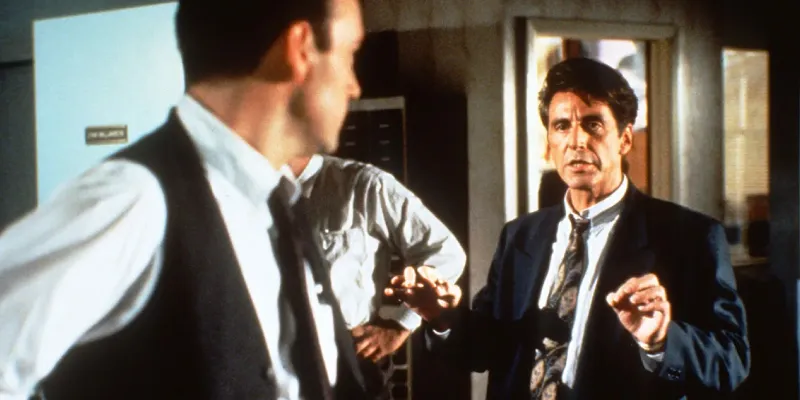
An incredible cast showing four different ways of being a salesperson
Beyond the script, a large part of why all this works is down to the cast.
Jack Lemmon, Al Pacino, Ed Harris and Alan Arkin play the four main salesmen, while Kevin Spacey plays the office manager and Alec Baldwin appears relatively little, although that is enough for him to star in the best-known scene in the entire film.
On top of that, each salesman represents a very different profile.
Shelley Levene, played by Jack Lemmon, is the salesman who used to be good but is no longer at his best.
He has experience, knows the trade and understands how everything works, but he desperately needs to start selling again. The problem is that this need shows, and there are few things worse for a salesperson than conveying exactly that to the person sitting opposite.
Richard Roma, Al Pacino's character, is at the exact opposite end of the spectrum.
He is number one in the office, he is selling well and has the confidence of someone who knows he can persuade the client.
There is one particular scene that perfectly explains why he is on top: one of his clients wants to back out of a deal and Roma tries to stop him. What is interesting is that he does not simply repeat the benefits of the purchase or tell him he made a good decision.
He starts to get inside his head.
He changes the direction of the conversation, tries to work out what really caused the doubt and looks for a way to get the client to stop thinking the way he was thinking a few minutes earlier.
He does it little by little and almost manages to turn around a sale that looked lost.
For me, it is the best scene in the film because it shows who Roma is and why he is the best salesman without anyone having to say it.
Pacino, incidentally, was nominated for the Oscar for Best Supporting Actor for this film. He did not win, but that same year he did win Best Actor for Scent of a Woman.
He was really on form back then.
Dave Moss, played by Ed Harris, represents another very recognizable type: the salesman who is permanently at war with the company.
The leads are bad, management does not know what it is doing, and practically every problem comes from above.
And, as often happens in these cases, he is probably right about some things, although that does not mean his way of dealing with them is exactly the best.
Finally there is George Aaronow, Alan Arkin's character, who has the least personality of the group.
He listens, hesitates and is quite easily swept along by the people around him.
What is interesting here is that all four face the same problem and yet react in completely different ways.
If you have worked in a sales department, you have probably met fairly similar versions of all of them.
Alec Baldwin, the first Wolf of Wall Street
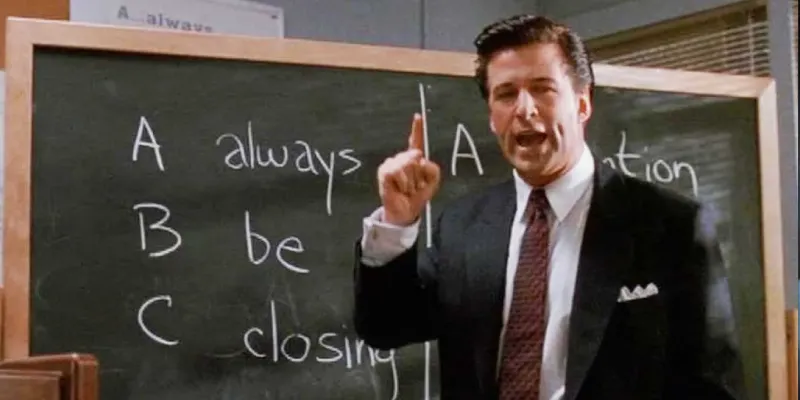
The most famous scene in Glengarry Glen Ross lasts only a few minutes and stars Alec Baldwin.
His character arrives at the office on behalf of the company to explain to the salesmen how things stand and basically spends the entire meeting humiliating them.
He reminds them that selling is all that matters, shows them the prizes in the competition and makes it clear that anyone who does not deliver results is out of a job.
That is where the famous “Always Be Closing” comes from.
You always have to be closing sales.
For years, the scene has been used as an example of a sales mindset and appears constantly in motivational videos for salespeople.
And I find that quite funny, because I think it is precisely one of those scenes that has been understood backwards.
Baldwin is not playing a great sales manager who comes in to teach the team how to sell.
He is playing a guy sent by a company that gives its salespeople bad leads, pits them against one another, threatens to fire them and then tells them that if they do not sell, the problem is entirely theirs.
As a speech and as a scene, it is spectacular, of course. As internal training or as a way to promote the attitude a salesperson should have, I have far more doubts. Watch the film and you will see what I mean.
The scene has a fairly clear connection with The Wolf of Wall Street.
Alec Baldwin's character could fit perfectly into that film without feeling out of place at all.
He is the dark mirror image of Mark Hanna, Matthew McConaughey's character.
At the beginning of The Wolf of Wall Street, Hanna sits down with Belfort (DiCaprio) and spends a few minutes explaining how that world really works.
He talks about money, commissions, clients and the logic behind the business. In a single scene, you understand perfectly what kind of place the protagonist has walked into.
Blake does something similar in Glengarry Glen Ross, although from the opposite side.
Mark Hanna sells you that world. He explains how wonderful it can be to make money and live inside it, however absurd the philosophy behind it may be.
Blake is not trying to seduce you, but to make it clear that you sell or you are out of a job.
One tells you why you would want to get in. The other, what will happen to you if you cannot handle staying there.
But both have something in common: in a few words they perfectly sum up the kind of company and sales culture the protagonists operate in.
Conclusions and verdict: is Glengarry Glen Ross worth watching?
Glengarry Glen Ross I liked it a lot, although I also completely understand why some people cannot get into it. My partner, for example.
It has a spectacular cast, very good writing and portrays quite well the different personalities that appear in the world of sales.
Also, having worked close to sales, many things feel recognizable to me and are well portrayed in the film.
My main problem —and my partner's— is that it is still too theatrical.
The monologues are excellent and the actors nail them, but I would have liked the adaptation to make a little more use of cinema's possibilities. That is why I would not recommend it to just anyone, even though the whole is far better than its flaws.
If you are looking for a film with pace, action, locations and a more visual narrative, this probably is not for you.
But for that you have The Wolf of Wall Street.
My rating: 4/5.
Technical details
| Item | Information |
| Title | Glengarry Glen Ross |
| Title in Spain | Éxito a cualquier precio |
| Year | 1992 |
| Director | James Foley |
| Screenplay | David Mamet |
| Based on | David Mamet's stage play |
| Cast | Al Pacino, Jack Lemmon, Alec Baldwin, Ed Harris, Alan Arkin, Kevin Spacey and Jonathan Pryce |
| Runtime | 100 minutes |
| Genre | Drama |
| Rating | 4/5 |
Rating
Who it is for
✔️ If you work or have worked in sales.✔️ If you enjoy theatre and films where the weight falls on the actors and the writing.
✔️ If you want to see a truly top-tier cast working with a script that gives them plenty of room.
Who it is not for
❌ If long monologues feel heavy to you.❌ If you need things to be happening constantly to stay interested.
❌ If you are looking for something like The Wolf of Wall Street in pace, editing or staging.
Frequently asked questions
What is Glengarry Glen Ross about?
It tells the story of several real-estate salesmen under intense pressure to improve their results and keep their jobs.
What does Glengarry Glen Ross mean?
The title combines Glengarry Highlands and Glen Ross Farms, two real-estate developments connected with the leads and sales of the protagonists.
Is it based on a stage play?
Yes. David Mamet adapted his own stage play for the screen; it had won the Pulitzer Prize for Drama in 1984.
Why is the Alec Baldwin scene famous?
Because of Blake's speech to the salesmen and the phrase “Always Be Closing”, which over the years has become one of cinema's best-known scenes about sales.
Did Al Pacino win an Oscar for Glengarry Glen Ross?
No. He was nominated for Best Supporting Actor for this film, although that same year he won the Oscar for Best Actor for Scent of a Woman.
Is it like The Wolf of Wall Street?
They share themes such as sales, pressure, money and manipulation, but cinematically they are very different.Glengarry Glen Ross is much more restrained and theatrical.
Is Glengarry Glen Ross worth watching?
Especially if you are interested in sales, theatre or films carried by great actors and dialogue. If you are looking for action or a very visual narrative, you will probably find it harder to get into.

Leave a Reply