
It looks as if streaming producers have developed a taste for Latin American magical realism.
A few months ago, Netflix presented the fascinating One Hundred Years of Solitude -an adaptation of Gabriel García Márquez’s novel of the same name- and now Amazon is adapting another no less important book.
And it does so with care.
What we have here is a careful adaptation, fairly faithful to Isabel Allende’s novel, very well acted and visually powerful.
It also goes by quickly, hooks you from the first episode and achieves something that is not so easy: making you accept magical realism without thinking the script is pulling your leg.
The plot of The House of the Spirits
Let’s talk a little about the plot, which is what matters most here. No spoilers, obviously.
The House of the Spirits tells the story of the Trueba family across several generations.
At the centre are Clara, Blanca and Alba, three women whose destiny is shaped by family ties, politics, violence, secrets, impossible loves and that supernatural element so typical of the literary genre it belongs to.
The series opens with a structure that makes it easy to get interested: a voice-over and the image of a girl pressing the keys of an old typewriter tell us a family story from its origins, beginning with a major flashback.
You do not need to have read the novel to follow it. In fact, one of its virtues is that it organises a large story, full of characters, time jumps and tragedies, quite well.
And it achieves something else, because adapting The House of the Spirits is not just about “telling what happens”. The hard part is capturing the tone of the book, one of the great representatives of Latin American magical realism.
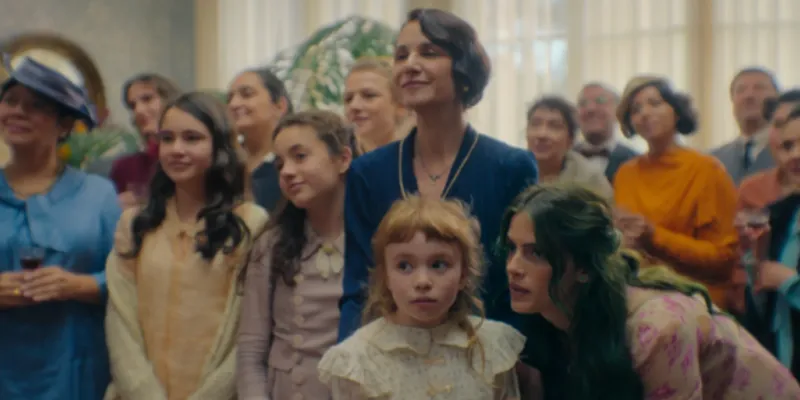
One of the pillars of the genre
The risk in adapting a story like this, so liable to destroy the suspension of disbelief the reader or viewer needs, is that everything may end up looking a bit ridiculous.
Premonitions, spirits, signs, presences, family destinies that repeat themselves… If it is not told well, you run the risk of making a soap opera with ghosts. And that is not the case.
The series works because it takes itself seriously. The characters believe what they are living through and pull you into their own particular world.
Clara does not feel like a whim of the author; rather, her way of being in the world is a natural part of the story. The same is true of the rest of the protagonists and antagonists: you understand their decisions -almost all of them-, even if you do not share them. You understand where they come from, what drives them and why they end up doing what they do.
And obviously it is easier to empathise with them—including Esteban Trueba—than it ever was with Succession.
On the other hand, since it was released so close to the adaptation of One Hundred Years of Solitude, the comparison is inevitable.
Netflix’s version, to me, comes out ahead visually; it is more surprising and more “different” from the more realistic classic European or American novels. Let’s say that there is room for more miracles in its universe than in this one.
The House of the Spirits is more costumbrist, more realistic —if that adjective can even be applied to these works—and more anchored in family and politics. I do not mean that as a flaw; in fact, it suits it well.
Here the magical element is a smaller portion and mainly centred on one character. It coexists with the everyday without any problem.
The best of The House of the Spirits
The series has several points that make it worth watching. For me, these are the best.
The cast is excellent
I would say that although the production is very carefully handled, the best thing about the series is the cast.
Alfonso Herrera is especially good as Esteban Trueba. He is the hardest character, someone you may like or dislike, but whom you understand and who is probably the one who best passes through all the different eras.
His characterisation works, his presence is commanding and his physical and emotional evolution is very well handled.
Esteban Trueba is an unpleasant, violent, selfish and tyrannical character, but the series does not reduce him to “the villain”. You do not forgive him, but you understand the internal mechanisms that move him. It is one of the novel’s great strengths and it is preserved here.
Also very strong are Clara, her mother Nívea and Rosa. There is something in that first family section that hooks you quickly, perhaps because the characters have a very clearly marked identity from the start.
Férula also seems to me a terrific supporting character. She shows the pain, restraint and inner tension that make you warm to her quickly, name notwithstanding.
And among the rest of the supporting characters, Pancha and Pedro Segundo have weight and significance. The series makes you care about them.
On the antagonists’ side, Esteban García does not need big lines to create unease. His gaze is enough. Great casting choice and a performance to match.
That said, I do have to point out that Pedro Tercero singing made me smile. But not for the right reason: he sings so badly -especially when young- that it borders on unintentionally comic. I find this production decision hard to understand, because another actor or dubbing by a singer would have worked better, I think.
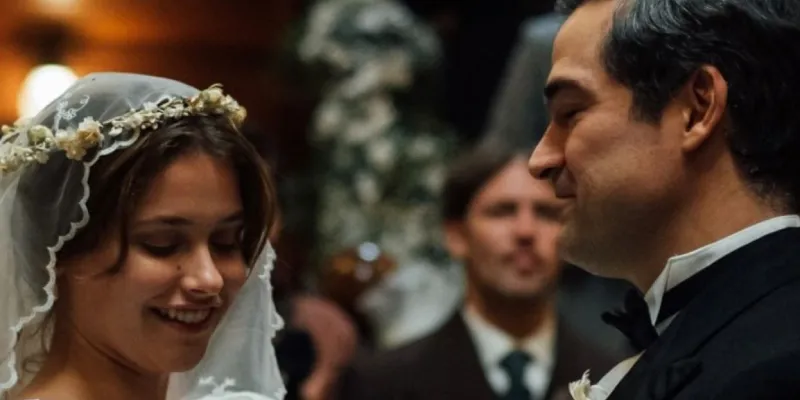
Cinematography, setting and production
The series looks very good. Photography, costumes, houses, exteriors, lighting, period setting… everything is at a high level.
There is no sense of a cheap production. Quite the opposite. You can feel the care, the budget and the intention to live up to the novel as an adaptation. All the settings -the house, the fields, the interiors-, the clothes and the period changes help draw us into the plot.
Less pretty, but still part of the production and direction, is the fact that the violence is handled with a steady hand. It is not dwelled on gratuitously, but it is not hidden either.
There are images that hurt: a slap, teeth, a head among brambles, rapes, implicit family violence and explicit political violence. They are not comfortable moments, because they should not be.
It hooks you from the start
Although it has 8 episodes, The House of the Spirits goes by quickly. It is easy to knock it out in two or three days.
The novel is very good and the series knows how to make use of it.
And that is despite the fact that it is not, at all, a series of constant twists or action. That is not what it is about. But the plot, its characters and the editing have that “come on, one more” quality that makes you want to see how everything develops.
The weakest parts of The House of the Spirits
But the series also has certain weak points that keep it from being essential.
Too safe
The main problem with The House of the Spirits is that everything is very carefully handled, but almost nothing surprises.
The direction is proper. The production is proper. The adaptation is proper. The tone is proper. But there is a feeling of caution, of driving with the handbrake on, that stops it from reaching the next level.
Personality appears more in the performances than in the staging. And that makes the series notable, but not especially memorable.
And that is despite the fact that this version has more space to tell things than the classic 1993 film starring Jeremy Irons and Meryl Streep, which allows it to develop the whole plot of the book better. That is probably why it is superior to the film, but I am not sure you will not forget it more easily.
It does not offer truly unforgettable moments
The series has powerful moments, but when you finish it, not that many scenes or images remain etched in your mind as one would expect from a work like this.
There are hard scenes, very good performances and careful production, but it lacks that punch of personality that turns an adaptation into something with a life of its own. When I say that, I am thinking of Game of Thrones, , Chernobyl or The Handmaid’s Tale.
It is very well made, but it lacks a vision of its own, an ambition to transcend.
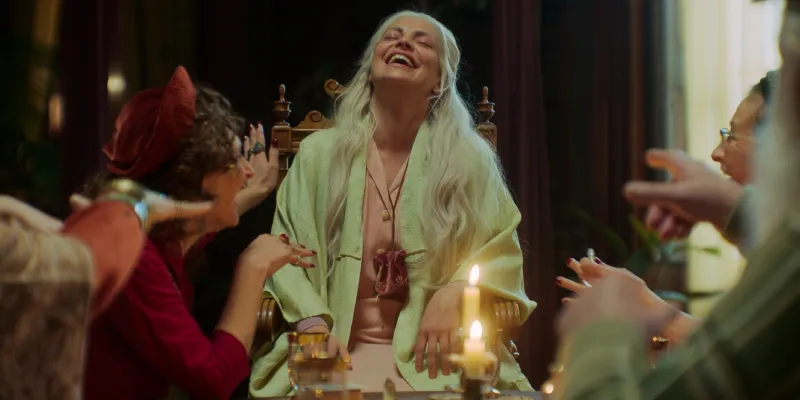
The change of actresses
Another thing that does not quite convince me is the change of actresses as the years go by.
I understand the decision. In a story that spans decades, changing performers can help mark the passage of time. But here it does not always work.
In fact, in some cases it creates a certain confusion, because the young and adult versions of some characters do not look enough alike or do not convey the same emotional continuity.
It happened to me especially with Blanca, Clara’s daughter, although it is a general feeling with several women in the series.
And the curious thing is that the series itself shows there was another possible path with Esteban Trueba: keeping the same actor and working on ageing through make-up, characterisation and performance. I am not saying it should always have been done -sometimes the age gap is too great-, but in some cases it would have given the series more unity.
Verdict: notable, but not outstanding
The House of the Spirits is worth it.
If you like the novel, Isabel Allende or magical realism, it is even more worth it. But even if you have not read the book, the series works.
As long as magical realism does not pull you out of the story, this is a solid, well acted and easy-to-watch adaptation.
The best things are the cast, the way it sustains the incredible through credible characters, and a very careful production. The worst thing is that everything feels too proper. It does not fail at anything, but it does not take enough risks to dazzle either.
It is a good series. A remarkable adaptation. A better version than the film for a story that needs space to show everything.
Unlike the novel it is based on, this is a very good work, but not a masterpiece.
Fact sheet for The House of the Spirits
| Field | Detail |
|---|---|
| Exact title | The House of the Spirits |
| Year | 2026 |
| Duration | 8 episodes |
| Director | Francisca Alegría and Andrés Wood |
| Main cast | Alfonso Herrera, Dolores Fonzi, Nicole Wallace, Fernanda Castillo, Juan Pablo Raba, Fernanda Urrejola, Rochi Hernández, Aline Küppenheim, Eduard Fernández and Maribel Verdú |
| Official genre | Drama, romance, unsettling |
| Country | Chile |
| Available on | Prime Video |
| Any spoilers? | No |
| Rating | 3.5/5 |
Rating
Who it is for
✔️ For anyone who wants a careful and faithful adaptation of Isabel Allende’s novel.✔️ For anyone who enjoys Latin American magical realism.
✔️ For anyone who has watched One Hundred Years of Solitude and wants another similar series.
✔️ For anyone looking for a well-produced period series that is easy to watch in a few days.
Who it is not for
❌ Not for anyone who cannot stand magical realism.❌ Not for anyone looking for thriller pacing.
Frequently asked questions
Is The House of the Spirits worth watching?
Yes. It is worth watching in general, and even more so if you like Isabel Allende, the original novel or magical realism. It is a notable, well-acted and carefully made adaptation.
Is the series faithful to the novel?
Yes, it is a fairly faithful and respectful adaptation of Isabel Allende’s work. It does not replace the book, but it captures its spirit, its family structure and its blend of politics, memory and magical realism well.
Do you need to have read the novel?
No. The series is perfectly understandable without having read the novel. That said, if you already know the book, you will probably appreciate some adaptation choices and the space the series format gives the story more.
Where can you watch The House of the Spirits?
The House of the Spirits is available on Prime Video.
How many episodes does The House of the Spirits have?
The first season has 8 episodes.
Is it similar to One Hundred Years of Solitude?
They can be compared because both are recent adaptations of major works of Latin American magical realism. One Hundred Years of Solitude feels more visual and surprising to me; The House of the Spirits is more costumbrist, more family-centred and more rooted in political reality.
Does this review contain spoilers?
No. The review comments on the tone, the characters and some general aspects of the adaptation, but avoids spoiling the story’s major twists.
What rating does The House of the Spirits get?
My rating is 3.5 out of 5. It is a notable series, but it does not reach outstanding level because it lacks personality and does not leave as many unforgettable moments as it could.

Leave a Reply