

Scott Snyder and Greg Capullo took the reins of Batman in 2011, coinciding with the launch of The New 52, DC Comics' attempt to relaunch its superhero universe.
Over five years and roughly fifty issues of the main series, they built one of Batman's most recognizable runs, bringing back classic villains, introducing new threats and repeatedly pushing Gotham to the brink of destruction.
Ten American collected volumes cover this run and, after reviewing each one separately, I think the overall verdict is pretty positive. Snyder clearly knows Batman inside out, knows how to tell gripping stories and has some terrific ideas. Capullo, meanwhile, delivers extraordinary artwork that sometimes clearly outshines the script.
There are, however, recurring flaws too: constantly oversized threats, implausible situations and a clear tendency to drag stories out.
The result is a run generally well worth reading, even if not everything reaches the same standard.
Scott Snyder: a writer who knows Batman extremely well
One of Snyder's greatest strengths on the series is his ability to find fresh perspectives on a character whose stories we've been reading for decades.
His first major success was the Court of Owls, an organization that has controlled Gotham for generations without Batman even knowing it exists. The idea works because it strikes directly at one of the hero's greatest strengths: his knowledge of the city.
He then brings back the Joker, turns him into a figure of horror and explores his sick relationship with Batman. In Zero Year he dares to reinterpret the hero's origins, while in Superheavy he proposes something different: temporarily replacing Bruce Wayne with Jim Gordon as Batman.
In every case, Snyder tries to add something to the character's mythology rather than simply repeat familiar stories.
He also knows how to build scenes and, above all, disturbing dialogue, especially when writing the Joker—he flirts with taking him to places superhero comics rarely venture—and how to end chapters so readers keep turning the pages.
The trouble is that he tries to push every one of those ideas to the limit.
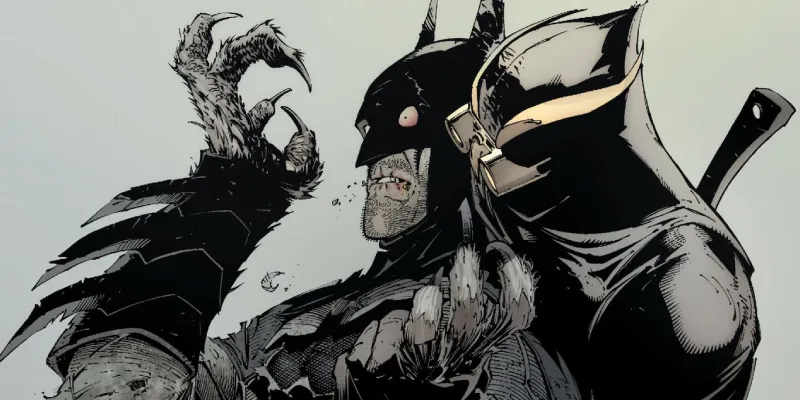
Every story wants to be the definitive one
If I had to point to just one flaw in this run, it would be its tendency toward excess.
In The Court of Owls, Batman uncovers a conspiracy that challenges how much he knows about Gotham. In Death of the Family, the Joker threatens to destroy his personal relationships. Zero Year turns the city into an apocalyptic landscape, and Endgame raises the stakes to even greater heights.
Each storyline seems determined to outdo the last.
This escalation works at first because Snyder knows how to put on a spectacle and create intense conflicts. Eventually, though, it becomes tiring. If Gotham is constantly facing its ultimate destruction, some of the sense of danger inevitably fades.
Credibility also becomes an issue. It's hard to accept that Batman knows nothing about an organization that has controlled his city for centuries, or that the Joker can fight him physically with almost superhuman abilities.
Such liberties are common in superhero comics, of course, but we should distinguish a good idea from a situation that seems to exist solely because the plot demands it, with no prior groundwork.
Curiously, the short stories in Graveyard Shift show that Snyder can also write excellent comics when he scales things back and brings back Batman the detective.
Greg Capullo: the real star of the run
While Snyder does very good work, Greg Capullo is even more consistent.
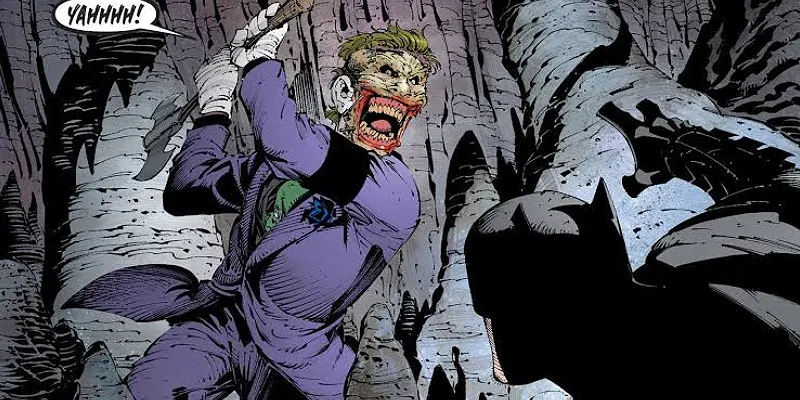
I'd already loved his artwork on Spawn, where he demonstrated his knack for grotesque characters, oppressive settings and crowded scenes with enormous visual impact. On Batman he draws on those strengths, simplifies them slightly (a smart move) and adds superb page layouts.
For example, his work on Death of the Family is disturbing. It's about as close to Spawn and outright horror as a Batman comic can get. The Joker, with his face torn off and worn like a mask, looks as if he's wandered in from a completely different kind of comic.
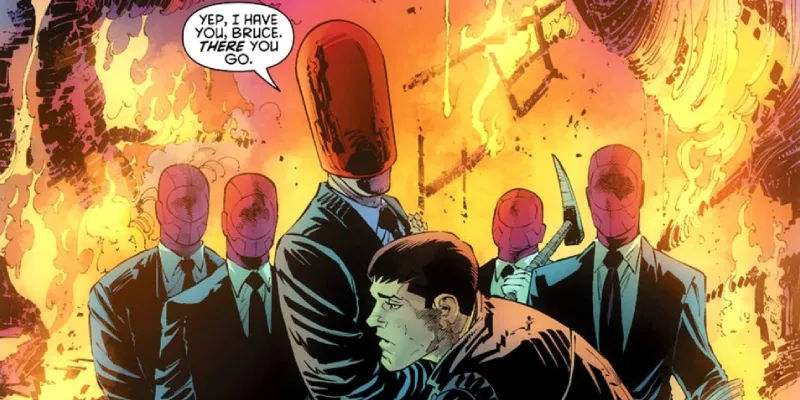
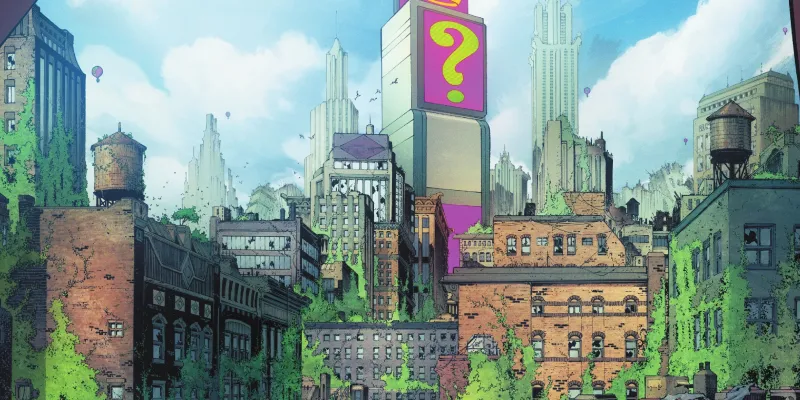
In Zero Year we find another of his great showcases. The range of settings, particularly outdoor ones, the design of an inexperienced Batman and Francisco Plascencia's colors create a Gotham that looks very different from the usual version.
Capullo also brings character to experiments such as Jim Gordon's armored Batman or the striking figure of Mr. Bloom.
His pages are dynamic, spectacular and full of personality, whatever the setting or situation. Even when the writing loses momentum, the artwork remains outstanding.
The best story arcs in Snyder and Capullo's Batman
If I had to pick the collection's highlights, I'd start with its first major arcs.
The Court of Owls: an excellent beginning
Volumes 1 and 2 introduce a new threat that fits perfectly into Gotham's mythology. The mystery, the investigation and the existence of the Talons make for a gripping story.
The idea that Batman knows nothing about such an ancient conspiracy isn't very believable, but the whole thing works extremely well. It's a fantastic introduction.
Full review: Batman: The Court of Owls.
Death of the Family: the Joker becomes pure horror
The third volume brings back Batman's greatest enemy in one of his most unpleasant incarnations.
The story stands out for its psychological tension, the cruelty of its dialogue—seriously, it's brutal—and the Joker's extraordinary visual design. However, its contribution to the relationship between the two characters doesn't strike me as quite as momentous as the plot itself suggests.
Full review: Batman: Death of the Family.
Zero Year: a spectacular reimagining of the origins
Volumes 4 and 5 reconstruct Bruce Wayne's first steps as Batman, bringing back classic elements such as the Red Hood and the Riddler.
It's an ambitious story, with a stronger first half and artwork that ranks among the very best in the series.
Its biggest drawback is the length. Frank Miller and David Mazzucchelli show what a concise origin story can do in Year One. By comparison, Snyder’s version goes on much longer than it needs to.
Full review: Batman: Zero Year.
Endgame: the finale that could have been
Next comes Endgame, the seventh volume, which brings the Joker back for a confrontation of seemingly definitive proportions. As definitive as anything can be in this universe, anyway.
It's a spectacular story, but it's also where Snyder's excesses become most obvious. The Joker becomes an almost unstoppable threat, and his physical abilities are taken much too far.
Even so, its hugely epic ending would have worked wonderfully as the finale to the entire run.
Full review: Batman: Endgame.
The remaining volumes
The sixth volume, Graveyard Shift, is a collection of short stories. Its chronology is rather chaotic and the quality of the artwork varies, but it includes interesting adventures featuring characters such as Clayface and Anchoress.
It's not essential, though it shows that smaller stories also have plenty to offer.
Full review: Batman: Graveyard Shift.
Snyder and Capullo continued after Endgame.
They did so with volumes 8 and 9, Superheavy and Bloom, introducing the boldest idea of the entire collection: Jim Gordon as the new Batman.
It's a premise worthy of Grant Morrison, although Snyder doesn't develop it quite as effectively. Its main problem is Mr. Bloom, a villain with a striking design whose powers and motivations never become sufficiently clear.
Full review: Batman: Superheavy and Bloom.
Finally, Epilogue brings together several standalone stories of uneven interest. The standout is a superb adventure featuring an elderly Batman against Lex Luthor, which connects perfectly with the story Twenty-Seven, included in the previous volume.
Full review: Batman: Epilogue.
Would the run have worked better with a different structure?
I'm convinced it would.
Endgame had the ambition, confrontation and conclusion needed to bring the run to a close. Instead, continuing it with Superheavy and Bloom forces the story to rebuild a situation that could have been addressed earlier.
And the interesting idea of Bruce Wayne being replaced by Gordon deserved to be explored—but, as I've said, not as the run's finale. Mr. Bloom doesn't deserve that honor.
I’d also have brought together in one volume (probably in Epilogue) – Twenty-Seven and Remains, two stories exploring how technology might perpetuate Batman's existence. Together, they are among the finest supplementary pieces in the whole collection.
With those two changes, I think the entire run would have better pacing, the Joker's appearances would be more spread out, and it would end on an epic, truly memorable note. A proper high.
But that's not what happened.
Conclusion: is Scott Snyder's Batman worth reading?
Yes. This is a good Batman run, packed with great ideas, gripping stories and outstanding artwork. It's the familiar Batman redefined for the way comics are written today.
Scott Snyder proves that he understands the character and finds interesting ways of pitting him against classic enemies and new threats.
His main weakness is ambition that too often becomes excess: stories that go on too long, wildly oversized conflicts and conclusions that repeatedly fall short of their premises.
Greg Capullo, meanwhile, delivers some of the strongest work of his entire career, combining remarkable consistency with spectacular visuals.
I don't think this is a masterpiece, or that all ten volumes are essential reading. But it is a run with a personality of its own, bringing interesting ideas and important stories to Batman's mythology and one that every Batman fan should know.
An impressive run.
The best of Snyder and Capullo's run
- Snyder's big ideas and his knowledge of Batman mythology.
- The Joker's reinterpretation, particularly some of the dialogue and its turn toward psychological horror.
- Greg Capullo's extraordinary artwork.
- The ability to create spectacular stories and keep readers hooked.
The worst of the run
- The tendency to turn every major arc into the ultimate threat to Gotham.
- Stories that last longer than they need to.
- Certain narrative experiments that never reach their full potential.
- Some situations and villains' abilities strain credibility.
- A final stretch that didn’t live up to the promise of Endgame.
Technical details
| Feature | Information |
| Series | Batman (The New 52) |
| Publisher | DC Comics |
| Lead writer | Scott Snyder |
| Lead artist | Greg Capullo |
| Lead colorist | FCO Plascencia |
| Series publication | 2011–2016 |
| Main series issues | Batman #1–52 |
| US collected editions | 10 volumes |
| Additional material | Annuals, specials and supplementary stories |
| Genre | Superheroes, mystery, horror and action |
Scott Snyder and Greg Capullo's Batman reading order
The table lists the ten US collected volumes in publication order. The middle column gives the original titles. The numbering may differ in other editions and does not follow the chronology of the story.
| US volume | Original title | Review |
| 1 | The Court of Owls | The Court of Owls |
| 2 | The City of Owls | The Court of Owls |
| 3 | Death of the Family | Death of the Family |
| 4 | Zero Year: Secret City | Zero Year |
| 5 | Zero Year: Dark City | Zero Year |
| 6 | Graveyard Shift | Graveyard Shift |
| 7 | Endgame | Endgame |
| 8 | Superheavy | Superheavy and Bloom |
| 9 | Bloom | Superheavy and Bloom |
| 10 | Epilogue | Epilogue |
Rating
Who it is for
✅ Readers who want to discover one of Batman's great modern runs.✅ Fans of Greg Capullo's artwork and spectacular page layouts.
✅ Readers who enjoy long stories, major threats and plenty of action.
Who it is not for
❌ Readers who prefer more realistic Batman stories.❌ Anyone looking for a short, light run.
Frequently asked questions
How many comics are in Scott Snyder and Greg Capullo's Batman run?
The main run covers issues #1 through #52 of Batman in The New 52, published between 2011 and 2016. The US collected edition spans ten volumes and includes extra material. Snyder wrote most of the series, and Capullo was its lead artist.
What is Scott Snyder's best Batman story arc?
The Court of Owls, Zero Year and Endgame are among the highlights of this run. The first introduces a new threat to Gotham, the second reimagines the hero's origins, and the third delivers a huge confrontation with the Joker. Your pick depends on whether you prefer mystery, adventure or spectacle.
Do you need to read all ten Snyder Batman volumes?
Not necessarily. The major arcs can be enjoyed without reading all the extra material, although it's worth following their order. Graveyard Shift and Epilogue are collections of standalone stories that add context but aren't essential to following the main plot.
Can you start reading Batman with Scott Snyder's run?
Yes. The New 52 relaunch in 2011 makes it easy to start with The Court of Owls, an accessible story even if you don't know all the previous continuity. Some familiarity with Bruce Wayne, Gotham and his main allies helps, but you don't need decades of comics under your belt.
How does Snyder's Batman relate to Grant Morrison's run?
Snyder's run began after Grant Morrison had completed much of his work on Batman, although their publications overlapped. Both runs share an interest in reinterpreting the character's mythology, but Morrison generally favors more experimental structures, while Snyder prioritizes spectacle, suspense and major confrontations.
Which Batman run comes after Scott Snyder's?
After The New 52, DC launched Rebirth in 2016. Tom King took over writing the main Batman series, while Scott Snyder continued working with the character in All-Star Batman and later on other projects connected to the DC universe.
Leave a Reply