
Scott Snyder and Greg Capullo had taken Batman to extremes during the first seven volumes of their DC run. From the conspiracy of The Court of Owls to the clashes with the Joker in Death of the Family, the creators had shown their ability to reinvent classic elements of the character.
After Endgame, a story that left things at an impasse, they decide on a radical change: sideline Bruce Wayne and turn Jim Gordon into the new Batman.
It's the boldest proposal of their entire run, but also the one with the most uneven results. Superheavy and Bloom, volumes 8 and 9 of the American edition, contain some excellent ideas, extraordinary artwork and a visually superb new villain.
Yet together they also form Snyder and Capullo's weakest arc up to this point.
Gotham needs a new Batman
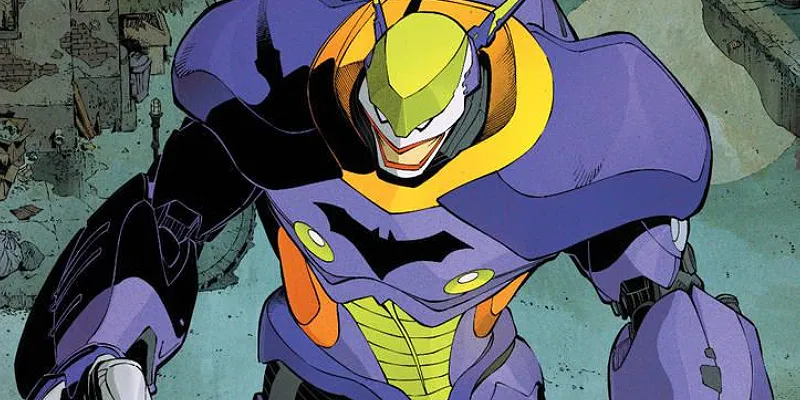
After the events of Endgame, Gotham is left without its protector. The city needs a new Batman, and the authorities decide to find a replacement. They choose Jim Gordon, who leaves his traditional role behind, dons a gigantic high-tech suit and becomes a superhero.
But this time he's not operating outside the law: he has institutional backing. The new Batman has resources, technology and police support, but he's also bound by rules Bruce Wayne would never have accepted. Perhaps because Bruce never needed that support.
As Gordon tries to adapt to his new role, a threat emerges: Mr. Bloom, a mysterious figure distributing seeds that grant extraordinary powers to those who use them. His arrival triggers a crisis that will test Gotham's new protector.
Jim Gordon as Batman: an idea worthy of Grant Morrison
Replacing Bruce Wayne with Jim Gordon is a decision as strange as it is exciting. We're not talking about another trained vigilante stepping into his shoes, but a veteran police officer used to fighting crime from a very different position.
The idea allows the story to explore a fundamental question: what would happen if Batman disappeared? Could anyone replace him, or does his existence depend precisely on Bruce Wayne's personality, obsessions and traumas?
What's more, making Batman an institutional figure creates an interesting contradiction. The character was born outside the system, while this new incarnation has its backing. Gordon has to navigate that duality.
It's the kind of conceptual experiment that brings Grant Morrison to mind. The Scottish writer often introduces surprising ideas into superhero comics, challenging their conventions and taking characters into unexpected territory.
The difference is that Morrison generally manages to develop those ideas better. Snyder sets up a fascinating situation—as usual—but doesn't always make the most of its possibilities. The experiment works as a starting point, although its development is less compelling than it promised to be.
Mr. Bloom: a disturbing and peculiar villain
The main problem with these two volumes has a name: Mr. Bloom.
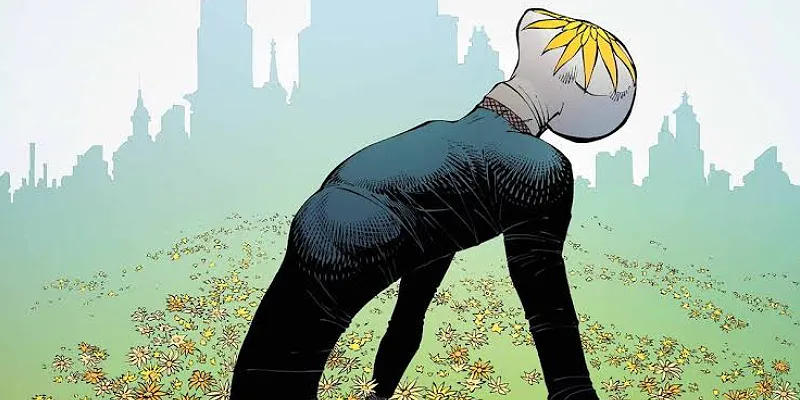
His design is extraordinary. He's an extremely thin figure, with elongated limbs and an unnatural appearance vaguely reminiscent of Slenderman. His presence is unsettling, and he stands out even among Batman's famously bizarre rogues' gallery, pushing the character closer to horror.
The trouble starts when we try to understand the character.
His powers, origins and true motivations aren't sufficiently defined in this arc. We know he uses seeds capable of transforming other people, but the rules governing his abilities and the scope of his plans remain confusing..
Perhaps later appearances will flesh him out. In these two volumes, however, Bloom ends up being far more interesting for his appearance and powers than for anything behind them.
And that hurts a story that needed a strong antagonist to balance its risky premise.
Greg Capullo is still in a league of his own
Fortunately, Greg Capullo continues to show why his work is one of the biggest attractions of this run.
His page compositions are more powerful than ever. His panel layouts, perspectives and handling of figures convey movement and spectacle.
The visual contrast between Gordon's enormous armour and the skinny silhouette of Mr. Bloom is striking. They're two radically opposite designs that are a pleasure to see together in the same panel.
Clearly, Capullo is an artist who does much more than illustrate the script: he brings personality, rhythm and considerable visual force to every sequence.
Twenty-Seven: a wonderful little surprise at the end
Curiously, my favourite part of these two volumes isn't part of the main story.
In the American volume, at the end of Bloom we find Twenty-Seven, a short story written by Scott Snyder and drawn by Sean Murphy, originally published in Detective Comics #27..
The story imagines a way for Batman to endure through the centuries through a system that creates new Bruce Waynes every 27 years. It's a surprising, unsettling science-fiction concept, and one that suits the character perfectly.
It also connects directly with the question at the heart of Superheavy. While the main story explores what happens when Batman disappears, this tale asks what would happen if he could exist forever. It's an idea the writer will develop further in the next and final volume of his run.
In just a few pages, Snyder and Murphy develop an appealing concept that, frankly, I found more powerful than much of the central conflict in these volumes.
Conclusion: a bold but uneven gamble
Batman: Superheavy and Bloom makes it clear that taking risks doesn't always guarantee good results. Snyder comes up with one of the most original ideas of his run, but Mr. Bloom's weaknesses prevent the story from reaching the heights of earlier tales such as Zero Year..
Gordon replacing Batman, Capullo's extraordinary artwork and the magnificent bonus story at the end partly make up for its flaws. It's a far more ambitious experiment than some earlier arcs, especially the transitional volume Graveyard Shift —though no more satisfying.
Mind you, this isn't a bad comic, not at all. But it's certainly an idea that could have been used much more effectively.
The best of Batman: Superheavy and Bloom
- The idea of temporarily replacing Bruce Wayne with Jim Gordon.
- Greg Capullo's page layouts and spectacular artwork.
- Twenty-Seven, a magnificent bonus story by Snyder and Sean Murphy.
The worst of Batman: Superheavy and Bloom
- Mr. Bloom lacks clear characterisation.
- The story doesn't fulfil the potential of its initial premise.
- Overall, it's less solid than Snyder and Capullo's earlier arcs.
Technical details
| Feature | Details |
| Original titles | Batman Vol. 8: Superheavy and Batman Vol. 9: Bloom |
| Series | Batman (The New 52) |
| Publisher | DC Comics |
| Main writer | Scott Snyder |
| Main artist | Greg Capullo |
| Main inker | Danny Miki |
| Other artists | Jock, Yanick Paquette and Sean Murphy |
| Issues collected | Batman #41–50 and supplementary material |
| Notable bonus story | Twenty-Seven, by Scott Snyder and Sean Murphy |
| Original issue publication | 2015–2016 |
| US collected editions | 2016 |
| Pages | 160 (Superheavy) and 184 or 200 (Bloom, depending on edition) |
| Genre | Superheroes, action, science fiction |
| Rating | 3/5 |
Rating
Who it is for
✅ Readers following Snyder and Capullo's complete run.✅ Fans of spectacular artwork and dynamic page compositions.
✅ Readers interested in exploring Batman's identity and legacy.
Who it is not for
❌ Anyone wanting to start reading Batman without knowing what happened in earlier volumes.Frequently asked questions
Which issues are included in Batman: Superheavy and Bloom?
Batman: Superheavy (volume 8 of the American edition) collects issues 41 to 45 of Batman and additional material. Batman: Bloom (volume 9) includes issues 46 to 50, as well as the story Twenty-Seven, originally published in Detective Comics #27. Both volumes form a single story arc.
Why does Jim Gordon become Batman?
After the events of Endgame, Gotham is left without its usual protector. The authorities decide to replace him with an institutionally backed Batman and choose Jim Gordon for the role. Unlike Bruce Wayne, Gordon uses an enormous high-tech suit and must operate under the supervision of the authorities.
Who is Mr. Bloom in the Batman comics?
Mr. Bloom is a mysterious villain introduced during Scott Snyder and Greg Capullo's run. He is known for his extremely thin, elongated figure and for using seeds that grant extraordinary powers. His identity, abilities and motivations form part of the story's central mystery.
Who draws Batman: Superheavy and Bloom?
Greg Capullo is the main artist on both volumes, working with inker Danny Miki. The books also feature contributions by other artists, including the bonus story Twenty-Seven, drawn by Sean Murphy and written by Scott Snyder.
Do I need to read the earlier Batman volumes to understand Superheavy and Bloom?
It's highly recommended. Although the plot introduces a new Batman and a different enemy, it follows directly from the consequences of Endgame, volume 7 of the American series. Reading the earlier volumes helps you better understand Bruce Wayne's situation, Gotham's transformation and the significance of Jim Gordon taking on the role of Batman.

Leave a Reply