
Oscar Wilde’s Divine Comedy is a good comic: ambitious and different. And that last point is worth saying from the outset so we do not get it wrong, because we are not dealing with a standard biography, nor with a comic that wants to review the writer’s life from cradle to grave with order, neatness and chronological obedience.
Javier de Isusi focuses on the ending. On the fallen, defeated, ruined, ill, exiled Wilde, reduced to a shadow of what he once was.
Or perhaps not exactly a shadow, because one of the comic’s best strengths is showing that even in ruin there was still brilliance in that wonderful mind.
The most interesting thing is thatthe work is worth reading even if you do not know much about Oscar Wilde and even if you do not know his literature or are not especially a fan of it.
Obviously, the more you know about the figure, the more layers you will catch. But the comic does not work only because of the appeal of the literary icon; it works because it humanizes him, showing his virtues -which he still had at that time- and, above all, his flaws.
In fact, it focuses so much on them that at times you end up wondering why his friends love him so much.
Isusi does not want you to admire Wilde, but to look at him and understand him: someone brilliant, but also dependent, wounded, contradictory and unable to stop moving closer to what harms him.
Dante, theatre and masks
The title is not there just because it sounds good, though it does. The reference to Dante’s Divine Comedy works as the spiritual structure of the work: descent, guilt, punishment, memory, possible redemption.
But the good thing is that you do not need to keep track of every reference to enjoy the comic. Not at all. If you spot them, they add something. If you do not, the story is still interesting.
The work has literary ambition, but it does not get trapped in it. The idea of theatre, of life as performance and the mask as a form of survival, fits Wilde very well.
In addition, the work uses interviews and testimonies to reconstruct the character from the outside.
This gives it variety and allows Wilde to appear as someone shaped by many gazes, not just his own.
The best of Oscar Wilde’s Divine Comedy
The best thing is that the author has a gaze of his own. This is not a commissioned job done to tick a box, but a work with a lot of inner material laid on the table.
Isusi does not tell “the life of Oscar Wilde” but one very specific part of that life. And he turns it into a reflection on fall, identity, desire, guilt and the need for affection.
The way he portrays Wilde. As I said earlier, he does not turn him into a perfect martyr. He shows him at a moment of physical, moral and emotional deterioration, but without reducing him to a caricature of himself.
There are scenes where that mix of tenderness and destruction comes through very clearly. Especially one with a young secondary character that sums up the protagonist’s virtues and flaws rather well: Wilde can be careful, generous and deeply human, but also someone unable to separate himself from desire, dependence and his own nature.
It is a small scene within a large work, but it has force and stays with you.
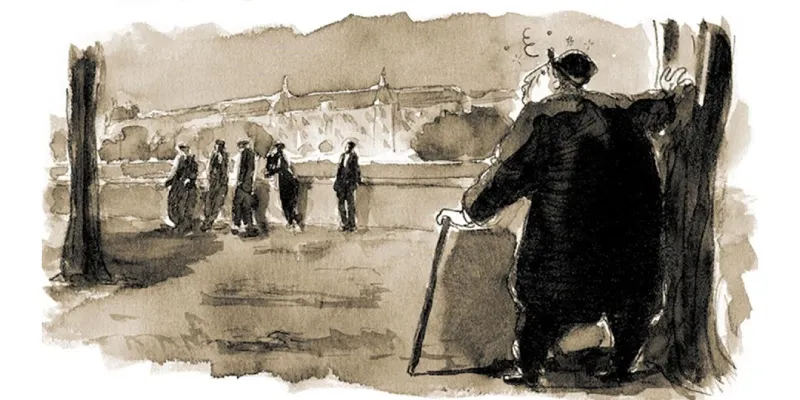
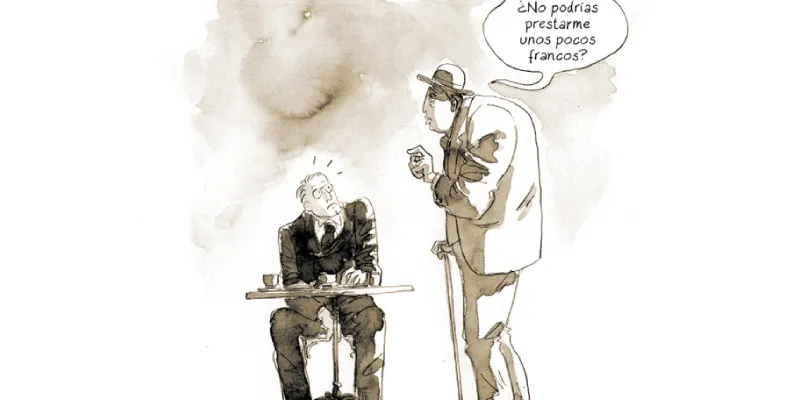
The artwork is another of the great successes. Javier de Isusi works with an expressive, beautiful style that is very well suited to what he is telling.
The watercolor gives it an artistic touch that fits perfectly with the nature of the work. Besides, the drawing is not there to show off, but to accompany the text and the character’s fall.
Here the visual side is part of the same world and is melancholic, elegant, and suggests a fragility similar to that of its protagonist.
Finally, I have to highlight the ambition of the work.
Not every comic has to aim so high, but when one does and manages not to sink under everything it wants to bring together, well, that deserves credit.
Oscar Wilde’s Divine Comedy wants to be more than an illustrated biography, focusing on the fall of the myth and combining it with a layer of symbolism underneath.
It looks like a lot to take on, and it is, but Javier de Isusi comes out of the tangle in good shape.
The weakest part of Oscar Wilde’s Divine Comedy
For me, the weakest part may be the chronological structure. Not because it is bad per se, but because I am not sure it improves on a more traditional order.
The time jumps clearly have a purpose. They seek to reconstruct Wilde through fragments, memories and testimonies. The problem is that sometimes this choice makes the timeline hard to follow clearly.
It does not break the reading, because the comic reads quite easily despite its length and ambition, but it does create a little extra friction.
Something similar happens with the interviews. As a device, they work. In fact, they help a lot to characterize Wilde from different perspectives. But at certain moments it is hard to recognize straight away who is speaking.
Partly because of the parade of characters itself, and partly because of the drawing, which, while very beautiful and expressive, does not always make it easy to identify every secondary character at once.
Neither of these are serious problems, but they are there.
The last drawback is more personal and not really about the work itself: while reading it, I missed knowing a little more about Wilde’s years of splendor.
I understand that this was not the aim of the work, since Isusi wants to focus on the end, on that Wilde after the trial, prison and the symbolic expulsion from the society that had once celebrated him, but I was left wanting to see what the great Wilde was like.
Verdict
Oscar Wilde’s Divine Comedy is a great read if you are interested in adult comics, literary biography or stories about brilliant people and their fall, but it also works if you simply want to read an ambitious, different and visually careful work.
It is not a light comic, although it reads better than you might expect given its length and the kind of story it tells. Nor is it a perfect work, but its strengths weigh more.
It works very well as a portrait of (one stage of) Wilde, in its drawing, in its ambition and in that idea of looking at a genius not when everyone applauds him, but when almost no one is left around to hold him up.
And that is where the work finds its greatest distinction: not in explaining why Oscar Wilde was important — literary history already does that — but in what remains of the person behind an important persona once almost the whole world has decided to censor him.
Fact sheet for Oscar Wilde’s Divine Comedy
| Field | Detail |
|---|---|
| Title | Oscar Wilde’s Divine Comedy |
| Author | Javier de Isusi |
| Publisher | Astiberri |
| Year | 2019 |
| Pages | 376 |
| Format | Hardcover, color |
| Genre | Drama, biography |
| ISBN | 978-84-17575-02-1 |
| Award | Spanish National Comic Award 2020 |
Rating
Who it is for
✔️ For readers interested in Oscar Wilde, even if they are not experts in his work.✔️ For anyone who enjoys adult, biographical comics with literary ambition.
✔️ For anyone looking for a measured, visually beautiful and emotionally dense work.
Who it is not for
❌ For anyone looking for a complete biography of Oscar Wilde from his years of splendor.❌ For anyone who needs a clear, chronologically ordered narrative.
❌ For anyone looking for action, a fast pace or a more conventional story.
Frequently asked questions
What is Oscar Wilde’s Divine Comedy about?
Oscar Wilde’s Divine Comedy tells the story of Oscar Wilde’s final years after his public fall, his time in prison, his exile and his last days in Paris. It is not a complete biography, but a portrait focused on his final stage.
Is Oscar Wilde’s Divine Comedy a biography?
Yes, but not a conventional biography. Javier de Isusi uses literary devices, interviews, time jumps and a structure inspired by Dante to emotionally reconstruct Wilde’s final years.
Do you need to know Oscar Wilde to read the comic?
No. Knowing Wilde helps you catch more nuances, but the work can be understood and enjoyed even if you do not have a special relationship with his literature.
Is it a light comic?
Not especially. It is an extensive, ambitious work with a clear literary charge. Even so, it reads more easily than its size and the kind of story it tells might suggest.
What is the best thing about Oscar Wilde’s Divine Comedy?
The best thing is the way it humanizes Wilde, Javier de Isusi’s expressive drawing, the use of watercolor and the ambition of a work that does not settle for being an illustrated biography.
What is the weakest part of Oscar Wilde’s Divine Comedy?
The worst thing is that the timeline can sometimes be hard to follow and some characters in the interviews are not immediately recognizable. You also miss a little more of Wilde’s years of splendor.

Leave a Reply