
I read Lord of the Flies” ( almost 30 years ago, in the late 90s, at secondary school.
Because our ethics teacher made us, not because I chose it.
In fact, back then, I did not know it at all. It did not even ring a bell. Neither the work nor its author, William Golding.
Now, with time, I find that curious. Because the work won the Nobel Prize in Literature in 1983 -no small thing- and yet much less award-winning works were talked about far more back then.
The thing is, 30 years later, I still remember how I started the book with bewilderment. Thinking something like “let's see what the hell they've made us read”.
And I remember much more clearly how I finished it. And the feeling it left me with:
Pretty wrecked.
Because this is not a novel by my beloved Pérez-Reverte where the good guys win, even if only pyrrhically.
Not at all.
Nor is there a Batman or a Goku to save the day.
It was not an adventure novel. Nor an epic survival story. It was something more uncomfortable. Something that forced you to ask yourself who you would be on that island.
And that question, at 15 or 16, is not something you have clear at all.
Because the book is not about feral children, but about power. Individual power and group power.
About responsibility.
About pressure and how we behave when external rules disappear and only our instincts remain.
I have always thought it is essential reading for any teenager. I thought so then and I think so even more now. Because it forces you to think. To reflect. To take a position.
And, above all, to be suspicious of yourself.
Now the BBC has just released a new adaptation in 2026. And I think it is a good excuse to return to that experiment.
And to talk about it.
Formal aspects of the series
But before getting into the heavy stuff, let’s talk a little about the secondary bits.
The series has only four episodes. And it works well that way. It does not feel rushed, nor does it drag on too much; the pace is right, and that means you can polish it off in one sitting or two without any problem.
Each episode is named after one of the protagonists: Ralph, Jack, Piggy and Simon. It is not a minor detail, but points to a key aspect of the plot: this is about people, not (only) situations.
In that sense, you can tell who the director is: Jack Thorne, the same one behind Adolescence, another series you are already taking too long to watch and which, again, every teenager in a Western country should see at least once.
Both series share a serious view of the youth world, without condescension or caricature.
The casting is magnificent, especially for the four main protagonists, although the one who will get all the praise is Jack, who manages to convey many things at once -savagery, vulnerability, evil, innocence- with that perfect face that could belong to a woman.
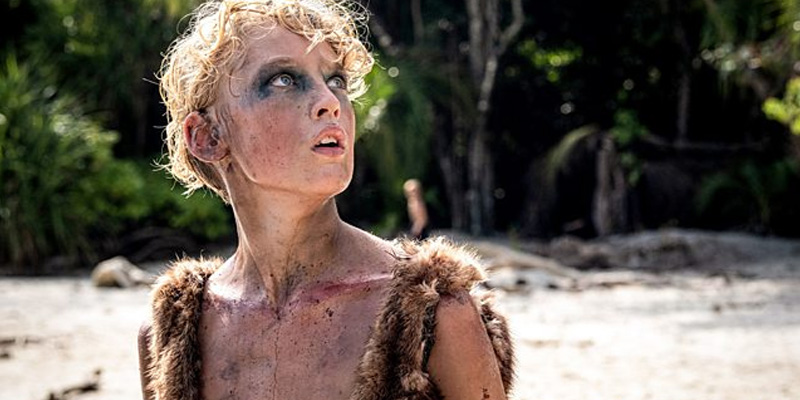
Likewise, the setting is very well worked. The island is not just a pretty background -or a terrible one, depending on the moment- but feels real: idyllic. Dirty. Free. Uncomfortable. All at the same time.
The make-up and the physical wear on the characters also help you surrender to the images.
That said, there is one striking aspect that I do not find so successful: the camera. And more specifically, the focus and blur effects.
There are scenes with very marked focus and defocus effects. Excessively so. And I do not quite understand the director's intention with it.
It is so exaggerated that, in fact, some scenes look almost as if they were shot on a mobile phone, in the style of the first part of 28 Years Later (2025). Not understanding the narrative aim, this pulled me out of the story at some point, trying to give it a meaning that escaped me.
Even so, I do not think it is something to give too much importance to. It is more a cosmetic and eye-catching detail.
What Lord of the Flies is about
The series is fairly faithful to the novel, so the starting point is the same:
A plane crashes on a desert island and only the boys survive.
No adults. No rules. No structure.
At first they try to organize themselves. Choose a leader. Set rules, such as keeping the fire lit so they can be rescued. But little by little, everything begins to break down.
In this sense, it is not a story of action, but rather one of degradation.
At the centre: leadership and the group, in the style of what happened in the magnificent The Experiment (another must-watch), only with children instead of adults.
And this is what is really interesting about the series: the different ways in which the characters pursue and exercise leadership:
- Ralph represents order. He wants rules. He wants cooperation. He wants everything to work as it should. But he lacks forcefulness.
- Jack represents charisma. He knows how to generate emotion. He knows how to create an enemy. He knows how to build a strong “us” against a “them”. And that pulls people in.
- Piggy is reason. He has clear ideas. He understands the situation. But he does not connect emotionally with the group. And that, in contexts of tension, weighs heavily.
- Simon is something else. He is conscience. The only one who senses that the monster is not outside, but inside.
The series underlines something very current: leadership is not won by whoever is right, but by whoever mobilizes emotions. And we see that constantly today: in politics, on social media, in any human group (or WhatsApp group).
That is why this story, which starts from an unreal but plausible situation, remains so uncomfortable:
Because it is about us.
About our nature.
About our instincts.
About how we would act in a lawless scenario.
And, spoiler: we do not do very well.
Differences between the novel and the series
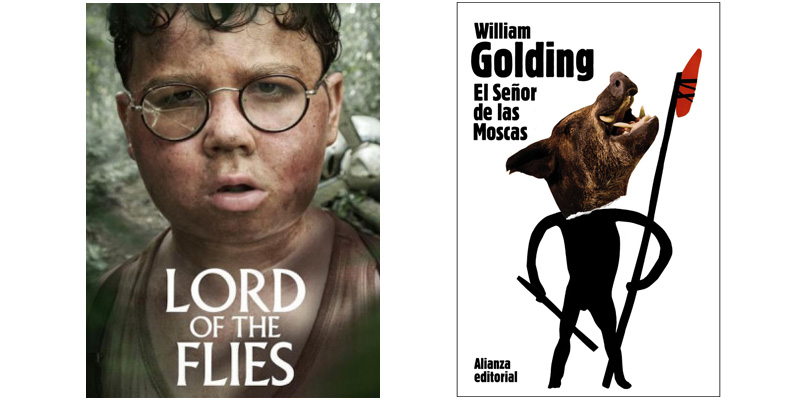
The adaptation seemed to me quite faithful in general terms to the idea I had of the novel (I have not reread it since), but with some nuances of change.
First, there is more psychological focus. The novel was more of a “fable”, while the series lingers more on glances, doubts, silences. It tries to be more realistic.
Second, the violence is more explicit. In the book the deterioration is progressive and sometimes more symbolic. Here it speeds up slightly and is shown more starkly.
Even so, I am not sure that the sense of pessimism generated by watching it surpasses that of the book. I would say it is rather the opposite. Although it is also true that I am older now and I am not facing the work for the first time…
Third, the religious and metaphorical symbolism is less marked. The novel has deeper layers in that sense. The series is more direct.
In this sense, there is a specific situation that in the novel can clearly be understood as the end of civilization, while the series focuses more on the dramatic aspect of the moment.
Fourth, the pace. As I said earlier, there are four not especially long episodes, so the plot is condensed. The slow but unstoppable crescendo of the book gains intensity and speed here.
And fifth, the aesthetics. In a sense, those camera effects clash and do not sit well with the formal classicism I remember from the original text.
In short, none of this betrays the work, but, as I say, it is very faithful, although there are more or less slight changes.
Conclusions
Let me say upfront that it seemed to me a more than good adaptation.
It does not replace the book, but it updates it. It brings it closer to 2026. I say this because there is a 1963 film I have not seen, but about which I have read all kinds of reviews. And yet I doubt there are many, if any, negative reviews of the series.
That said, I still think the novel is essential reading in adolescence. It forces you to ask yourself who you are and what you would do. It helps you to look in the mirror and define yourself.
And that is not something many works manage. Even less so today, with the junk Netflix churns out every week.
Probably we all think we would act better if we found ourselves in the same situation, but…
Are we sure?
At least I am not.
That is where the discomfort of watching it lies.
And that is where the power of Lord of the Flies still lies, more than 70 years after its publication.
Technical sheet
| Field | Data |
|---|---|
| Title in Spain | El señor de las moscas |
| Original title | Lord of the Flies |
| Year | 2026 |
| Type | Miniseries |
| Original work | Lord of the Flies, William Golding's novel published in 1954 |
| Creator / adaptation | Jack Thorne |
| Screenplay | Jack Thorne |
| Direction | Marc Munden |
| Production | Callum Devrell-Cameron |
| Executive producers | Joel Wilson, Jamie Campbell, Jack Thorne, Marc Munden, Nawfal Faizullah, Cailah Scobie, Amanda Duthie |
| Main cast | Winston Sawyers, Lox Pratt, David McKenna, Ike Talbut |
| Main characters | Ralph, Jack, Piggy, Simon |
| Other characters | Roger, Sam, Eric, Maurice, Bill, Robert, Percival |
| Music | Cristobal Tapia de Veer; main theme and additional music by Hans Zimmer and Kara Talve |
| Cinematography | Mark Wolf |
| Editing | Matyas Fekete, Andonis Trattos |
| Seasons | 1 |
| Episodes | 4 |
| Episode titles | Piggy, Jack, Simon, Ralph |
| Approximate duration | 4 episodes of about 60 minutes |
| Genre | Drama, adventure, survival, psychological thriller |
| Country | United Kingdom / Australia |
| Original language | English |
| Production companies | Eleven, One Shoe Films |
| International distribution | Sony Pictures Television |
| Original network / platform | BBC iPlayer, BBC One and Stan |
| Original premiere | 8 February 2026 |
| Available on | BBC iPlayer / BBC One in the United Kingdom; Stan in Australia; Netflix in the United States |
| Filming | Malaysia and United Kingdom |
| Premise | A group of boys is left stranded on an island after a plane crash and tries to organize without adults, until the initial order breaks down and the group drifts towards violence, fear and the struggle for power. |
Rating
Who it is for
✔️ For teenagers and adults willing to face a story that unsettles.✔️ Or for anyone who enjoys uncomfortable works.
✔️ If you like stories about power, leadership and fear.
✔️ If you are into good, brief, serious miniseries with substance.
Who it is not for
❌ For anyone looking for pure escapism.❌ If you prefer a kind or feel-good series.
❌ If you expect more action than reflection.
Frequently asked questions
Is the series faithful to the novel?
Yes in the main plot. It shifts the focus towards a more psychological and visual analysis and a less symbolic one.
How many episodes does it have?
Four, each titled after one protagonist.
Is it recommended for teenagers?
Yes, especially as a complement to reading the book. Although it may hit harder when seen from adulthood, after gaining a few years of experience.
And for adults?
Absolutely.
Is the book or the series better?
The book is more symbolic and deeper. The series is more direct and emotional. They are different experiences. If you can only access one (why?), stick with the book, but you would miss a very good miniseries.
Why is it still relevant in 2026?
Because it talks about leadership, power and group behavior. And that does not go out of fashion. Quite the opposite.

Leave a Reply