
Most audiovisual works -whatever they are, films, comics or video games- can be reviewed by analyzing and breaking down each part (visuals, sound, structure, pace, script, drawing…) as separate pieces.
And there are others -not so many- that force you to change the methodology.
Because they are so intertwined and so well connected to one another that the sensations their enjoyment creates would not be the same if any piece changed.
My Favorite Thing Is Monsters clearly belongs to the second group.
It is not just a comic: it is a cultural product, a creative anomaly and, above all, a work of art in the most literal sense of the term.
Let’s start with the context, because here the context matters.
Emil Ferris began this book at 40 after a mosquito bite infected her with West Nile virus and left her “good” hand paralyzed. She did not come from the usual commercial comics circuit or the most orthodox indie scene. She came from illustration, design and art.
And that shows from the very first page.
To make matters even more striking, the book took 15 years to be published, through all sorts of twists and editorial problems.
Fifteen.
This work is an act of obsession and resistance.
Formal aspects of the work
You notice it as soon as you open it: the visual density of the drawings made with ballpoint pens simulating a girl’s notebook, the recreation of works of art with this technique, the texts…
Everything gives off the sense of being faced with something worked to the limit, without concessions.
Curiously, a comic that seems niche ends up being universal, and it is rare for it not to appeal to anyone who enjoys art. Or a good story.
What My Favorite Thing Is Monsters Is About
And yet the story, strictly speaking, is simple: a girl, Karen Reyes, lives in dangerous late-1960s Chicago and becomes involved in an investigation around a death in her building.
From there, memories, traumas, fears, sexuality, identity, racism, violence and loneliness unfold.
Everything is filtered through the gaze of a girl who sees herself as a monster and finds in those monsters nothing Lovecraftian, but rather classic ones (from cinema, pulp magazines and popular imagination) as a way of analysing the world.
That said, the story matters, but it is not the main thing.
Or at least it does not seem that way to me.
What makes this comic so special
Because the weight of the work and its grandeur lie in the drawing. And when I say drawing, I mean everything: composition, texture, repetition, obsession, ugliness, beauty and horror coexisting on the same page.
Ferris draws as if every page were the last.
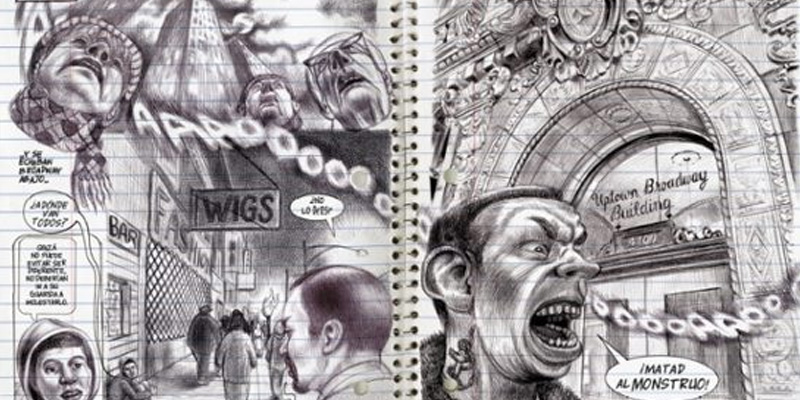
The school-notebook style, the lined pages, the margins, the stains, the crossings-out… they are not an aesthetic trick: they are part of the story.
This comic is not only “read”; it is explored.
You stop, go back, lose yourself in a corner, in a face, in a background that tells another story different from the one in the foreground.
There are pages that work almost like paintings. Others like emotional collages. Others like intimate diaries impossible to fake.
The result is deeply honest.
And for that reason, and despite its 400 pages (it is a proper brick), it is a book for people who appreciate art, wherever it comes from.
You may never have read a graphic novel in your life and still be trapped here until you finish it.
Ferris talks about monsters, yes. But the real monsters are not the ones with fangs and claws. They are broken adults, uncomfortable silences -and dialogues-, normalized violence, social hypocrisy, the fear of being different.
The monster as metaphor is handled with enormous visual and symbolic intelligence. Just like what it tells and what it lets each person’s imagination fill in on its own.
Conclusions
After all that, I do not think it will surprise you that I recommend the work to anyone who enjoys art, without labels.
Certainly to anyone who thinks comics are “only” a minor medium. So they can understand the heights that the conjunction of image and text specific to this medium can reach.
And also to anyone who thinks that by 40 everything in our life is already set.
Because after reading this book and what it has achieved, those ideas prove their irrelevance.
| Field | Data |
|---|---|
| Title | My Favorite Thing Is Monsters |
| Original title | My Favorite Thing Is Monsters |
| Author | Emil Ferris |
| Script | Emil Ferris |
| Art | Emil Ferris |
| Translation | Montserrat Meneses Vilar |
| Spanish publisher | Reservoir Books |
| Original publisher | Fantagraphics |
| Year of original publication | 2017 |
| Year of publication in Spain | 2018 |
| Release date in Spain | April 5, 2018 |
| Pages | 432 pages in the Spanish edition / 416 pages in the original edition |
| Format | Paperback in the Spanish edition / paperback in the original edition |
| Genre | Graphic novel, auteur comic, mystery, thriller, horror, historical drama |
| Country | United States |
| Main characters | Karen Reyes, Anka Silverberg, Deeze, Marvela, Sam Silverberg |
| Setting | Chicago, late 1960s |
| ISBN / EAN Spanish edition | 9788417125639 |
| ISBN original edition | 9781606999592 |
Rating
Who it is for
✔️ For anyone who enjoys art, regardless of format.✔️ For readers who value visual storytelling as much as (or more than) the story.
✔️ For anyone looking for a singular, different work.
✔️ For anyone who wants to enjoy exploring more than reading.
✔️ For anyone who still thinks comics are a minor art.
Who it is not for
❌ For anyone who wants a light and quick read.❌ For anyone who needs plot above everything else.
❌ For anyone looking for a classical work.
❌ For anyone who still thinks comics are a minor art.
Frequently asked questions
Is My Favorite Thing Is Monsters a conventional comic?
No. Although formally it is a comic, it works more like a total work of art. Text, drawing and structure are so integrated that analyzing them separately impoverishes the experience.
Do you need to be a regular comics reader to enjoy it?
No. It is especially recommended for people who appreciate art in general, even if they do not read comics. In fact, it often surprises those who arrive without prejudices about the medium.
What is the story about?
The protagonist is Karen Reyes, a girl living in late-1960s Chicago who becomes involved in the investigation of a death in her building. From there, the story addresses themes such as identity, trauma, racism, sexuality, violence and loneliness.
Is the story the most important thing in the book?
The story is relevant, but it is not the main axis. The true weight of the work lies in the drawing and in how the visual form builds the meaning of the story.
What is special about the visual style?
The whole book is drawn with ballpoint pen, simulating a girl’s school notebook. Margins, crossings-out, repetitions and stains are not a gratuitous aesthetic device, but an active part of the narration.
Why is it said to be an obsessive work?
Because every page is worked to the limit of detail. The visual density, the repetition of motifs and the recreation of classical artworks with the same technique convey a clear sense of creative obsession and resistance.
How long did the book take to be published?
The whole process lasted about 15 years, due to editorial problems and the very nature of the project. That time is key to understanding the depth and singularity of the work.
Who is Emil Ferris and why is her personal story relevant?
Emil Ferris began this book around the age of 40, after suffering paralysis in her dominant hand. She did not come from the usual comics circuit, but from the world of art and illustration, something that deeply marks the final result.
Why are monsters so important in the story?
Monsters work as a metaphor. They do not represent fantastical creatures, but human realities: broken adults, everyday violence, social hypocrisy and the fear of being different.
Is it a long or demanding book?
Yes. It has around 400 pages and requires slow reading. It is not a comic to read quickly, but one to explore, stop over and go back through.
What kind of reader will enjoy it most?
Anyone interested in art, visual storytelling and works that do not fit into simple categories. Especially recommended for those who believe comics are a minor medium… and want to change their mind.
What message does it leave beyond the work itself?
That comics can reach extremely high artistic heights and that starting ambitious projects at 40 (or later) is not only possible, but can lead to extraordinary works.

Leave a Reply