
The other day Amazon Prime showed me that a (great) film I had only seen once more than twenty years ago was available, so this weekend it was time to revisit it with my partner, who didn’t know it.
Spoiler: she loved it.
And the thing is, it is a little-known work that is hard not to like.
Quick take on Kolya
Kolya strikes me as a great film for the whole family. And “for the whole family” is not synonymous with soft, flat cinema designed so nobody has to think too much. Not at all.
It is a small, warm and tender film, and also a story with real substance.
Here the protagonists are not heroes, nor exemplary figures; quite the opposite. They are two people trapped by circumstances, by the historical moment and by a decision made by one of them that changes their lives without them being able to do much about it.
The best thing about Kolya is precisely that: how it builds a human relationship little by little, without grand speeches, without dramatic twists and without needing to underline every emotion.
It is an endearing and emotional film -a little in the spirit of Life Is Beautiful– and carried by two protagonists who act wonderfully. One of those films that seem simple until you realise how hard it is to do something like this without slipping into commercial calculation.
And I’m very glad that a film like this won an Oscar, giving it a media spotlight it would otherwise have lost -very unfairly. In short, a must-see.
What Kolya is about
The plot begins with Louka, a Czech musician living in a degree of precariousness, with a somewhat messy personal life and a marriage of convenience he accepts more out of need than conviction.
From there appears Kolya, a Russian boy who ends up entering his life in a way neither of them has chosen.
That starting point could have led to a much more typical film, with the worn-out story of a selfish adult who learns to love thanks to an adorable child. But Kolya has the virtue of not being reduced to just that.
Louka changes, of course, but he does not do so overnight. He does not suddenly become a radiant, perfect and self-sacrificing person; even at the end, he remains someone with contradictions, strengths and weaknesses.
His transformation is gradual and believable, born from the need to live together, care and face a responsibility that is too much for him at first.
What makes Kolya work
This favourable opinion of mine rests on several elements, which I go into below.
Louka and Kolya carry the film
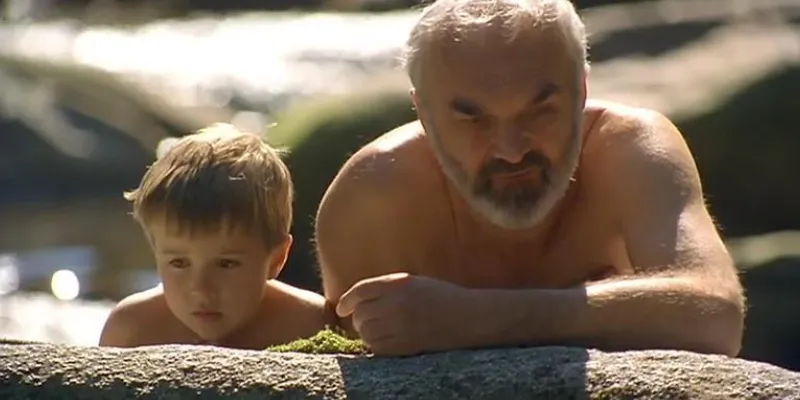
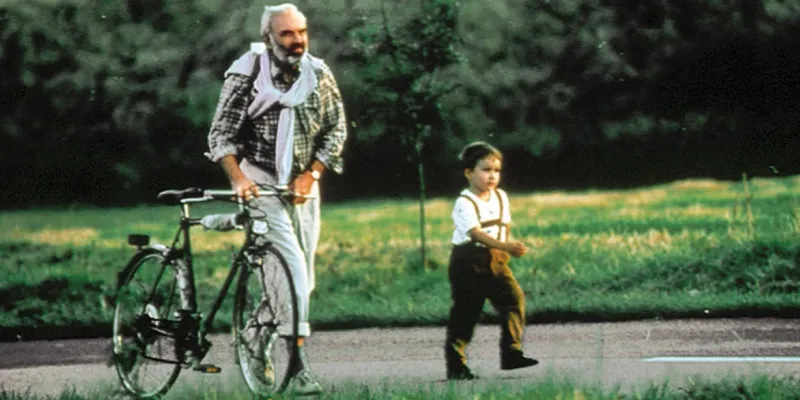
The relationship between Louka and Kolya is the heart of the film. There is not much to explain here: if that relationship did not work, Kolya (the movie) would not either. But it works. And wonderfully well.
Zdeněk Svěrák, the actor with the unpronounceable name who plays the musician, conveys very well that mixture of weariness, irony, clumsiness and humanity in the adult protagonist.
Louka is not a hero, but he is brave. And that bravery is clear not in performing great feats, but in facing what is in front of him when the easy thing would have been to look the other way.
Andrej Chalimon, as Kolya, brings naturalness and tenderness without seeming like a child designed in a lab to melt the viewer’s heart. He does not have the look one might expect for that, but he also works wonderfully.
Because what he conveys with his gestures is an evolution that also feels real, the result of a relationship built little by little.
The film shows us something very simple: important bonds often begin out of obligation, by accident or through pure survival. And then, before you know it, the relationship has already been forged.
An endearing film, but not sappy
Kolya is very moving, but not sentimental. It has gentle humour, warm photography and a humanist tone that make it very accessible to anyone, but it does not seem desperate to squeeze easy tears out of you. That is one of its great merits.
It could have been a manipulative film, because it had all the ingredients for it: adorable child, selfish adult who changes, delicate historical context, improvised family, music, loss, affection… But it does not take the easy route.
It is kind, yes. Very much so. And that kindness is part of its identity, since it does not seek to unsettle you, crush you or leave you devastated, but simply to accompany you for a while.
Amid so many solemn and pompous dramas we keep running into lately -apparently you can’t make great films under three hours anymore- a humanist gaze like this is welcome.
The political context stays in the background
The political context of Kolya is relevant, but it is not another character.
The story is set in Czechoslovakia (before its split) at a specific moment, with the Soviet presence and political changes in the background.
That context appears when it needs to: to condition the characters, push the plot forward and remind us that our private lives are never separate from the world and the environment in which they take place.
I think it is a very successful way to handle the historical context.
The worst of Kolya
The main reservation I would have about Kolya is that its secondary characters are not as developed as its protagonists. The film is so focused on Louka and Kolya that everything else is quite clearly pushed into the background.
I do not think it is a serious problem, because that is the story it wants to tell, but it does mean that some characters work more -or only- as narrative support than as figures with a life of their own.
I also understand that its ending may not create consensus. I liked it, but I perfectly understand that some people would have preferred a more commercial, rounded or feel-good ending. The film chooses another path, and that decision may leave part of the audience with a less comfortable feeling than expected.
For me, precisely for that reason, the ending fits. It does not break the tone of the film at all, but it also does not simply hand over the easiest emotional reward. That is why it has merit.
Verdict: is Kolya worth watching today?
Yes. Kolya is still very much worth watching today.
It is an intimate, warm and deeply human film. One of those stories that do not need to look huge to stay with you. Its strength lies in the relationship between its two protagonists, in the realistic evolution of both and in that way of looking at ordinary people facing circumstances bigger than themselves.
It is not a film for anyone looking for action, cynicism or a particularly groundbreaking story. Nor for anyone who needs everything to be fast, direct and commercial. But if you like films about human relationships, small well-told stories and cinema capable of moving you without becoming heavy-handed, Kolya is a safe bet.
An endearing, honest and very well-acted film. No wonder it won a more than deserved Oscar for Best Foreign Language Film.
Rating
Who it is for
✔️ For recent parents, because it connects very well with the idea of caring, protecting and changing without realising it.✔️ For teenagers, because it is a good gateway into more intimate, human and less obvious cinema.
✔️ For anyone who enjoys small films focused on human relationships.
✔️ For anyone who wants an emotional story without falling into the most obvious melodrama.
Who it is not for
❌ For anyone looking for action or a very fast pace.❌ For anyone who wants a very commercial, rounded and comforting film at every turn.
❌ For anyone who does not connect with intimate stories where what matters lies in small changes.
Frequently asked questions
Is Kolya worth watching today?
Yes. Kolya still works very well as an intimate, warm and deeply human film.
Is Kolya a film for the whole family?
Yes. It is recommended for the whole family, but not because it is simple; because it speaks about affection, care and responsibility.
Does Kolya have spoilers?
You do not need to know much more than its premise. The best thing is to let the relationship between Louka and Kolya develop without spoiling it.
Where to watch Kolya in Spain?
Right now it appears on Prime Video, Filmin, Acontra Plus, Prime Video with Ads and Tivify, although it is worth checking first because this changes.
Did Kolya win the Oscar?
Yes. It won the Oscar for Best Foreign Language Film.
Who directed Kolya?
Kolya is directed by Jan Svěrák. Zdeněk Svěrák, his father, plays Louka.
Is Kolya a comedy or a drama?
It is a comedy-drama: moving, gentle and softly funny.
What is Kolya’s original title?
The original title is Kolja, although in Spain it is usually searched for as Kolya.

Leave a Reply