
Martin Campbell is the director behind GoldenEye and Casino Royale, the James Bond films. In other words, two movies proving he knows how to shoot action and make interesting films. Which makes it curious that Green Lantern (2011) ended up becoming one of the most talked-about box-office flops in superhero adaptation history.
Even though it grossed $220 million on a $200 million budget—plus another $100 million for marketing—it's a textbook example of (almost) everything you shouldn't do with a superhero movie.
Even Ryan Reynolds has spent years making jokes about it, although when he finally sat down to watch it all the way through in 2021, he admitted it wasn't quite the disaster everyone remembered..
After revisiting the extended cut, I largely agree with that last assessment. Green Lantern has obvious problems, starting with visual effects that have aged terribly, but it's a movie that knows what it wants to be and is entertaining.
That already puts it ahead of quite a few superhero movies and series that, while technically better, are far more of a slog.
A fairly predictable story
In short, the film introduces Hal Jordan, a reckless test pilot chosen by an alien ring that can turn his willpower into physical objects. He thus joins the Green Lantern Corps, an organization protecting different sectors of the universe.
The story ticks every familiar superhero-movie box: a protagonist learning to accept responsibility, personal conflicts, a love interest and a threat forcing him to overcome his fears.
It doesn't help that, on top of those basics, the film tries to explain too much at once. Between the Guardians, the rings, Oa, the different Lanterns and the villains, there's enough material for several films. The problem is that many ideas are barely explored because setting up a sequel seems more important..
Which is a shame, particularly where Sinestro is concerned: without a doubt the best character of the lot.
Ryan Reynolds plays, unsurprisingly, Ryan Reynolds
By now we know pretty well what sort of character Reynolds tends to play. His Hal Jordan is that cheeky, slightly cocky guy who rarely takes anything seriously, the type he already played in Blade: Trinity and would perfect years later in Deadpool..
It's hardly original, but this kind of hero always works.
He has chemistry with Blake Lively, even though Hal and Carol Ferris's relationship is pretty worn-out territory. The irresponsible pilot and the woman who knows him all too well have been appearing in films for decades. Still, they work together on screen. So much so that Reynolds and Lively ended up marrying in real life.
The rest of the cast isn't half bad either. We have Tim Robbins, Angela Bassett, Peter Sarsgaard and Mark Strong as Sinestro, who deserves far more screen time than he gets.
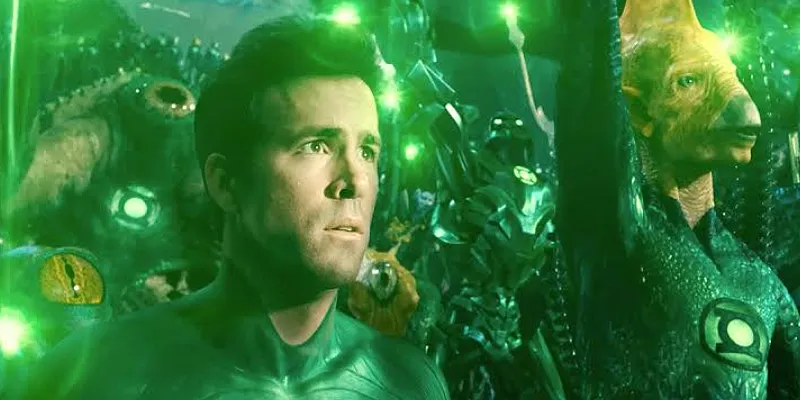
The digital effects swallow the movie whole
Here's the main problem with Green Lantern..
The special effects are bad, especially the suit and the objects created by the ring. Everything has that plasticky look of the era's poor computer effects.
Everything looked rubbery back then, and it sticks out even more now.
What's more, many of the ring's creations seem designed purely for spectacle, without much logic behind the choice. A prime example is the race car and track Hal conjures up to stop a helicopter (seriously, was that the best option?).
Being able to create practically anything you can imagine should open up endless possibilities, yet some of the solutions here seem to come straight out of a toy box.
Interestingly, whenever Campbell can shoot action without burying it under tons of CGI, his expertise shows. The opening sequences with real aircraft are handled rather well and remind us that he's an experienced director.
The problem is that the excess of digital effects ends up smothering the entire film like a blanket. Even the staging choices get buried beneath the digital spectacle.
Parallax isn't scary, but Sinestro shows promise
The Green Lantern Corps universe ought to be one of the film's most interesting elements, but it's badly underused. Oa, the Guardians, Hal's training, Kilowog and Tomar-Re hint at a fascinating mythology we barely get to know.
Particularly underused is Parallax as a villain.
The film explains that the Guardians were responsible for his creation, which had real potential, but his motivations are poorly developed and, when he becomes a threat, he's much less impressive than he ought to be.
Peter Sarsgaard fares better as Hector Hammond, the human antagonist, but even he can't make up for the main villain's weakness. With a better-developed Parallax, this could have been a very different movie.
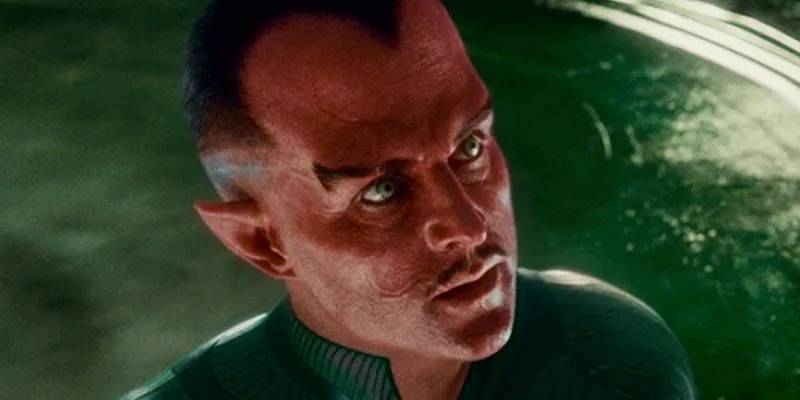
By contrast, Mark Strong steals every scene he appears in as Sinestro. His presence, authority and conviction that fear can also be used as a weapon are far more compelling.
The movie hints at his connection to the yellow ring and the possibility of exploring the Sinestro Corps in a sequel that never happened. A shame, because that story looked much more promising.
Is the extended cut worth it?
The extended cut adds around nine minutes, mainly about Hal's childhood, his father's death and his relationships with Carol and Hector. It also extends a conversation with his nephew.
It doesn't fundamentally change the movie or fix its problems, but those extra minutes aren't wasted either. They add some context to the relationships and, above all, don't hurt the pacing.
In fact, its 123 minutes go by quite pleasantly. The plot is predictable and the effects can momentarily pull you out of the film because they look so obvious, but I wasn't bored.
On the other hand, compared with the first season of the series Lanterns, which is far more mature and better constructed, this movie clearly feels aimed at younger viewers. That's a shame, because this universe could have supported something much more ambitious.
Conclusions and verdict
Green Lantern is still a weak film because of its script, effects and all the opportunities it wastes. But I don't think it's the unmitigated disaster its reputation suggests, either.
It has a cast full of familiar faces, some well-shot action sequences and a pace that works even in the extended cut. What annoys me most is that, with such an interesting universe, it spends so little time developing it and instead settles for a villain as forgettable and underdeveloped as Parallax.
All told, I would have liked to see more of Oa and, above all, a sequel focused on Sinestro and his Corps. The film we got is fairly conventional, visually uneven and unambitious in its development, but more watchable than I expected.
If you haven't seen it for years and only remember Reynolds's jokes, give it a chance on a lazy Sunday afternoon. You might be surprised to find that some current superhero movies are considerably more boring.
Green Lantern fact sheet
| Detail | Information |
| Title | Green Lantern |
| Year | 2011 |
| Director | Martin Campbell |
| Theatrical runtime | 114 minutes |
| Extended-cut runtime | 123 minutes |
| Cast | Ryan Reynolds, Blake Lively, Mark Strong, Peter Sarsgaard, Tim Robbins and Angela Bassett |
| Music | James Newton Howard |
| Genre | Action, science fiction, adventure and superheroes |
Rating
Who it is for
✔️ For anyone who enjoys superhero origin stories.✔️ For Ryan Reynolds fans.
✔️ For anyone curious about Hal Jordan and the Green Lantern Corps universe.
✔️ For anyone wanting to revisit a notoriously maligned movie and see whether it's really that disastrous.
Who it is not for
❌ For anyone particularly demanding about digital effects and computer-generated costumes.❌ For anyone expecting a story as mature and well crafted as Lanterns.
❌ For anyone who needs a memorable villain and a well-developed threat.
❌ For anyone looking for an adaptation that explores Green Lantern mythology in depth.
Frequently asked questions
How long is the extended cut of Green Lantern?
The extended cut runs 123 minutes, compared with 114 minutes for the theatrical release.
What does the Green Lantern extended cut add?
Mainly scenes from Hal Jordan's childhood, his father's death and his relationships with Carol and Hector. It also extends a conversation with his nephew.
Is the extended cut better than the original?
It offers a little more context for the characters, although it doesn't substantially change the movie or solve its biggest problems.
Why does Green Lantern have such a bad reputation?
It was heavily criticized for its digital effects, especially the suit, its predictable script, underdeveloped villains and failure to make the most of its science-fiction universe.
Who plays Sinestro in Green Lantern?
Mark Strong plays Sinestro, one of the most important Green Lanterns and one of the film's most interesting characters.
What is Parallax in Green Lantern?
In the film, Parallax emerges from an ancient Guardian who tries to master the yellow energy of fear and ends up corrupted by it.
Was there a Green Lantern sequel starring Ryan Reynolds?
No. Although the movie set up a potential follow-up involving Sinestro and the yellow power, the sequel was never made.
Is 2011's Green Lantern worth watching?
It may be worth a look if you want a light superhero adventure and can accept its dated effects and predictable plot. It's weak in several respects, but still quite entertaining.

Leave a Reply