
Bosch: Legacy could easily have been seasons 8, 9 and 10 of Bosch. The name changes, Harry's situation changes and the spotlight is shared a little more, but in essence it is identical to the original series.
That is why, before continuing, I recommend reading my Bosch review and, above all, watching its seven seasons. Legacy is a direct continuation, and watching it makes no sense if you arrive without knowing Harry, Honey Chandler and Maddie.
That makes the good news clear: it retains practically all the strengths of its predecessor. And its few flaws too.
It is still a classic, slow-paced, adult and very solid police drama, although it still struggles to give us truly memorable moments.
Plot of Bosch: Legacy
Harry Bosch no longer works for the Los Angeles Police Department. He is now a private investigator, which in theory should change how he acts and investigates.
In practice, he is still the same person: methodical, distrustful, stubborn and always willing to operate close to the line when he believes the situation demands it.
The first season introduces this new stage as Bosch takes a case involving a businessman's inheritance. At the same time, Honey Chandler tries to rebuild her professional and personal life, while Maddie begins her career in the police.
In the second, the storylines of Bosch, Chandler and Maddie become more personal and eventually connect around an especially dangerous investigation.
The third keeps the same structure and forces the protagonists to face the consequences of their decisions. It also sets up the next chapter in the universe created by Michael Connelly —the new series Ballard—and does it well, without turning the ending into a blatant advertisement.

Bosch is still Bosch
As we were saying, the change of profession changes the character very little. He loses his badge and some access to police resources, but keeps his methods, his contacts and his way of understanding justice.
In my review of the original series, I said that one of its strengths was the ambiguity of his decisions. Bosch's intentions are usually good, but his methods raise doubts.
He is not the typical action-movie cop who commits any outrage and then justifies it by saying the bad guy had to be stopped. In his case, you understand the reasons, but you are not always sure he is acting correctly or legally.
Titus Welliver continues to embody the character in an enviable way. His looks and silences still say more than many entire conversations.
The truth is that, after ten seasons across both series, and as happens with other actors and characters such as Dr. House, the actor and the character seem like the same person. That is the level.
Honey Chandler becomes a lead character
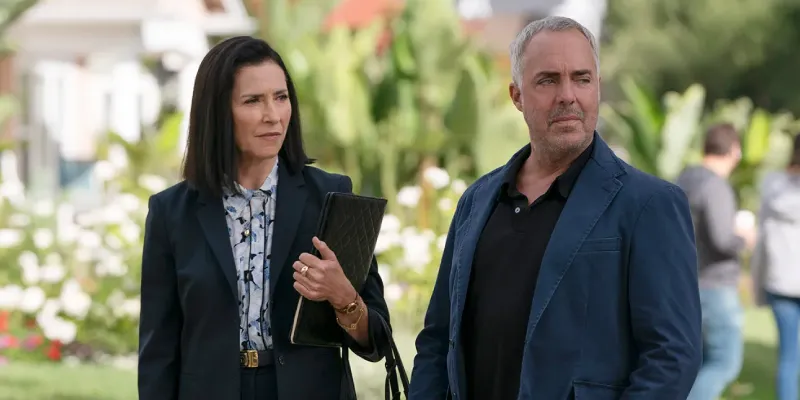
Honey Chandler worked very well as a supporting character in Bosch and here she works just as well as a co-lead.
Giving her more room does not make her less interesting. She remains intelligent, ambitious and capable of facing Harry as an equal.
The two work together because they need each other and because, despite their differences, they share certain ideas about justice. Yet the tension between their methods, interests and goals never fully disappears.
Her professional storyline has enough weight to stand on its own and prevents the series from depending solely on Bosch. That was necessary for a reason I will mention shortly: the series does miss some of the original supporting cast.
Maddie gets a little more room
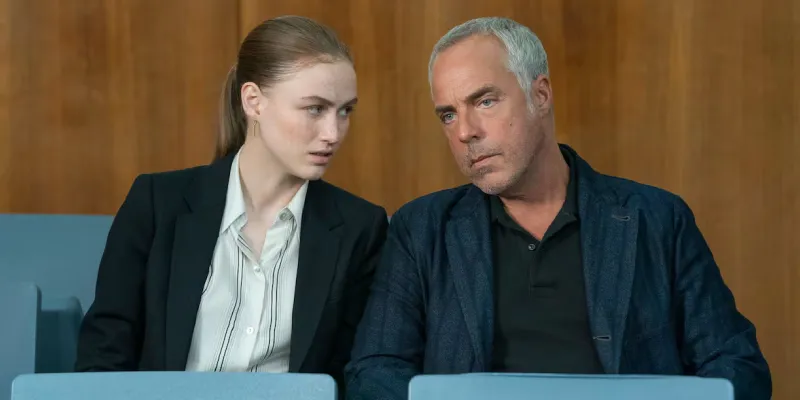
To offset the absence of many characters from the original, and Chandler's promotion to co-lead, Maddie is developed much more than in the previous series.
She is no longer there only to humanize her father or trigger certain decisions. She has her own job, conflicts and responsibilities.
Even so, she remains the least compelling part of the leading trio.
The difference in age and experience between her and Bosch and Chandler is too noticeable. Maddie seems very junior, insecure and indecisive, which is logical in her development but gives her storylines less force.
She is not a bad character and the performance is not poor. The other two leads are simply much more interesting.
The original supporting cast is somewhat missed
Jerry Edgar, Grace Billets and Irvin Irving helped raise the level of Bosch. Their relationships with Harry offered different perspectives on police work, the institution and his methods.
In Legacy they are somewhat missed, though not enough for it to become a serious problem.
And it is not a problem because, among the new additions, one stands out: Maurice “Mo” Bassi, the technology specialist who helps Bosch.
He is an unusual character for this kind of series: calm, quirky and with a personality that goes beyond the standard computer geek needed whenever the hero requires information.
He also shares Bosch's love of jazz, which remains present in the series and forms part of the protagonist's identity. So much so that Amazon has even published a brilliant playlist for fans of the genre.
Same formula, same strengths
Legacy takes its time just like Bosch . The investigations move slowly, there are many conversations and nothing spectacular happens every ten minutes.
Even so, the plots do not feel particularly drawn out. The characters, dialogue and small decisions keep things interesting without artificially speeding up the pace.
It also retains the serious, adult tone, with very little room for comedy. It is a series to enjoy gradually, not to binge while checking your phone every five minutes.
What keeps it from being outstanding
Its main flaw is the same one Bosch : had: everything is very competent, but not very memorable.
All three seasons maintain a very similar level. None clearly stands above the others, and there is no obvious drop in quality either.
That shows remarkable consistency, but also a certain lack of ambition. Few twists, conversations or scenes stay with you for years.
Bosch: Legacy is a very good police series, but it rarely becomes anything more.
And, after all, not everything can be The Wire.
Verdict: is Bosch: Legacy worth watching?
Yes, provided you enjoyed Bosch.
They are first cousins. So much so that this continuation could have been folded into the original series without viewers noticing any major changes.
It keeps the tone, pace, moral ambiguity and solidity of its investigations. It loses some of the richness of the previous supporting cast, but makes up for it by giving Honey Chandler more prominence, developing Maddie and adding Mo.
“More of the same” usually sounds like criticism. Here, that is exactly what you are going to get. And that is a good thing.
Technical details
| Item | Information |
| Original title | Bosch: Legacy |
| Title in Spain | Bosch: El legado |
| Years | 2022-2025 |
| Seasons | 3 |
| Episodes | 30 |
| Runtime | Approximately 45-55 minutes per episode |
| Creators | Michael Connelly, Tom Bernardo and Eric Overmyer |
| Main cast | Titus Welliver, Mimi Rogers, Madison Lintz, Stephen A. Chang and Denise G. Sanchez |
| Genre | Police drama, crime and noir |
| Country | United States |
| Available on | Prime Video |
| Rating | 3.5/5 |
| Spoilers | No |
Rating
Who it is for
✔️ For anyone who enjoyed Bosch, the original series.✔️ For anyone who values classic police dramas and long investigations.
✔️ For anyone looking for a series to watch gradually.
Who it is not for
❌ If you have not seen Bosch first or did not like it.❌ If you are looking for constant action.
Frequently asked questions
Do you need to watch Bosch before Bosch: Legacy?
Yes. It is a direct continuation and assumes you know the relationships and decisions from the original series.
Is Bosch: Legacy a reboot?
No. It continues Harry Bosch's story after he leaves the police.
How many seasons does Bosch: Legacy have?
It has three seasons and thirty episodes.
Will there be a fourth season?
No. The third season closes this stage of the character and sets up the continuation of the universe in another series.
Where can you watch Bosch: Legacy?
All three seasons are available on Prime Video.

Leave a Reply