
If you have a digital business, or a business that acquires customers through digital channels, your customers are already telling you —explicitly and, above all, implicitly— what works, what creates doubts and what holds them back.
The question is whether you are collecting that information, organizing it and using it to make better decisions.
Collecting customer feedback means understanding what is really happening when someone buys, books, requests a quote, enters their customer area or finishes using your service.
I have seen it in very different projects:
- In ecommerce businesses like Yo pongo el hielo.
- In complete checkout changes like at Yoigo.
- In multilingual feedback systems for booking websites like Ruralidays.
And in every case, when you ask properly, things appear that you cannot see if you only look at sales, Analytics or support tickets.
This is the first article in a series about turning customer feedback into useful data for decision-making.
The series will have four parts:
- Why collecting customer feedback is essential.
- How to design a feedback form to understand why your website or app converts.
- How to use AI to translate and classify open-ended answers.
- How to turn that feedback into dashboards and a monthly follow-up routine.
Before talking about forms, automations, AI or dashboards, we need to start with the basics: why you should collect feedback and what you can do with that information.
Your customers are already giving you useful information
When I talk about customer feedback, I do not mean only a satisfaction survey.
I mean everything the customer tells you, or lets slip, about their experience: the website, the purchase process, delivery, support, the service, the product, the price, trust or any point where something delighted, confused or stopped them.
A customer who abandons a booking because they do not understand the conditions is giving you a signal. A user who gets stuck in a new checkout is giving you a signal. A person who calls because they cannot find information that should be clear on the website is also giving you a signal.
The problem is that those signals are often disconnected: a Google review, an email to support, a call, a comment in a survey, a WhatsApp message, a complaint on social media or a sales conversation.
And to use it you need a system or a process, because otherwise it is just noise. And this, as I will explain, can be done in a very, very simple way or in a more complex one.
What you can really learn from customer feedback
Not all feedback serves the same purpose. One thing is knowing whether your website creates doubts, another whether delivery fails and another whether the product or service delivers what was promised.
That is why it is useful to think of feedback in several layers.
The website and the purchase or contracting process
This includes everything that happens before or during conversion: navigation, clarity of information, forms, checkout, payment methods, availability, trust, prices, errors or doubts before buying, booking or requesting a quote.
This type of feedback is useful for improving conversion.
It does not just tell you “the website does not convert”, but where the problem may be:
- A confusing field (where you have to type “a coruña”, exactly like that).
- An unclear tooltip written by a developer.
- A missing payment method.
- An unnecessary coupon field.
- A cancellation policy that creates more doubts than certainties.
- A form that is far too long and starts by choosing between “Mr. or Mrs.”.
- And the worst one: no clear value proposition and no elements that increase trust.
We have all suffered them.
Operations
If you work in marketing, you probably underestimate this second layer.
And you will do so for one reason: in this discipline we usually stop at what happens before conversion, while here we measure what happens after the purchase, booking or contract.
That is, shipping, delivery, installation (fiber), customer service, real availability, deadlines, access to a course platform and the support received or incident management when opening a ticket.
This is extremely important because many times the problem is not on the website. The website sells well, but then the experience is damaged in delivery, communication, support or timelines.
And that affects repeat purchase, recommendation and reputation. And therefore, marketing. Or do you think all those users who convert and come in direct are due to an analytics cookie problem or, worse still, a branding campaign?
The product or service
The third layer and, in general, the first one that comes to mind when we talk about feedback. Because here we are already talking about the final experience:
- Whether the product matches what was specified.
- Whether the service lives up to what was promised.
- Whether the training provides value.
- Whether the accommodation was as expected.
- Whether the price feels fair.
- Whether the customer would recommend the experience.
This part changes a lot depending on the type of business. If you sell your own brand, product feedback is pure gold.
If you sell third-party products or act as an intermediary, the previous two layers may carry more weight, especially with well-known and established brands. But that does not mean you should not use this feedback to your advantage: think of Amazon customer reviews and how they encourage purchases, for example.
Public feedback
You may not have any feedback collection system, and yet you may still be able to obtain it.
From where? From Google reviews, Trustpilot, marketplaces, social media, forums, comparison sites or public comments.
Even if you do not have any form set up, you probably already have feedback out there.
That is why the first step to using your customers’ feedback can be as simple as reviewing your ORM: what they say about you, where they say it, what is repeated, what complaints appear and what positive arguments your own customers use.
It does not replace your own feedback collection system, but it helps a lot with knowing where to start improving.
When it makes sense to ask for feedback
The answer is not “always”.
There are several right moments, depending on what you want to measure.
You can ask for it right after a purchase, booking or contract. At that moment the customer has not yet enjoyed the product or service, but they can assess the website or app experience: whether the information was clear, whether the process inspired trust, whether payment was easy or whether there were any doubts before finishing.
You can also ask for it after they have enjoyed the order, product or service. This is usually the most complete feedback, because the customer has already lived the real experience.
Here you can measure delivery, quality, expectations, support, service, satisfaction and the likelihood of repeating or recommending.
Another interesting moment is when they access their customer area. This makes a lot of sense in SaaS, training, telecommunications, bookings, insurance or any service where the user returns to consult, manage or change something.
There are also special moments in the development of the online channel when it is worth listening more carefully. Examples:
- When you change a checkout.
- You redesign a booking page.
- You change a lead capture form.
- You change pricing.
- You launch a new sign-up and onboarding process.
In those cases, feedback helps you understand whether the change improves the experience or whether you have fixed one thing and broken three along the way.
In complex processes, it can even make sense to ask for feedback within the flow itself, not only at the end. Think of telecommunications, insurance, financing, long bookings, professional services or training.
If the process has several steps and a lot of information, you may need to know at which point friction appears, with a small questionnaire / chatbot of one or two questions, which is very easy to implement.
There are also delicate moments when feedback is worth a lot: after an incident, a return, a cancellation, an abandonment or a non-renewal, or even an interaction with customer service.
It will not always be easy to collect it and it will not always be advisable to do it in the same way, but it can give you very valuable information about unmet expectations, price issues, lack of trust or competitors’ alternatives. And it is a clear predictor of NPS and churn.
That said: it is not about adding a survey just for the sake of it and ticking the box, since the goal is for people to complete it. And a user does not have to be willing to do that at every moment.
Better one good form at the right time than three badly placed forms that generate nothing or, worse, only noise.
NPS is useful, but it is not all feedback
The NPS can be a very useful tool, but it is not the center of everything.
In recurring services, subscriptions, telephony, SaaS, ongoing training or businesses where the relationship with the customer lasts over time, it can provide a very clear signal about satisfaction, recommendation and churn risk.
But in an ecommerce business where someone buys once or twice a year, or in a one-off service, NPS can fall short if it is not accompanied by more specific questions.
A score helps, but it does not explain the problem by itself.
A 9 is fine, but it does not tell you why it went well. A 4 is worrying, but if it is not accompanied by a comment, it does not tell you whether the problem was the website, the price, delivery, support, availability, the product or expectations.
That is why NPS must be one more piece within the feedback system, not the only metric to look at as if it were revealed truth.
Let’s say:
- The score gives you a signal.
- The comment gives you the context.
- Closed questions help you organize the analysis.
Collecting feedback helps you improve, sell better and protect your reputation
Feedback is not only useful for knowing what is going wrong. It is also useful for selling better.
If several customers tell you they chose your service because of the clarity of the information, trust, free cancellation, speed, support or variety of options, there you have real commercial arguments. Not invented in a marketing meeting (or with the CEO). Real ones. And ideal for your sales pitch, your sales team, customer service and website messaging.
If several users repeat that they did not understand a price, that they had doubts before paying, that they could not find information or that the checkout made them distrustful, there you have work for CRO.
If several customers complain about delivery, deadlines, availability or support, there you have operational work.
If negative comments appear in your own channels, you have an opportunity to protect your reputation before the problem turns into public reviews.
And if positive comments appear, you can use them too: to generate trust, reinforce messages, improve content, detect competitive advantages and understand what the people who buy from you truly value.
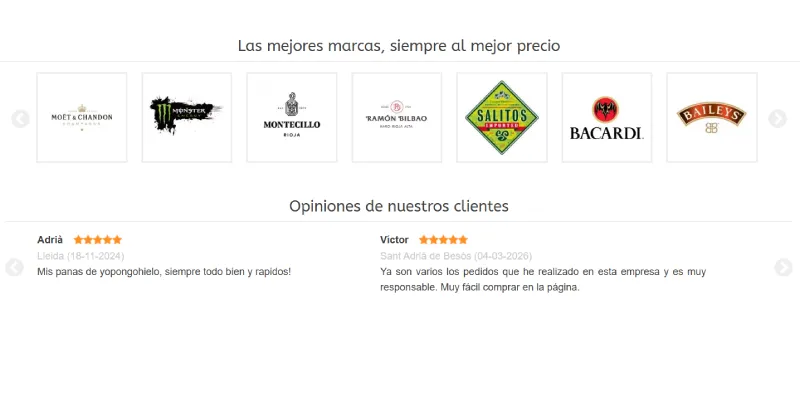
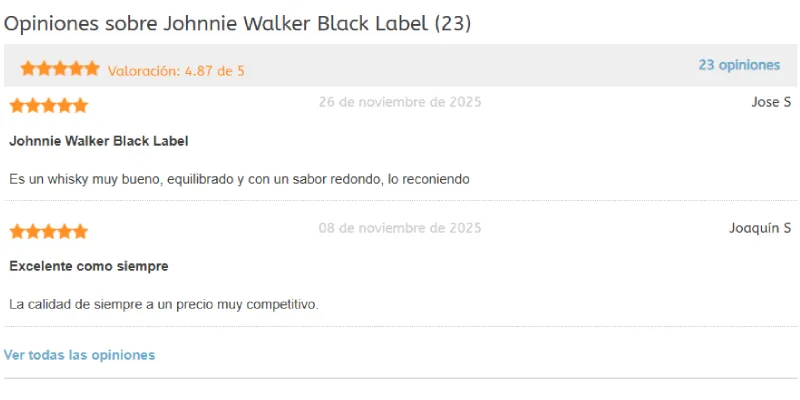
Two examples from Yo pongo el hielo, which help us increase conversion especially among new users:
Company comments:
Comments for each product:
So always remember that feedback has two equally important sides: internal improvement and commercial use. The first helps you fix things. The second helps you communicate, sell and position yourself better.
AI can help you organize the noise, but not decide for you
When volume grows, or when you have answers in several languages, reviewing feedback by hand can become tedious.
That is where AI can help a lot.
It can translate comments, group open-ended answers, detect repeated topics, classify incidents or identify mentions of competitors. That is exactly what we will see in the third article of this series, where I will explain how to set up a flow with n8n, Google Sheets and Gemini to process customer responses.
But there is something important: AI must not make the decisions for you.
AI can prepare the data. It can organize the noise. It can help you see patterns. But deciding what gets changed, what gets prioritized and what impact each thing has is still the job of the business.
That is why later we will also talk about dashboards and monthly governance. Because collecting feedback is not very useful if nobody then sits down to review it, discuss it and turn it into actions.
Common mistakes when collecting customer feedback
Let’s go through the problems I usually encounter.
#1. Not collecting feedback
It seems obvious, but it happens a lot. Many companies make decisions by looking only at sales, traffic, calls or tickets. All of that helps, of course. But it does not replace asking the customer what they experienced and what they missed.
#2. Collecting it badly
It is not enough to place a form anywhere. You have to think about where it appears, when it is requested and what experience the user has just had.
Asking right after buying is not the same as asking after receiving the order. Asking after an incident is not the same as asking when they access the customer area. The context completely changes the answer.
#3. Incentivizing answers badly
Offering a gift, a discount or entry into a draw can make sense, but you have to do it carefully. If the incentive weighs too much, it can bias the answers or attract low-value responses.
The idea is not to buy opinions, but to make it easier for more people to spend a minute answering.
#4. Taking every answer literally
An individual answer can be very valuable, but it can also be extreme, one-off or not very representative.
You should not change a website, a commercial policy or an entire process because of a single isolated comment.
You have to look at patterns, triangulate the information, apply analytics and ratios, and add a bit of common sense.
#5. Ignoring feedback (all of it, or the part we do not like)
The fifth mistake is exactly the opposite: if many customers repeat the same thing and you do nothing, feedback becomes wasted hours.
Asking for opinions and then not looking at the answers or doing nothing with them is an elegant way of reducing our productivity while pretending to do the opposite.
How to start without overcomplicating it
You do not need to build a perfect system from day one.
You can start by reviewing the public feedback that already exists: reviews, comments, social media, marketplaces, product pages, comparison sites or recurring customer emails.
Then identify the key moments of your experience: purchase, booking, contracting, delivery, use of the service, customer area, incidents or cancellations.
And from there, decide what you want to learn.
Wanting to improve conversion is not the same as detecting operational problems. Measuring product satisfaction is not the same as understanding why someone does not renew. Each objective needs different questions and different moments.
If you know exactly what you want to measure, you can build a more complete form. If you are not clear, start small. Three good questions are better than ten questions nobody will answer (or that nobody will review later).
The important thing is that feedback does not get stuck. You have to collect it, organize it, review it and turn it into decisions.
We will look at this last part more calmly at the end of the series, when we talk about dashboards and monthly follow-up.
Next step: design a useful feedback form
Collecting customer feedback is not listening just to look good.
It is creating a system to better understand what experience the customer has, what holds them back, what they value, what annoys them and what you can improve. And for that, the next step is to design the form properly.
It does not need to be perfect. But it does need to ask at the right moment, with the right language and with a structure you can analyze later.
We will see that in the next article of the series:
How to create a customer feedback form.

Leave a Reply