
This Tuesday, as part of the event Business+ Ecommerce Lab 2026 – Strategic Ecommerce: AI, logistics and experience to sell better, I am taking part in a round table where I will try to share my view on this whole thing of personalization based on digital marketing.
Something that is not new, but that I have been applying in projects for more than ten years, as you will see now. But the truth is that AI allows huge scale at the average-user level that was previously hard to achieve. That really has changed.
Below, I leave you with my answer to each of the major points we discussed in the talk.
What organizational and technological capabilities are essential to move from simple data collection to intelligent real-time activation without creating operational problems? (data governance, marketing-IT alignment…)
Generally, it is not about organization or technology, but rather vision. About analyzing what data we have and what can be done with it.
A normal website or app generates billions of data points. Some you collect one way (server), others another way (Google Analytics or CRM), and others you simply do not collect. Because you are not interested or because it has not occurred to you, which is what usually happens most.
So this is not a tools problem, but, as I say, mainly a matter of vision. And the first thing is to have one.
From there, marketing, IT and business have to talk:
- Deciding what needs to be collected.
- What for.
- How it will be executed technically.
- How the data will be activated.
- And one that is often forgotten: how the success of the action will be measured.
And that’s it.
Later I give several examples of personalization and answer these four questions for each of them, but first I want you to keep one idea in mind:
Total real time does not exist.
And that is fine, because many of these activations and personalizations do not need milliseconds, they need logic and consistency.
How is advanced analytics (predictive models, machine learning, scoring) being used to anticipate purchasing behavior and not just react to it? (cart abandonment, dynamic pricing…)
The first thing is to distinguish analytics from reporting. Reporting is part of analytics and is done in every medium-sized company. But analytics is more. And advanced analytics much more.
Seeing that a user abandons checkout is not advanced analytics. It is not even analytics, in my view. It is an event that should trigger an action, such as an exit-intent popup or an automatic email send. And we would be talking about CRO, rather.
Another thing is when we get into models that assign probability to a user / customer:
- Purchase probability.
- Abandonment probability.
- Churn probability.
Controlling and assigning these scores lets you act before the event happens, with a higher chance of success than if you act afterwards.
For example, a purchase-propensity score that activates specific offers or content can work very well. Same with dynamic pricing: adjusting prices based on demand, stock and behavior has a direct impact if it is integrated into the business.
In both cases the difficult part is distinguishing the “signals” that move a user toward purchase, from the rest of what their behavior leaves us. Once detected, activating them is relatively easy.
Also, in my experience, well-executed simple rules -such as those based on biases- work better than other more complex and convoluted algorithms.
Where is the balance between truly actionable segmentation and analytical complexity that paralyzes execution? (automation, cost, omnichannel…)
Here I think I go against the current. I say this because I see projects that start with simple segmentation and then keep complicating it, ending up with hundreds of microsegments that contribute rather little.
In this sense, I like to use segments from proven methodologies such as RFM and not stray far from that. I think it is very well thought out and lets you target groups of users that really differ from each other.
Obviously language and/or country, must be considered, especially for creative pieces and copy, more than for the behavior itself, though that too.
Back in the day I already talked about what omnichannel meant as opposed to multichannel. Hyper-personalization makes this much more complicated. That is why I think we should not go crazy.
An example: at Lowi, when we moved from offering mobile service to fiber, we found more than 100 different customer cases when doing upselling (one line, several lines, same or different, businesses, individuals…). This was clearly unmanageable.
What did we do? We chose to offer a reasonably good experience for everyone. There were more frequent cases whose experience was polished more, but the strangest ones were all grouped under an acceptable experience, not the most optimal.
Did we do it wrong? Through the lens of hyper-personalization it may seem so, but going one by one and resolving each case in the most optimal way would have required a MUCH larger investment in resources than the supposed benefits of doing it. It was not worth it.
That is why, in my view, consistency and omnichannel always beat personalization. Because if the system is not perfectly tuned, a user may receive one message by email, another on the website and another one in-store, creating much more friction than if you did not try to personalize anything at all.
The challenge is to personalize consistently. And that is not always possible.
In addition, there is a brand component that is often ignored. Not everything should be hyper-personalized. There are messages that must be the same for everyone because they build positioning. The balance lies in combining layers: a coherent brand base plus contextual personalization, that is the difficult part.
What metrics prove that hyper-personalization really impacts conversion, average order value and loyalty, and how is its ROI calculated rigorously?
Well, at these levels, companies that consider hyper-personalization, are supposed to have everything that comes before it very optimized. And then there are not huge leaps, but rather small increases.
So, given that you are already at a high level, changes are made carefully and, since you need to experiment, A/B tests are your friends.
And be ready to see many tests that do not improve conversion or lack statistical significance.
It is normal.
This is speaking about the website or app. Now, if the issue is going from having no automated email marketing to setting up well-segmented flows and RFM, then things change. And we can indeed see double-digit increases in conversion and channel revenue.
In addition to this increase, two other KPIs will most likely come along:
- Customer repeat rate.
- Overall revenue.
The reason is none other than the repetition effect of advertising: you will manage to be much more present in your customer’s mind, which is the best thing that can happen to you.
As for ROI, well, if you know me you know that I am not a big fan of this metric except when we are talking about selling digital products or training. So I would be lying if I gave you a figure because I neither know it nor care. In personalization, as with almost everything in the online channel, it is enough to do things well, little by little and with common sense.
Examples of personalization that can give you ideas
These are some cases we have executed in projects across different channels and formats.
Full flow: channels + web
This has been, to date, the largest personalization work I have been involved in. And it was a very ambitious project that covered:
- The website.
- The landing pages.
- The customer area.
- All marketing campaigns and channels.
- The call center (the agent saw exactly the same thing as the customer).
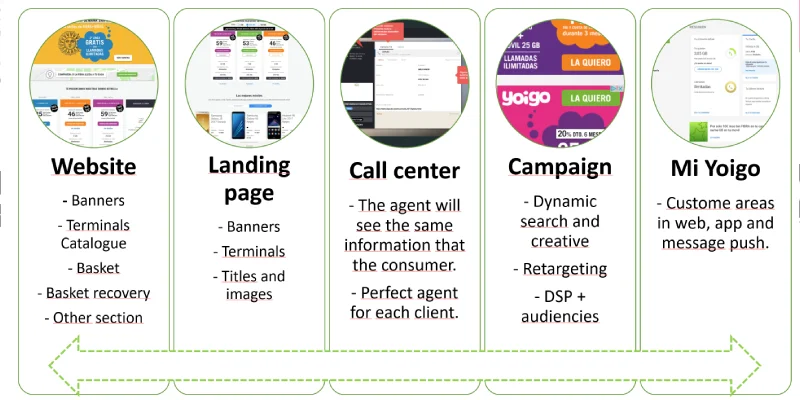
The full user journey, from when they saw us (display) or searched for us (SEM), to when they signed up or called the call center.
And when I say the website, I do not mean a little message here and another there. No. The whole website was personalized:
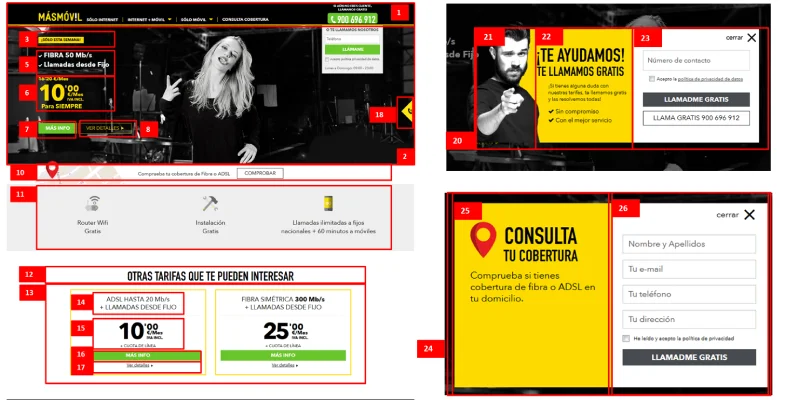
Anyway, a huge project, because now you will see all the variables we could take into account, which, because of the sector, are very different from the usual ones.
Variables
- Operator from which the user is browsing:
- Customer of the company.
- From another company in the group
- From the competition.
- Contracted services.
- Has fiber coverage.
- Has ADSL coverage.
- Visit to rate landing pages.
- Services of interest.
- Number of visits to the website.
- Visit to the customer area.
- Whether they are a customer, whether they have a permanence commitment.
- Dynamic keyword insertion: the exact keywords the user uses in SEM are shown to them on the website.
- Whether the user comes from comparison sites (Idealo, Rastreator).
- Display campaign seen: replicated on the website.
As you can see, having all this type of data is not normal in just any web project.
Measurement
Complex exercise:
- Pre- and post-personalization exercise measurement.
- Google Analytics.
- AdServer.
- Custom advanced analysis.
CRM
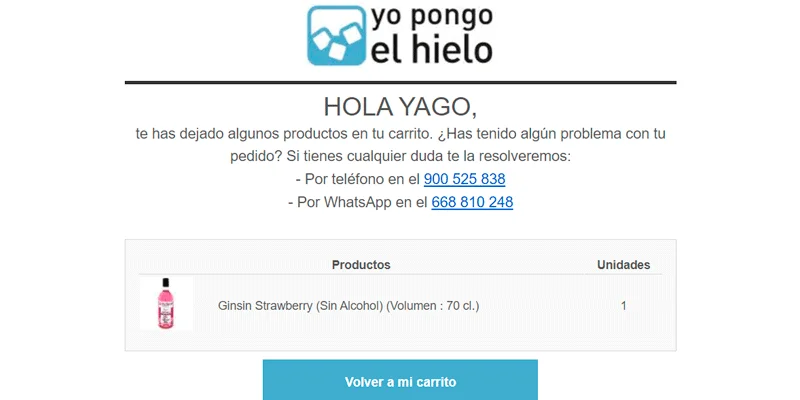
Here is a list of all the personalized emails we sent at the time at Yo pongo el hielo:
Email marketing for ecommerce.
Adding these segmented emails, together with the daily email, was a game-changer in the project. The two variables I mentioned earlier, repeat purchase and revenue, shot up.
Variables
Many, although fewer than before:
- Gender.
- Age and birthday.
- RFM (number of orders, date and amount).
- Products purchased.
- Preferred category.
- Second preferred category.
- Products viewed by the user.
- Products most viewed by other users on the website.
And a few more I am surely forgetting.
Measurement
Email server:
- Deliverability.
- Number of emails sent.
- Unsubscribes.
Google Analytics:
- Traffic from tagged links.
- Revenue.
Ecommerce
Module with the user’s latest viewed products
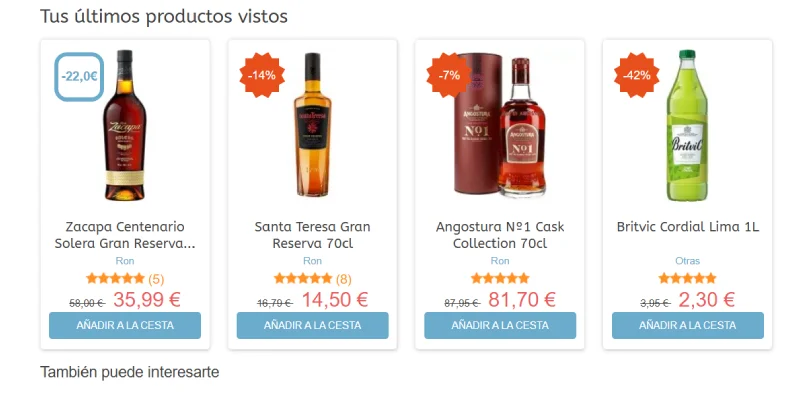
Simple and effective. This module reminds the user of the products they have recently viewed, so we reach them again with something that, in principle, already caught their attention.
Variables
Products viewed by the user.
Measurement
GA4 event.
Social media

Personalized assets for audiences at Lowi (different characters, football teams…). It did not move the needle much for us, so the effort was not worth it.
Variables
Interests and sociodemographics, if I remember correctly.
Measurement
Platform of Facebook Ads (it was not Meta yet).
Conclusions
Personalization is not a matter of tools, but of analysis and knowing what to do with data. Without that, you accumulate data – not even information – that you do nothing with.
Another myth that must be knocked down is that real time is overrated. In most cases what matters is not speed or immediacy, but the business logic behind it.
Within analytics, the more useful kind is the one that lets you act earlier with your customers, rather than the one that explains what has already happened.
Another important point is that complicating segmentation is usually a mistake. Better a few well-differentiated segments (use RFM) than many barely usable ones because they are too similar.
On the other hand, not everything can be personalized. If you break consistency between marketing or sales channels, you worsen the experience.
At certain levels, hyper-personalization does not change the business overnight, but helps with small increases.
Ultimately, I would tell you that if you want to personalize, think in terms of less complexity and more execution.
Frequently asked questions
What is web hyper-personalization?
Web hyper-personalization consists of adapting the user’s experience based on the data we have about them: behavior, visits, products viewed, previous purchases, location, language, source campaigns or prior relationship with the brand.
Does hyper-personalization depend only on technology?
No. Technology helps, but what matters is being clear about what data to collect, what it will be used for, how it will be activated and how we will measure whether that personalization works.
Is it necessary to personalize in real time all the time?
Not always. Real time is quite overrated. In many cases you do not need milliseconds, but business logic, consistency and well-thought-out activation.
What is the difference between analytics and reporting?
Reporting tells you what happened. Analytics should help you understand why it happened and, above all, what you can do afterwards. Advanced analytics goes one step further and makes it possible to anticipate behaviors.
What is customer scoring?
A scoring is a score that tries to estimate the probability that a user will do something: buy, abandon, repeat a purchase or unsubscribe. Used well, it lets you act before the event occurs.
When does segmentation become too complicated?
When you end up with many microsegments that you cannot activate practically. It is better to work with a few well-differentiated segments, for example with RFM methodology, than to create dozens of almost identical groups.
What is the RFM methodology?
RFM segments customers based on three variables: recency of purchase, purchase frequency and amount spent. It is simple, actionable and very useful for ecommerce because it lets you differentiate customers by value and real behavior.
Should the entire customer experience be personalized?
Not necessarily. Some parts of the experience can be personalized, but others must remain consistent so as not to break the brand or generate contradictory messages between web, email, paid media or customer service.
What metrics are useful for measuring personalization?
The most common are conversion, channel revenue, repeat purchase, average order value, email revenue, unsubscribes, deliverability and specific analytics events, such as clicks or interaction with personalized modules.
Does hyper-personalization transform a business overnight?
Normally not. In mature projects it usually brings small increases. Where it can have a very strong impact is when you move from having no automation to working with segmented flows, especially in email marketing.

Leave a Reply