
Star Wars: Maul – Shadow Lord is one of the best things Star Wars has put out in recent years. By “things” I mean mainstream stuff: series or films, leaving aside comics and games, which do exist and are very interesting.
And not (only) because it brings back Darth Maul, one of the characters who, for the general public, made more of an impact through aesthetics than through background, but because the series understands what to do with him. Just as his previous appearances in Rebels and Clone Wars did.
It is clear that Dave Filoni -who has been involved in all three series- understands the character: he does not put him on screen just so fans can applaud and that is it; instead he always wraps him in a very attractive aura and, in the case of the series at hand, gives him a context that suits him: the underworld, criminal ambition, inquisitors, Mandalorians, a young padawan and a galaxy where his hated Empire is beginning to occupy everything.
He is not the simple intense-staring, double-bladed villain promised by the posters for The Phantom Menace. He is more a betrayed, disillusioned survivor, a threatening tragic figure whose desire for revenge exceeds his powers and, perhaps, an antihero.
One of those characters who, once you get to know them, stop being “bad guys” and become grey.
And the series shows all of this very well.
Quick opinion on the Darth Maul series
Let’s be clear: it is not perfect, but it is worth watching. Especially if you already come with some context from The Clone Wars and Rebels.
That is why I would not start the Star Wars universe here, because anyone who does not know who Maul is, what happened to him or why his relationship with power, hatred and the Emperor matters will feel a little lost
But if you know the character at least a little, even if only from his single film appearance, the series is very likely to work for you.
To the striking look and traits from that appearance -he is still violent, aggressive and dangerous- an important nuance is added: now he is also broken. He has ambition, but also wounds. He wants control, but he is still someone marked by having been used, mutilated and cast aside.
And believe me, that makes him much more interesting than simply watching him strike threatening poses as he did in The Phantom Menace. A lot of the appeal of the series lies there, but there is more.
Before getting into that, let’s talk a little about the plot.
What Maul – Shadow Lord is about, without major spoilers
The series shows Darth Maul at a stage in which he tries to move along the margins of the galaxy -and of the law, leading the Shadow Collective– while the Empire tightens its grip.
This is not a bright story about Jedi, hope and galactic destiny.
Here, as in Andor, everything is dirtier. It is the guts of the Empire. Its day-to-day life in the streets.
There is crime, chases, awkward alliances, Mandalorians, inquisitors and characters surviving as best they can in an increasingly closed universe.
The series keeps Star Wars DNA, with good guys, bad guys, robots, spaceship chases and the omnipresent Force, of course, but takes it into a murkier, more street-level and less “lofty” area.
And this other, more mundane galaxy is pretty cool too.
Maul as an antihero?
One of the series’ great successes is not turning Maul into a hero.
Because he is not one.
Maul is still Maul. He is still capable of manipulating, betraying and making unethical decisions. The series does not suddenly try to turn him into someone noble or a redeemed character just because. And at some point you do think that might happen.
But it does not, which makes him more interesting.
His fight against the Emperor places him in a more morally ambiguous position. He is certainly not good, but facing him there is something even worse. And when a villain faces a greater monster, that grey area appears, the one Star Wars should explore more often.
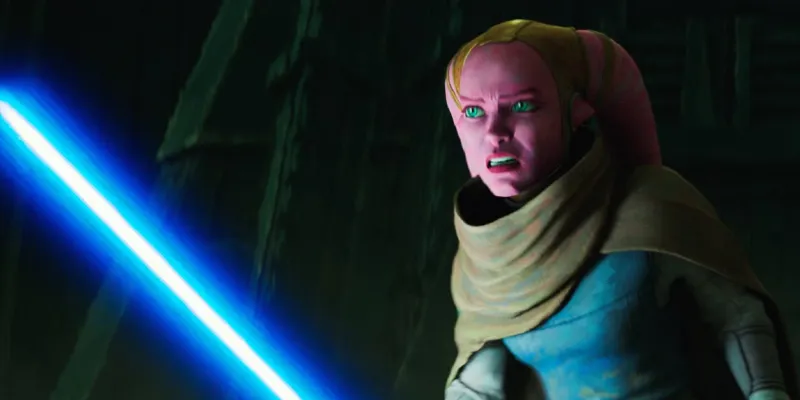
The relationship with the young padawan works precisely because of that. Maul can protect, teach or care about someone, but that does not mean he stops being dangerous. He can show human gestures and still remain a threat. Because everything fits into his plan.
That contradiction is what sustains much of the series.
I also like that it does not hide his physical weaknesses. His robotic legs are not there merely as a continuity detail. They remind us that Maul is a reconstructed character, literally.
A survivor who is imposing at various moments, but also someone less powerful than the almighty Vader. And someone who carries all his defeats, mentally and physically.
What I liked
Besides the treatment of the main character, which we have already discussed, there are several other very positive points in the series.
Supporting characters who do not feel like filler
For example, it does not depend only on Maul.
This is important, because Star Wars has a dangerous tendency to take refuge in its big names. Classic characters, known bloodlines, recognizable nods and figures who appear almost out of obligation (hello, Skywalker family).
Here, as in The Mandalorian, the series creates a small ecosystem around the protagonist. There are new or lesser-known characters who have a function, a tone and something resembling their own story.
They are not waiting for Maul to enter the scene.
They are there to push the story forward, to contrast with him and to make that world feel bigger than the simple return of a popular character.
Mainly the Jedi master Eeko-Dio Daki, his padawan Devon Izara and Captain Brander Lawson. His son and Rook Kast to a lesser extent.
Two-Boots, for example, works as comic relief without feeling like a Jar Jar Binks-style clown shoehorned in. He brings some humanity and sympathy to a fairly dark environment, and that is appreciated.
That covers the “good guys”, but the “bad guys” also deliver.
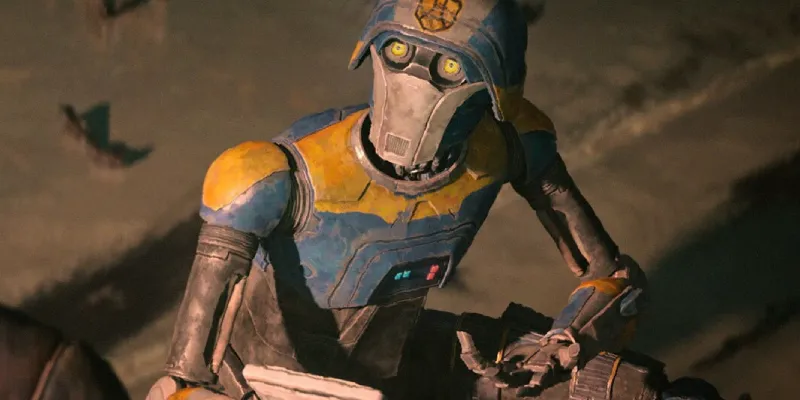
The inquisitors are imposing without needing the usual icons
The inquisitors -Marrok and the Eleventh Brother- despite not being new, are one of the best additions to the series.
And they are because they do not need to become the big classic icon of the moment.
They command respect without having to be mythical villains. They work as an intermediate threat, as the Empire’s attack dogs, as a reminder that the imperial machinery does not depend only on the gigantic figure of you-know-who.
This is exactly the kind of character I was referring to at the beginning when talking about the need and possibilities for expanding the saga.
Because if every major threat has to lean on a legendary character, the universe becomes smaller. By contrast, when the inquisitors work, the Empire feels broader, more organized and more dangerous.
There are levels:
There is the anonymous stormtrooper and his fairground (laser) shotgun.
There is the imperial bureaucrat officer.
There are these hunters trained to pursue, intimidate and destroy.
And above them are the names we all know.
The bigger and more appealing the intermediate layers are, the stronger the Star Wars universe will be. This series is a good reflection of that.
A criminal, noir and less clean Star Wars
The criminal/noir tone gives a lot of personality to Maul – Shadow Lord.
It is a different context from the typical traditional heroic plot. Let us remember that he is a character (re)born from resentment, violence and manipulation. Putting him in a murkier environment is a coherent decision.
Because there are many secondary stories to tell besides saving the galaxy from the Empire.
There are police officers, criminals, legal businesses and murkier ones.
Once again, this change of scale that we already saw in Andor suits Star Wars wonderfully.
The franchise does not always need to be in prophecy, lineage, destiny and big final battle mode. Because that is impossible. And that is where the film disappointments come from.
Lately it works better when it looks at a specific corner of the galaxy and lets the characters wander around there.
The episodes fly by
Another point in its favor: the pace.
The episodes are short, get to the point and almost always leave a sense of progress. There is not too much fat. It does not spend half an hour explaining things you have already understood.
Filoni has shown that he handles this format brilliantly:
He enters.
He sets up conflict.
He moves characters.
He exits.
That makes it very easy to watch.
There is narration. There is pulse. There is a desire to watch the next one.
In fact, I did think that if they had assembled it as a three- or four-hour film with a few cuts, it would have worked wonderfully.
Animation and technical side: among the most solid recent Star Wars
Technically, the series is at a very high level.
The animation has evolved enormously since The Clone Wars, although it keeps certain distinctive traits (such as the “cardboard” faces), I think deliberately, rather than because improvement was impossible.
You will see shots that could fit perfectly into a live-action series or film
The action is understandable and the staging is very good. It does not feel like a minor product (quite the opposite) or a simple piece made to complete canon or the Disney+ library.
And the best thing is that the technical finish matches the tone: Maul moves as he should move. The inquisitors have presence. The settings have atmosphere. The action has weight, supported by great sound.
It is a very classic style: here the fights, chases and tense moments are clear. You know where each character is, what is happening and why it matters.
What I did not like
Not much, honestly, but there is something.
What grated on me was a device Maul uses more than once to shake off his pursuers. Not because of the device itself, but because of the repetition. To me, it feels in a way like a lack of ideas from the writers.
The other drawback I see is the need to introduce an important classic character.
Yes, it works when he arrives. The series knows how to give him weight, does not stretch it out more than necessary and perfectly understands that, with certain characters, presence is often enough.
But I also have the feeling that Maul – Shadow Lord could have done without him.
Not because he is annoying. He is not. In fact, he leaves some powerful moments. The problem is different: you can feel that very recent-Star-Wars need to bring out a recognizable figure to artificially raise the importance of the story.
And this series did not need it that much.
It already had conflict.
It already had supporting characters.
It already had tone.
It already had inquisitors.
It already had Maul in a sufficiently interesting position.
Sometimes Star Wars should trust more in what it has just built and less in opening the drawer of the usual icons.
Does that appearance add something? Perhaps in this particular series, yes. But it also reminds you that the franchise is still somewhat afraid of walking without holding on to its best-known figures.
Final verdict
Star Wars: Maul – Shadow Lord is a very good animated series.
It does not reinvent Star Wars, but it does understand something the franchise too often forgets: bringing back familiar characters is not enough. You have to give them a context worth having.
And here there is one.
Maul carries the series, but he does not monopolize it. The supporting characters are not NPCs, the inquisitors raise the threat, the criminal tone gives it its own identity and the animation supports it without feeling like a technical showcase.
On the other hand, its flaws are minimal.
And that is why it seems to me one of the best things in recent Star Wars.
Technical sheet
| Exact title | Star Wars: Maul – Shadow Lord |
| Year | 2026 |
| Length | 1 season, 10 episodes; approx. 25 min per episode |
| Director | Dave Filoni – creator. Brad Rau – supervising director |
| Main cast | Sam Witwer, Gideon Adlon, Wagner Moura, Dennis Haysbert, Richard Ayoade, Chris Diamantopoulos |
| Official genre | Action and adventure, Animation, Science fiction, Crime |
| Country | United States |
| Available on | Disney+ |
Rating
Who it is for
✔️ For those who enjoyed The Clone Wars and Rebels.✔️ For anyone looking for an animated series with pace, strong technical polish and charismatic supporting characters.
✔️ For anyone who appreciates a dirtier Star Wars.
✔️ For anyone who wants to see Darth Maul as more than a cool design.
Who it is not for
❌ For anyone who wants to start Star Wars from scratch.❌ For anyone who does not connect with the franchise’s animation.
❌ For anyone expecting a bright or childlike story.

Leave a Reply