
The point that best explains what you're going to find in Debris is that its creator, J. H. Wyman, was also the showrunner of Fringe.
And it shows. A lot. A hell of a lot.
Because once again we're looking at a science-fiction series with strange phenomena and a touch of horror, a conspiracy that gradually grows and characters (and actors) who are similar or even identical.
If we also add another series that will constantly come to mind while you watch it, the legendary The X-Files, with the equally legendary Mulder and Scully at the helm, I'm sure the picture you're forming will be very close to what you're going to find.
So yes, Debris is a kind of offspring of Fringe and The X-Files. And although it comes off worse when compared with its spiritual parents, the truth is that if you like science fiction, I think it's worth watching.
A very appealing premise
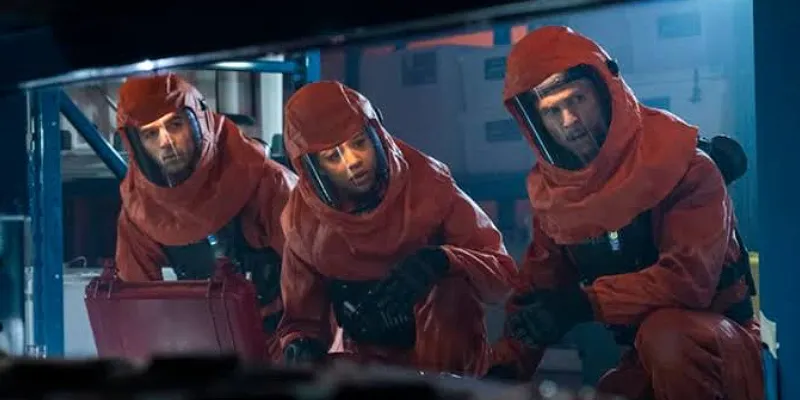
The plot starts with the wreckage of an alien spacecraft that has fallen to Earth.
But these aren't just pieces of metal.
Each one has different properties and can have different effects on people, matter or reality itself. So the protagonists, Finola Jones and Bryan Beneventi, travel to different places to locate this debris and investigate what it is causing.
A large part of the series' appeal lies precisely in discovering what is happening, so I won't tell you any more.
The premise is good, especially once you see it on screen, because the effects of this debris are considerably disturbing, in the vein of Fringe or some of the ideas in Black Mirror.
The series is structured so that each episode presents a different science-fiction idea. And you soon see that there is quite a lot of plot behind all that debris: different governments interested in it, people trying to get hold of it and a conspiracy that, inevitably, keeps getting bigger as the season progresses.
This second part was what hooked me most. As in The X-Files , with the whole Cigarette Smoking Man angle and the issue of Mulder's sister.
The standalone cases are fine, but as new factions appear and you start to understand that each one wants something different, the overarching plot gains weight. In fact, to keep the references going, at times it even has a bit of an air of Alias, with organizations, secrets and characters whose side you're never quite sure of or who they're working for.
Too much Fringe
The biggest problem Debris has is also one of the things that initially makes it appealing: it feels a lot like Fringe.
The tone is similar. So is the kind of science fiction. Even that mix of hard-to-explain phenomena, science and terrifying situations feels very familiar.
And of course, if you haven't seen Fringe , that's no problem and it will probably surprise you. But if you have, you compare them. And the comparison doesn't favor Debris, because Fringe did practically everything better.
The cases were better, the characters were more developed and the overall plot was more interesting. I'm not saying Debris is a bad copy, because it has an identity and story of its own, but it does start from very similar ingredients and delivers an inferior result.
With The X-Files , the comparison is a little different.
There, a lot rests on the lead duo. Mulder and Scully were hugely charismatic characters, and much of the show's appeal came simply from watching them investigate things together.
Finola and Bryan don't come close to that level. Not even remotely.
Flat characters
And I think this is another problem with Debris.
The two protagonists are fairly conventional and they aren't developed all that much during this first season either. In the end, the two issues combine: because they don't have especially distinctive personalities and you don't get to know them very well, it's hard to empathize with them.
They aren't bad characters and they aren't badly acted. They simply need more development, and in this first season it was far more interesting to discover what was behind the debris and the conspiracy than to learn about them. A mistake that didn't happen, for example, with Lost, where despite all the mysteries, the characters were the key.
There is another point against the series by comparison. And in this respect The X-Files had another advantage: it arrived much earlier. Many of its ideas, its way of mixing conspiracies with standalone cases, and even the investigator pairing itself felt far more original back then. Debris arrives several decades later and I don't know whether it's unavoidable, but the way the series develops feels familiar.
Lots of mysteries, few answers
The series gets better as it goes along.
The conspiracy takes shape, you begin to get to know the different parties involved, and it feels as though the story is preparing to become as big as Fringe in later seasons.
But that's precisely the problem: it saves too much for later..
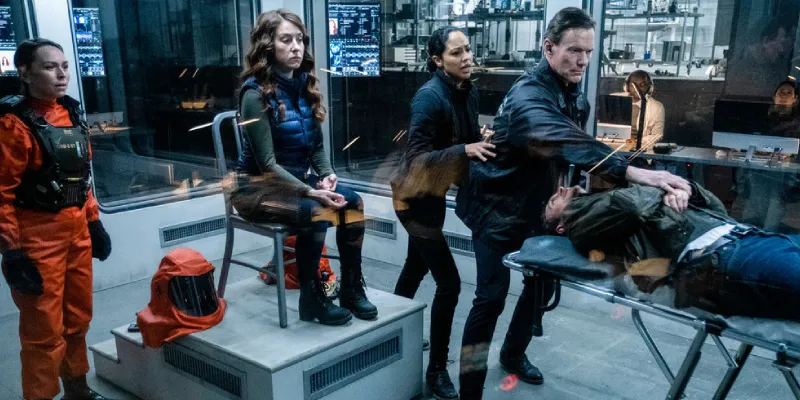
Obviously, in a series planned for several seasons you can't explain everything by the end of the first 13 episodes. But I do think it should have resolved more mysteries than it does.
Because it ends and you feel that you've moved forward, yes, but also that too much of what matters has been left in place for season two.
And there was no season two.
NBC cancelled it, leaving many questions unanswered.
Curiously, something very similar had already happened to Wyman with Almost Human, another of his science-fiction series with a very appealing premise that was also cancelled after just one season.
I don't know whether it's bad luck, the kind of stories he comes up with (probably this), or simply coincidence, but there is definitely a pattern. And it's a shame for those of us who enjoy this kind of science fiction.
I don't know whether it was cancelled because of the budget as well as the ratings, but technically speaking this isn't exactly a big-budget production either, so I don't know how much each episode cost.
Overall it does the job, although some of the special effects look pretty obvious. It doesn't stop you enjoying the show, but it's there.
Conclusions and verdict: is it worth watching?
Debris struck me as an interesting series and I think it's worth watching if you like science fiction, even knowing in advance that it was cancelled.
It has an appealing premise and the plot becomes more interesting as new factions appear and things get bigger. In fact, you finish the season wanting to know more about that universe.
The problem is that we never will. And that's a shame, because there was plenty to work with. I think that if it can't continue as a TV series, a comic series or a run of novels could make good use of it.
And that would address the show's two main shortcomings, which I think are why it failed to hook the audience as it should have: developing the protagonists and resolving its mysteries.
I couldn't end these conclusions without mentioning the inevitable comparison.
If you've seen Fringe, this is very similar, although it never reaches the same level of quality. And if you're coming from The X-Files, what you'll miss most is protagonists with the charisma of Mulder and Scully and the originality of a series that simply arrived much earlier (and, it has to be said, loses quite a bit when rewatched today).
Even so, it's 13 episodes and the premise is worth it.
I'd watch it.
Debris technical details
| Item | Information |
| Title | Debris |
| Creator | J. H. Wyman |
| Genre | Science fiction, mystery, drama and thriller |
| Year released | 2021 |
| Seasons | 1 |
| Episodes | 13 |
| Runtime | Approximately 42–43 minutes per episode |
| Original network | NBC |
| Main cast | Riann Steele, Jonathan Tucker, Norbert Leo Butz and Scroobius Pip |
| Status | Cancelled after its first season |
| Rating | 3/5 |
Rating
Who it is for
✔️ For science-fiction fans.✔️ For those who prefer the development of situations over characters.
✔️ For those who enjoyed Fringe or The X-Files.
✔️ For anyone who doesn't mind starting a cancelled series.
Who it is not for
❌️ For anyone expecting another Fringe at the same level.❌️ For anyone looking for especially charismatic protagonists.
❌ For anyone who needs everything neatly resolved.
Frequently asked questions
Is Debris worth watching?
Yes, especially if you like science fiction. It was cancelled and leaves questions unanswered, but its premise and conspiracy make its 13 episodes worth watching.
Is Debris similar to Fringe?
Very much so. They share a creator, tone, science fiction, strange phenomena, certain horror elements and an overarching plot that gradually grows.
Is Debris similar to The X-Files?
Yes, especially in its structure. A pair of protagonists investigate different cases while a much larger conspiracy unfolds.
Does Debris have a proper ending?
No. The first season resolves some things, but leaves quite a few mysteries open for later seasons that never arrived.
Why was Debris cancelled?
NBC cancelled the series after its first season. The story was designed to continue, so several questions were left unanswered.

Leave a Reply