
There are works that are worth reading in their own right.
There are others that are worth it because they start from something great. And, as long as they don’t distort their source, they already have a lot going for them.
Adapting a classic
This graphic-novel adaptation of Fahrenheit 451, created by Tim Hamilton from Ray Bradbury’s original novel, clearly belongs to the second group.
What I mean is that it is worth reading because it is based on a book that is very much worth reading: a science-fiction classic published in 1953 and on a par with other dystopias such as those imagined by Orwell or Huxley. A novel about censorship, cultural manipulation and collective numbness.
The adaptation is very faithful: no modern reinterpretations, no unnecessary added twists, and no forced updates (like in the Foundation series, to name just one).
In fact, the title of this comic, Ray Bradbury’s Fahrenheit 451, includes the author of the original novel, making its intentions perfectly clear.
Hamilton does not try to “improve”, “change” or “update” Bradbury — let’s remember, this is a 70-year-old work — he simply adapts it.
And for me, given the already-mentioned stature of the original, I think that is a smart choice.
The plot
The plot, without spoilers, is about a dystopian future in which firefighters are not there to put out fires.
Their job is to burn books. And the houses that contain them.
Because books contain ideas. And ideas create conflict. And the regime that governs this society prefers a calm population. Distracted. Numb.
The work focuses on one of these figures, Guy Montag. An upright, proper firefighter who, after meeting a strange young woman, begins to question many of the principles he has always believed in and defended.
And if I tell you that the story is more road movie than epic, you can already imagine where it goes.
The point is that the importance of the work lies not so much in what it tells, but in how it tells it. And, above all, in the feeling of sadness and hopelessness it conveys.
Of emptiness. Of progressive dehumanisation.
What it leaves behind
In that sense, the graphic novel does give us the same emotions as the book, although to a lesser degree, perhaps because it shows in images what the book leaves to our imagination.
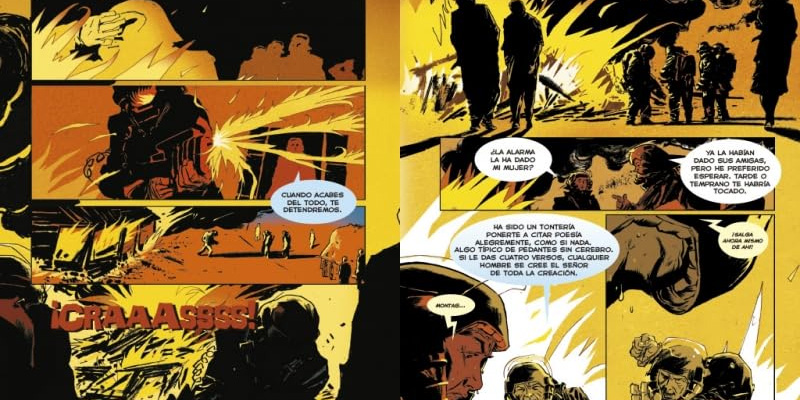
And the drawing does work: dark, schematic lines and few colours (reds, yellows, ochres). With very powerful fire. A more than decent style that fits the text well and that I personally find appealing, though without showing off. It does the job.
Still, I look at it and cannot stop thinking about what early Frank Miller could have done here. We would probably be talking about something else entirely. But he did not draw it.
Conclusions
In any case, a recommended read, especially if you have not read the original, though also if you have. It will not disappoint you.
It is not a masterpiece — the novel could indeed reach those heights — but you know what?
It is a very honest comic, and honestly, that is enough.
P.S.: Reading, these days, what has come to light about Anthropic —the company behind the AI Claude, oddly enough the company in the sector with the strongest ethical values—I could not help thinking of this story.
Because it seems that burning books, sadly, does not remain in fiction.

Technical details
| Field | Details |
|---|---|
| Title | Fahrenheit 451 (graphic novel) |
| Original title | Ray Bradbury’s Fahrenheit 451: The Authorized Adaptation |
| Original work | Fahrenheit 451 |
| Author of the original work | Ray Bradbury |
| Adaptation / artwork | Tim Hamilton |
| Original introduction / foreword | Ray Bradbury |
| Translation | Carlos Mayor Ortega |
| Spanish publisher | Debolsillo |
| Collection | Best Seller | Comic |
| Original publisher | Hill and Wang |
| Year of original publication | 2009 |
| Original publication date | July 21, 2009 |
| Year of publication in Spain | 2019 |
| Release date in Spain | February 7, 2019 |
| Pages | 160 |
| Format | Hardcover / hardback |
| Dimensions | 246 x 165 mm |
| Language | Spanish |
| Original language | English |
| Genre | Graphic novel, literary adaptation, science fiction, dystopia |
| Country of publication of the Spanish edition | Spain |
| Main characters | Guy Montag, Clarisse McClellan, Mildred Montag, Captain Beatty |
| Setting | Dystopian future in a society where books are banned |
| ISBN / EAN Spanish edition | 9788466346818 |
| ISBN original edition | 9780809051014 |
Rating
Who it is for
✔️ If you like classic dystopias.✔️ If you prefer to read Fahrenheit 451 in comic-book format without betraying its essence.
✔️ If you value literal adaptations of the original.
✔️ If you are looking for a short read with ideas underneath.
Who it is not for
❌ If you expect a graphic masterpiece.❌ If you want a loose or modernised adaptation.
❌ If you do not connect with sad, sober and dehumanised stories.
Frequently asked questions
Is the graphic novel faithful to Ray Bradbury’s original work?
Yes. It is a very respectful adaptation. It does not introduce major changes or modern reinterpretations. Tim Hamilton simply transfers the original text into visual language without updating it or “improving” it.
Do you need to have read the novel to enjoy the comic?
No. It works independently. If you have not read the original, it is a good entry point. If you have already read it, it adds a new visual layer to the story.
Does the graphic novel convey the same thing as the book?
It conveys the same ideas and the same tone, but with less intensity. The book appeals more to the imagination and can feel more devastating. The comic makes concrete in images what the novel leaves as evocation.
What is the drawing style like?
Dark, sober and with few colours (reds, yellows and ochres). Schematic lines and a very powerful use of fire as a visual element. It does not try to dazzle, but to accompany the text.
Is it a masterpiece?
The original novel can indeed be considered a major work of science fiction. The graphic novel does not reach that level, but it is an honest, coherent and recommended adaptation.
Is it a good option for young readers?
Yes. It can be an accessible way to approach a classic about censorship, cultural manipulation and numbed societies.
Why is Fahrenheit 451 still relevant today?
Because it talks about censorship, control of information and entertainment as a tool of mass distraction. And those issues remain fully relevant, even if the formats change.

Leave a Reply