
Last week, the Digital Marketing Malaga community invited me to present our case. In other words, the process we have followed in our Digital Business Consulting projects at Disruptivos to adapt to the arrival of AI, which, as in every industry, has brought about a major (r)evolution.
The talk went pretty well, but the truth is I expected it to, because I am quite happy with the process we have followed and the results we have achieved. Above all because we have laid the foundations we need to build on them without having to start from scratch.
If you do any kind of consulting—digital or otherwise—you will see that 80% of what I explain applies to your business, so I want to summarize the main points of the talk here.
Reasons to use AI and automate processes

There are obvious reasons, as you will see in a moment, but when we really analyzed what we wanted to achieve with AI, we realized that saving time was only one part of the benefits.
In fact, some of the benefits I now consider most important have less to do with doing consulting faster than with doing it better and, above all, more consistently.
The question that triggers everything: does AI really give us the results we want?
ChatGPT gives us remarkable results. You could prepare a good prompt, add some context and, within seconds, have an analysis, a proposal or a document that previously would have taken much longer.
The problem arose when you tried to use that result in a real project.
Often the quality was not good enough, it lacked depth, some answers were better than others, and the result depended too much on how you had phrased the prompt or what information you had added.
So we ended up changing the question. Instead of simply asking ourselves how we could use more AI, we started asking ourselves what we had to change in our processes so that AI would give us the results we actually needed.
That change may seem small, but for me it is the foundation of everything we have done since.
Using AI is very easy. Making it part of a professional, repeatable process with clear quality standards is much harder.
Saving time is only the most obvious reason
The first benefit of automation is obvious: saving time. Consulting involves a significant amount of information research, data collection, preliminary analysis, document creation and administrative work that is necessary, but does not need to be carried out manually by a person from start to finish.
In fact, it should not be.
Because if we can reduce a task that used to take four hours to one hour, we gain three additional hours to spend on other things. Multiplied across every phase of a project, that has a significant impact.
But there is one important point: time savings could not come at the expense of quality. If a task takes half the time but the result is worse, there is no real improvement for us.
So the important thing is to save time while maintaining the same level of quality.
Standardizing quality across all consulting projects
This is probably the reason that has ultimately mattered most to me.
When several people carry out consulting projects, differences are inevitable. One consultant may be particularly strong in technical SEO, while another goes much deeper into link building. One may prepare extremely detailed documents and another may be much more direct.
That is not bad per se, because ideally you want to make use of each person's experience, but it can create a problem when the depth and quality of the service end up depending too heavily on the consultant carrying out the project.
We wanted exactly the opposite. If a client hires Digital Business Consulting from Disruptivos, there should be a certain level of depth and consistency regardless of who delivers it.
AI and automation can help us a great deal here, because we can define in advance which elements must be reviewed, which KPIs need to be analyzed, which documentation should be used and what minimum depth we expect in each section.
Afterwards, of course, the consultant can expand, assess and change whatever they consider appropriate, but there is a common baseline that every project must meet.
Leaving the consultant the work that actually adds value
A consultant's value lies above all in their judgment. In understanding the business, knowing which information matters and which does not, questioning a conclusion, spotting something that does not fit, setting priorities or deciding what makes sense given the client's real constraints.
It also lies, of course, in the relationship with that client. There are things that do not appear in Analytics, Search Console or a CRM and that you only understand after talking to the people who know the business.
That is why our idea has never been for AI to do the consulting, but to handle part of the preliminary, repetitive or mechanical work so that the consultant can spend more time precisely on the areas where their experience adds the most value.
Helping new consultants without constantly depending on senior staff
There is another problem that appears as soon as a team begins to grow or when you move someone to a different project. During their first days or weeks, they need to ask questions constantly because they lack the full contextual information.
- Where a document is located.
- Which template they should use.
- Who is responsible for a particular area.
- Which KPIs need to be analyzed.
- How a specific deliverable is structured.
This is completely normal, but it has a fairly obvious consequence: for one person to move forward, another has to keep interrupting their own work.
And that is where AI comes in, because it can become a knowledge layer for the project and the company itself. If the methodology, processes, templates, responsible people and documentation are well organized, many of those questions can be answered directly without always having to turn to another consultant.
This does not replace training; it simply reduces many interruptions that add no value and helps a new person become autonomous sooner.
Disruptivos' consulting methodology
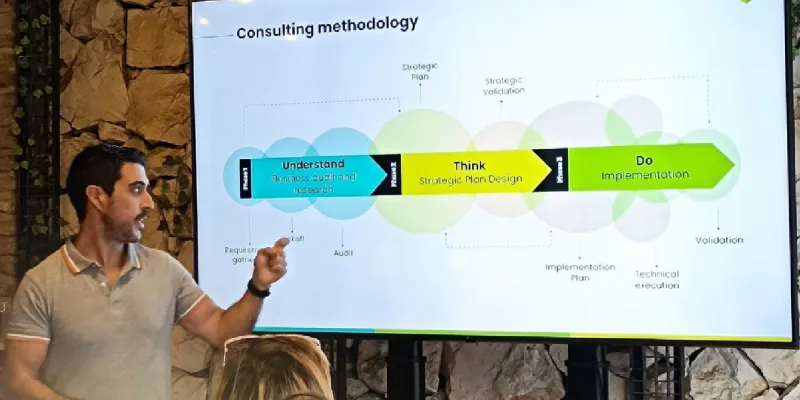
The first thing to explain is that, although the execution process has changed, the company's consulting framework or methodology has not. It is exactly the same before and after AI. And if you are a consultant, it will probably sound familiar or resemble what you already do.
The three phases of a consulting project
Our methodology can be summarized in three major phases: understand, think and do.
The first is about understanding the business. Here we analyze the company, its numbers, value proposition, technology and objectives; audit its digital channels and assets; and complement that with market research, demand analysis and competitor research.
Then comes the phase of thinking. With all that information, we build a strategic plan that should essentially answer three questions: what needs to be done, in what order and who should do it.
The third phase is implementation. Not every project gets this far, because some end with delivery of the strategic plan and the client handles execution, while in others we continue working on implementing the proposed improvements.
Breaking down the entire process
Once we had explained the methodology, the next thing we did was break it down.
It was not enough to say that we carry out an SEO audit, a market analysis or a strategic proposal. We went down several levels—and later we would break it down even further—and ended up with 6 steps, each with several milestones.
For each milestone we answered three very simple questions: how long it currently takes us, what part could be automated and how long it should take after automation. We had the first one calculated; the other two were estimates that had to be tested on real projects.
And here one of the ideas you should take away from this whole process emerged: if a process exists only in your head, you are not yet ready to automate it.
First you need to write it down, break it into parts and explain how it is done. Otherwise, when you try to automate it, you will end up discovering exceptions, decisions or small steps that may be intuitive to an experienced person but that you had never documented.
And therefore, a new consultant or an AI does not know how to process it correctly.
Degrees of automation
Not every task supports the same degree of automation.
For example, a significant part of market research can be automated. We can collect search volumes, trends and public industry information, or analyze part of competitors' digital presence without requiring a person to do all the work manually.
In other areas the percentage is much lower. Heuristic CRO analyses, for example, still involve a very high degree of human judgment.
Certain administrative tasks, such as creating folder structures or projects in Asana, can be automated almost completely.
That is why you cannot treat automation as all or nothing. There are processes where you can automate 80% and others where automating only 20% makes sense, and that is perfectly fine.
And remember what we said earlier: the question is not whether a task can be fully automated, but which part makes sense to automate without making the result worse.
Our results
When we add up the average time we used to spend on all the tasks in a Digital Business Consulting project, a typical project came to approximately 80 to 100 hours of work.
After analyzing the automation potential of each section, the theoretical estimate came to around 38 hours. On paper, that was a huge reduction, effectively bringing the process down to less than half the original time.
Reality is not there yet.
At the moment, we are closer to 50 hours, which still means cutting the time we previously needed almost in half. While maintaining our quality standards, which, as I said before, were non-negotiable.
And it is not 38 hours because processes have exceptions, errors appear, clients differ and not every integration works ideally. Automating the perfect path can even be relatively straightforward, but automating everything that can go wrong is practically impossible. And it is not worth it.
The result is good. And more importantly, we now have a core structure we can keep improving instead of relying solely on adding new prompts or tools.
The systems and tools we are building
Once we had defined the process and understood which parts made sense to automate, we began building the tools.
When we started, we did not care whether the solution ended up being a GPT, an n8n workflow, an agent or our own application. First we needed to define exactly the task or process to solve and then choose the right tool.
Our real objective was one specific thing, perhaps somewhat different from what you might expect, but it clearly defined what we were trying to achieve: make life easier for any new consultant without lowering our standards.
First: document processes, metrics, KPIs and templates
To achieve this, we had to document the entire consulting process in much greater detail than before when we broke down the methodology. Each section became concrete tasks with instructions, related documents and templates explaining how it should be carried out.
Then we did the same with the metrics and KPIs.
We have different levels of consulting and, depending on the project, we know which exact metrics should be analyzed in each area of digital business, such as SEO, CRO, paid media, email or content. A consultant can add anything they consider necessary, but there is a minimum baseline they must review that is standard across all consulting projects.
The same applies to the audits themselves. We created templates so that, instead of simply asking AI to "do an audit," we provide it with the structure we use, the areas that must be analyzed and the type of information we expect to find.
Another key point you should take away: we do not let AI decide what a good consulting project looks like. First we define the standard ourselves and then make AI work within it.
Choosing the degree of automation: the three approaches
From there, we can choose different degrees of automation.
The first and simplest is to use AI as an assistant. It can be a custom GPT, a Gem, a project with specific instructions or any similar tool that we provide with our methodology and documentation.
It is the option with the least automation, but also the one that lets you achieve results more quickly and without having to build too much.
The second level consists of automating tasks by connecting different tools. This is where systems such as n8n come in, allowing information to pass automatically from one application to another, incorporating AI models into specific parts of the process and keeping human validation where necessary.
And the third level would be building a complete system, either with agents or with our own SaaS with a front end and back end.
When we started working on all this, agents were less developed than they are now, so we focused mainly on the first two paths. If we were starting from scratch today, we would probably look much more closely at an agent-based architecture, although I still think it makes sense to validate each part of the process first before building a huge system.
The tools we developed
Different tools and experiments have emerged from this whole process. Some are already working, others are still evolving, and several will probably change quite a bit over the coming months.
What matters is not so much the specific tool we use, because many of them will probably be different in two years, but what problem each one solves within the process.
Oráculo: a knowledge base for each project
One of the first things we developed was what we internally call Oráculo.
The name may sound more advanced than it is. Basically, it consists of having a knowledge base containing the information needed to work on the project:
- Project context.
- Client communications.
- Our deliverables (audits, guides…)
- Information from our project management tool.
- Monthly KPI report.
All of that inside an AI system so the consultant can ask it questions.
Anything.
In fact, with those sources, it is hard to have a question that Oráculo cannot answer well.
We have one Oráculo per client and another for each different project, so any new consultant can get oriented easily.
Obviously, this only works if the source information is well organized and up to date; putting disorganized documentation into an AI does not magically make it organized.
Automating project management with n8n, Drive and Asana
Another example is a workflow we created in n8n to automate part of the project management layer.
When the sales department closes a project, it generates a report following a specific structure. The consultant only has to copy that information and feed it into the workflow, where we use an AI node to interpret it and automatically prepare both the folder and document structure in Google Drive and the corresponding project and tasks in Asana.
Before creating anything, the system displays the information and asks the consultant for validation. If anything is incorrect, we can change it before the rest of the process runs.
This development also taught us something else important: automating when everything works well is relatively easy, but handling errors and exceptions is much more complicated.
A person intuitively applies a host of small rules that they often do not even realize they are applying. When you automate a process, all those rules need to be written down and the system needs to know what to do when something does not match the expected case.
Consulting assistant
Another tool we are building has a somewhat different goal: to serve as an assistant during the consulting work itself.
Here the idea is that someone can enter the type of business and the main KPIs and that the system can help them identify what they should review and where problems may exist.
To do that, the system needs to know the KPIs we consider relevant and work with public benchmarks and internal information that let it provide context and assess the metrics.
We do not want the assistant to make decisions for the consultant, but to give them clues and reduce the work needed to reach the point where the truly key part of the analysis begins.
Creating the first draft of an audit with AI
The next step is to use everything above to generate the first draft of an audit.
We use project templates for Claude Code, Codex or Antigravity, prepared specifically for a particular area, with our methodology, templates and instructions, so that AI can generate a first version of the audit document from the available information we provide.
We are already testing this approach in areas such as SEO, although it is still under development.
One thing: generating a first draft does not mean generating the final deliverable.
The consultant still has to review, edit, organize and prioritize the draft. AI can let them start from a document that is already 50%, 60% or whatever percentage complete, instead of always starting from a blank page.
That is the goal: not to replace the consultant, but to give them a much better starting point.
Conclusions and a small exercise
After this entire process, there are several ideas I recommend keeping in mind.
The first is that automation is not simply about saving time. Documenting a methodology, defining standards and deciding what should happen in each situation is more important than choosing the tool that will later execute the process.
The second is that there is no single solution for everything. Sometimes a good prompt is enough; other times it makes sense to create a custom GPT; in some cases we will need n8n; and in others we will end up developing an agent or even a complete application.
What you need is to know what types of tools exist and which one best fits the problem you want to solve.
The third has to do with the consultant's role. The cheaper and faster execution becomes, the more valuable judgment, decision-making ability, management and the client relationship will become.
And there is a fourth and final consequence that not everyone keeps in mind: AI greatly expands what a single person can do.
A marketing specialist who previously could not develop a small tool because they did not know how to program can now do it. Someone specialized in CRM can create automations that previously would have required a developer, and a business professional can prototype solutions they would never have considered building before.
That does not mean we have all become developers, designers or analysts, but that the execution barrier has fallen so much that it will become increasingly important to know what we want to build, why and how it should work rather than how to build it, since AI will do it for us with the right instructions.
To finish both the article and the talk, I will leave you with a very simple exercise that I think is worth doing.
Think of a task you regularly perform at work and ask yourself which part of that task you could stop doing manually within six months.
Then think about what you need to achieve it: perhaps a tool, a few hours to document the process, help from someone else or simply learning how a particular technology works.
You will already have taken the first step on the path to automation.
If you want to take the second, choose something specific that you can test this very week on a real project.
That is how you will begin to discover how it can truly change the way you work.
Frequently asked questions
How can AI help in consulting?
It can reduce repetitive work, speed up preliminary analysis, organize documentation, generate first drafts and help maintain a more consistent level of quality across projects.
Can AI replace the consultant?
That should not be the goal. AI can handle part of the mechanical work, but judgment, prioritization, business interpretation and the client relationship still depend on the consultant.
Is automating consulting only about saving time?
No. It can also standardize processes, improve consistency across projects, reduce errors and make it easier for new consultants to work more autonomously.
What should you do before automating a process?
Document it and break it down into specific tasks. If a process exists only in one person's head, it is very difficult to automate it correctly.
Can an entire consulting project be automated?
It does not have to be. Some tasks can be automated to a large extent while others require much more human judgment, so the important thing is deciding which part makes sense to automate without making the result worse.
Which consulting tasks are easiest to automate?
Data collection, part of market research, creating project structures, certain administrative tasks and some preliminary analyses usually lend themselves well to automation.
Which tasks still need more human involvement?
Those requiring judgment, interpretation, prioritization, understanding the client's context and strategic decisions usually need much greater human involvement.
What tools can be used to automate consulting?
Depending on the problem, a custom GPT, an n8n workflow, an AI assistant, an agent or even an in-house application may be enough.
What is the Oráculo you use at Disruptivos?
It is a knowledge base for each client or project that brings together context, communications, deliverables, project management and KPIs so consultants can query that information through AI.
Can AI generate a complete audit?
It can generate a first draft from a methodology, templates and prior information, but the consultant must review, correct, organize and prioritize it before turning it into a final deliverable.
How much time have you managed to save with automation?
A consulting project that previously required between 80 and 100 hours now takes around 50 hours, while maintaining the same quality standards.
What is the consultant's greatest value in an AI environment?
Judgment. Understanding the business, interpreting information, detecting problems, setting priorities and making decisions will remain more important than manually executing every task.

Leave a Reply